Showing posts with label Wagner. Show all posts

Tuesday, November 1, 2016

O, nun waren wir Nacht-Geweihte! Tristan und Isolde at the Met

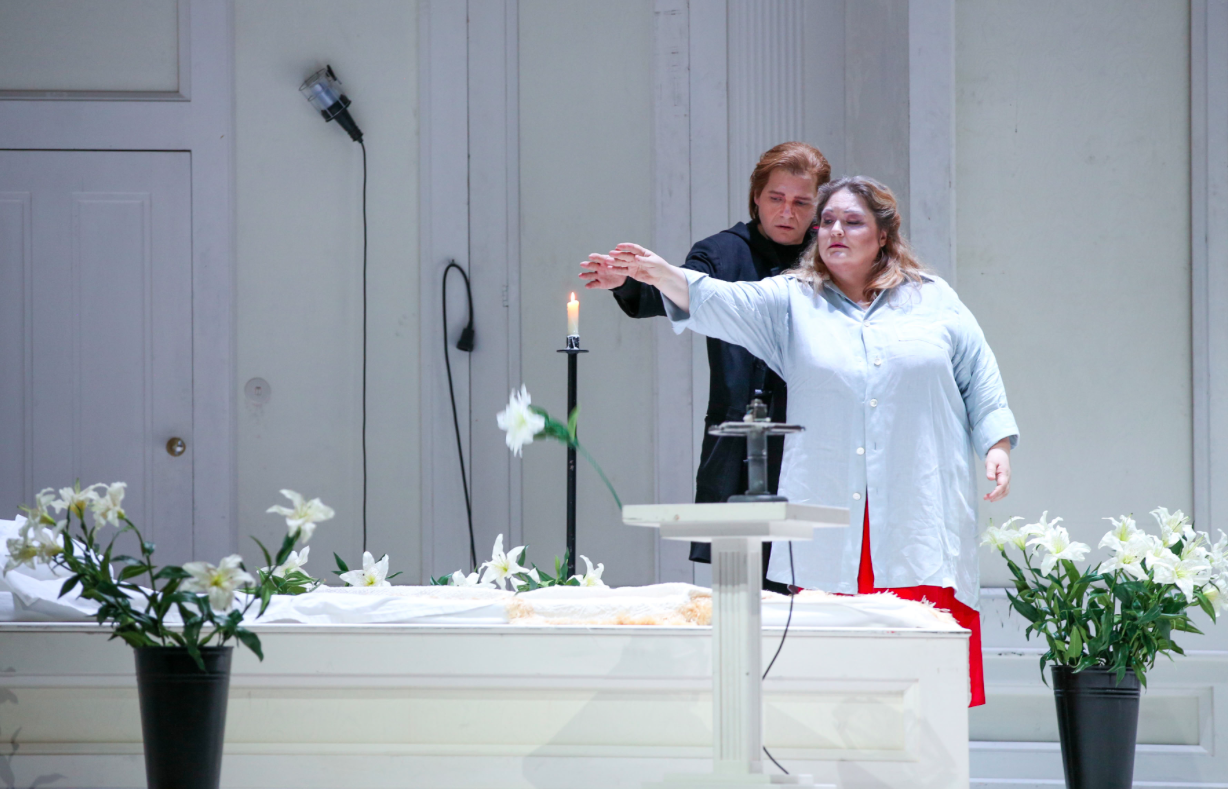
Staging a perfect Tristan is one of opera's most notorious impossibilities. The Met has, to my mingled astonishment and gratitude, succeeded in staging one that is hair-raisingly good in musical terms, and that grapples passionately and intelligently with the dramatic tensions inherent in the work. Mariusz Treliński's production insists on superimposing the metaphorical and literal levels of Tristan und Isolde's narrative, staging both reality and the lovers' perceptions of it. I thought this brought superb emotional payoff. In this of all works, it is--or should be--hard to separate discussion of the drama from discussion of the music. And the music-making of the performance I saw (the last of the run) was of a quality that leaves me, three days later, clutching handfuls of my hair like a parody of the shocked, enraptured, half-deranged 1865 audiences. The singers, led by Stuart Skelton's tragically dignified Tristan and Nina Stemme's incandescent Isolde, left me breathless. In the intervals, I kept incoherently trying to impress upon my mother, whose first live Tristan this was, how extraordinary it was to get a pair of lovers so well-matched, so vocally consistent and expressive over the course of the long evening. The orchestra, under Asher Fisch, conveyed the human and the superhuman.

While Treliński's production sometimes read against Wagner's text, it was very attentive to the music, to the setting of gestures and glances, movement and stillness. All three acts take place on the ship, lending additional tension to the artificially closed society of the plot, and additional poignancy to the lovers' desire to absorb the whole world into themselves. The world outside the ship may have been annihilated or simply deemed irrelevant; in any case, the ship is a successor to the mythical countries of medieval romance. Wo sind wir? Where are we? ask the lovers, and the question is never meant only literally. Tristan and Isolde are, of course, in separate compartments in Act I, he on the bridge and she in a cabin, but they both retreat to the lower stage left when overwhelmed and seeking privacy. It is in this same space that they will find their truest intimacy in Acts II and III. The video projections, designed by Bartek Macias, were the first I have seen in person that have made a substantive contribution to an opera production. Some complained about the repetitive nature of the images, but I took them as visual leitmotifs. The forest might be the forest in which Tristan's mother perishes, but it's also reminiscent of the films of Eisenstein and Tarkovsky, to say nothing of the many forests in which the quests of medieval romance take place. One of the most persistent images is of a radar screen: blank, seeking, reaching into the unknown. Sometimes this field is itself filled with memories and visions; in Act III, it is synchronized with the hospital machines that record the persistence of the life that Tristan tries to renounce, before at last being obliterated by waves and Weltatem.

I heard Asher Fisch conduct Parsifal three years ago, and Thursday's Tristan was no less impressive. Fisch led the orchestra in a performance that was daring both in scope and detail, charting a sure course from the first murmurs of the strings to the final, ecstatic hush. Fisch used dynamic variation and subtle shifts in tempi to great effect, drawing on the apparently inexhaustible resources of the Met's orchestra. To single out strings, brass, or woodwinds would be invidious; they were all excellent. It is the orchestra, after all, that must give voice to the lovers' speechlessness and that must echo their cries, that must give full expression to the meanings and implications of a libretto with vocabulary as limited and rich as that of liturgy or myth. All this they did. Each of the Vorspiele seemed a study in itself. I was also very impressed by the stage-pit coordination, precise enough that the turn of Tristan's head spoke volumes, even before Was ist? Isolde? and Marke broke my heart by extending his hand to his friend on that last, unbearable wail of the brass in Act II. I know I'm gushing, but I love this work, where metaphysical reflections vibrate in one's bones and blood.

Tuesday, September 20, 2016

Operatic Ephemera: Tristan at the Met

In about a month's time, I will see the Met's new Tristan und Isolde with my mother (her conversion from opera-skeptic to budding Wagnerite is chronicled here.) We're both very excited. After I described the plot to her, she said she thought she'd like to look at the words, and asked if they were printed anywhere. I joyfully assured her that they were, and promised to lend her my libretto. In digging it out of my untidy collection, I discovered that I own not the modern red-and-white edition, but something far more interesting: this fabulous artifact. It includes a full-page endorsement of Knabe pianos by Göta Ljungberg, and a deliberately archaic English translation, oddly sprinkled with pseudo-medievalism. ("O, er weiss wohl warum!" becomes "Oh! he wots well the cause.") The missteps may be many, but Isolde's contemplation of the waves in the Liebestod, asking "Shall I sip them, / dive within them, / to my panting / breathing win them?" struck me as surprisingly effective in its ecstatic eroticism.

The libretto also includes an "extra": a piano version of the Liebesnacht! I was fascinated by this, richly evocative of an audience expected to have the skills and desire to take the music home with them in this way, whether to an upright piano in a corner or to a far grander instrument and leisure to play it in. But even more interesting to me was the note by the libretto's first owner: "March 16, 1934 -- At the Metropolitan with my most beloved cousin -- The greatest performance -- Tristan + Isolde / Henry + Julie Grün."


Wednesday, June 10, 2015

Tristan und Isolde: an appreciation

Twitter informed me this morning that it was the 150th anniversary of Tristan und Isolde's postponed and scandalous premiere. I felt impelled to pour out some of my own feelings about Tristan (and collect some relevant resources on it) here. Even without a Twitter account, one can enjoy the videos, images, and anecdotes of #Tristan150. Tristan has inspired me with stereotypically ecstatic fervor since I first encountered it. Almost a decade ago, it was my first live Wagner; seven years ago, it was the first opera I saw at the Met; and the brilliant performance I got to see last year in Frankfurt still resonates freshly. In between those landmarks in my own opera-going experience, I acquired several recordings and a libretto from secondhand shops, and, one memorable semester, was thoroughly distracted from a week of lecturing on the fourteenth century by those timeless chords of unappeased yearning echoing from a music history class down the hall. Since Tristan is an opera so resolutely profound, so rich in possible theatrical representations, herewith a few links. The entire Konwitschny production, with Waltraud Meier radiant at its heart, is available to view here. Definitely the Opera's thoughtful commentary on the Sellars/Viola production is here. A review of Chérau's 2007 production for La Scala--with the justified observation that "a perfect Tristan is probably beyond mere mortals"--is here.

Even in inevitably imperfect performances, it is inevitably haunting. I cherish the memory of having heard Christine Goerke sing the Liebestod in a school auditorium. I'm inclined to agree with Nietzsche's assessment: there is nothing else quite like it in its mysterious perfection. I will close, though, with a famous assessment by a very different author: Mark Twain. His biting wit is on full display in his account of Bayreuth's 1891 season, but the satirical mood of his assessments of Parsifal and Tannhäuser is not in evidence in his account of Tristan. And in his account of Met audiences, I recognize a kindred spirit. Also instantly recognizable is his testimony that a good Wagner performance can leave one "in no fit condition to do anything."

Tuesday, January 13, 2015

Nights at the Opera: 2014


However belatedly, I decided to round up a personal "best of" list for the last calendar year. It's always an enjoyable experience of revisiting... particularly poignant for me as I looked back on the last of my German opera-going (for now.) Due to my own relative restraint (not to say remissness) in attending, I've limited myself to a top three in my usual categories.

Standout performances:

Tanja Ariane Baumgartner. Selecting one of her performances was difficult, as she was one of the most reliably exciting singers in my Frankfurt season. But her Charlotte, in Werther, was not only richly sung, but intensely intelligent and intensely sensual; showing Charlotte as a lively, trammeled spirit, rather than a domestic saint, was much appreciated by me!

Anja Silja. She's still got it. She may have invented it. In Aribert Reimann's Gespenstersonate, she made parrot noises and commented on the human condition, and I was thrilled and terrified.

Monday, January 12, 2015

Blogging Backlog, or, from Deutschland to Dissertation

As the Monty Python peasant says, "I'm not dead yet!" A mixture of malaise in cultural readjustment and madness in dissertation-writing, however, put me very nearly out of commission for late autumn opera-going. Thanks to friends pulling me to opera, however, I did get to see three operas at the Met, which deserve more than belated notes here, but I thought they deserved at least notes.


  • Death of Klinghoffer. I even started a blog post on this one. And I'm sorry I didn't finish it, as it was a theatrically gripping, emotionally powerful experience. The opera (admirably, I think) resists the imposition of narrative, the interpretation of narrative, allowing the characters to offer their own competing claims in turn. The production is less comfortable with such ambiguity (and ambiguity is not even quite the right word; Keats called it "negative capability.") Anyway, I thought it was great, with Paulo Szot a standout as the compassionate, remorseful captain.

Tuesday, May 20, 2014

Reading List: rein GOLD

Elfriede Jelinek's 2013 Rein Gold is a text of many complexities, not the least of which is its genre. The prose work is subtitled as a “Bühnenessay,” an essay for the stage, and the audience is sometimes directly addressed as if sitting in a theater, applauding or restless or hissing. But the identity of the text as writing is also discussed. Brünnhilde is imagined as armed with a typewriter, to wield against her father’s rune-written spear. It is a meditation on the events of the Ring Cycle, on the creation of the Ring Cycle, and on its reception. It is also a meditation on the ways in which Wagner and his work have been interpreted, fetishized, and abused. The sprawling, death-marked, perhaps-renewable system of 20th- and 21st-century capitalism is also woven into the texture of the work, appearing like a reflection of the Ring’s events... or a transformed leitmotif. If I were putting it on my bookshelves, it would be at home next to the libretti or Zizek’s Living in the End Times.

Saturday, May 3, 2014

Trug des Herzens, Traum der Ahnung: Tristan und Isolde in Frankfurt

Liebesnacht: Ryan/Wilson in Act II
Photo © Oper Frankfurt/Wolfgang Runkel
It seemed appropriate to me to begin the month of May with Frankfurt's Tristan und Isolde, an opera I've loved since hearing it cold as my first live Wagner. Frankfurt's current run boasts not only an impressive pair of lovers in Lance Ryan and Jennifer Wilson, but strong performances in further roles, and a rich reading of the score from conductor Stefan Blunier. Christof Nel's atmospheric production is a darkly pessimistic one, suggesting that there can be no comfort this side of death, and even that is denied to Isolde. The man next to me dozed stertorously through much of the first act, and whispered more than once in the second two… but I was gripped and moved.

Wednesday, November 6, 2013

Wolfram von Eschenbach, beginne!

The adventures of Siegfried.
Even in the midst of my researches, Gentle Readers, I find myself reminded of opera. This week, I discovered (while looking for much less flashy legal texts) that manuscripts for several of Wagner's source texts have been digitized. So whether you have a hankering for the thrill of reading a handwritten copy of Das Nibelungenlied (as who does not?) or just want to look at some beautiful images, I have links for you. First up: Das Nibelungenlied. Pictured is the first section post-prologue, The Adventures of Siegfried (Aventiure von Sifride.) Good news for all my fellow Walküre-lovers: the first thing we're told is that "Siegfried was a true child of royalty, whose father was called Siegmund, his mother Sieglinde." If you want a line-by-line rendition of the text pictured in readable type, go here; if you want a transcript of the whole thing based on Handschrift A (pictured,) go here; if you want to look at the whole manuscript, go here. If this has piqued your interest, but you just want to read it in English, don't worry; you can do that here.

Next: Wolfram von Eschenbach's Parzival, for triple Wagner-opera points.

Friday, October 25, 2013

Tannhäuser: dem unsren sei dein Lied nicht fern

Desire and the dangers of female archetypes: Tannhäuser Act III. Photo (c) Oper Frankfurt


I only made it into Thursday's performance of Tannhäuser by the skin of my teeth, nabbing the last rush ticket about four minutes before curtain. Frankfurt's house was packed, eager, and informed, respectfully silent during the performance, and busily chatting about this and other Tannhäusers during the intervals. The adrenaline rush of ticket-getting may have contributed to my sensitivity, but I found the treatment of the score by the orchestra under Constantin Trinks never less than exciting and compelling. Although I did not find all aspects of Vera Nemirova’s production equally convincing, it was both intellectually sophisticated and viscerally moving. Its greatest achievement was in handling Wagner’s presentation of dichotomous feminine ideals, exposing the perniciousness and inevitable violence of such attitudes. This was achieved by teasing out many of the other ideas in the score (Dresden version) and libretto. I appreciated that religious faith was not treated as intrinsically foolish or deluded, as I appreciated Nemirova’s refusal to treat the sentimental piety of the text as though it were both profound and axiomatic. Instead of a fictionalized thirteenth century, Nemirova creates a fictionalized 1960s for the drama of desire, conviction, and community. 

Sunday, May 19, 2013

Fin-de-siècle fantasies: Renee Fleming, Jeremy Denk, & the Emerson Quartet

Adele Bloch-Bauer I: Gustav Klimt, 1907
Saturday, May 4 saw the last night of Renee Fleming's "Perspectives" series at Carnegie Hall, and its inventive programming and insightful delivery spoke well both for the artist and for the series concept. The selection and arrangement of pieces resisted any teleological or excessively literal interpretation of how the music represented the window to modernity of the program's title. Intricately interwoven, the selections proved mutually illuminating, with several texts in multiple settings, and sensibilities and styles ranging from the full, complex romanticism of Brahms through the lush sensuality of Strauss and Wagner to sharp minimalism. Two of the composers (Wellesz and Zeisl) were new to me; another reminder of the extraordinary artistic ferment of Vienna around the turn of the twentieth century. The artistry of Fleming, Denk, and the Emerson Quartet was likewise not merely intelligent, but itself creative.

Wednesday, May 1, 2013

Ich sei das Weib! Goerke and the Greenwich Village Orchestra

Christine Goerke. Photo via IMG Artists
A non-professional orchestra and an international soprano might sound like strange bedfellows, but in Sunday's concert of Wagner selections, Christine Goerke and the Greenwich Village Orchestra proved to have a partnership with admirable chemistry. I jumped at the chance to hear Goerke, whom I hadn't encountered live since her Norma in Philadelphia in 2008, and whom New York audiences will next hear as the Dyer's Wife in the Met's Die Frau Ohne Schatten next season. The orchestra proved to be a polished as well as passionate ensemble, a charming reminder of the days when enthusiasts themselves, and not only their stereo sets, were responsible for reproducing the beloved music of the operatic stage. If the strings occasionally lacked in precision or the woodwinds in finesse, it was still a very creditable performance under the baton of Pierre Vallet, who led crisply and cleanly.

The Tannhäuser overture and bacchanal saw the orchestra at its finest, with each theme given dramatic value, and with sprightliness leavening the pseudo-medieval pomp and ceremony. When Goerke entered, she lit up the hall, embracing its dingy neoclassicism in an expression of radiant joy before launching into "Dich, teure Halle." Elisabeth's effervescent happiness filled Goerke's sound as her sound filled the hall. German nerd that I am, I loved the expression which Goerke gave to text. The very strength of her rich sound seemed almost to work against the desolation of "Allmächt'ge Jungfrau," but perhaps I have insufficient sympathy with Elisabeth's self-denying selflessness. Certainly Goerke sang it beautifully. I was delighted that the GVO gave this aria its response, Wolfram's achingly beautiful "O du mein holder Abendstern." Jesse Blumberg sang it with a resonant, warm baritone well-suited to it. I found myself wishing that the legato phrases had been taken more slowly, and that Blumberg's perfectly correct German had perhaps been invested with more poignancy, but judging by aufience response, these reservations placed me in a minority.

Sunday, February 24, 2013

Parsifal: durch Mitleid wissend

The education of the pure fool: Parsifal, Act I
The more I think about Francois Girard's production of Parsifal, the more I am struck by how thoughtful its engagement with the work is, and how gloriously humane its message. Girard uses the visual language of Christianity and Buddhism without being tied to either, thereby more effectively getting at essential truths without using symbols which might seem exclusive. For this is a production recognizing that the effect of all sin (or evil... but I'll stick with the word of the libretto) is alienation from self, from others, and from the natural world. The eventual atonement and reconciliation are attained through true recognition of others, with agape love, this force so powerful that it lightens what had been in darkness, unites what was divided, heals what was broken. False dichotomies are broken down, and symbols are used to lead to truths instead of as ends in themselves. It's a beautiful production visually, as well; much was done with the relationship of humankind to nature which I didn't fully take in, but I hope to better this on further attendance. Girard presents the community of knights in the first act as suffering from a dangerous blindness, mirrored in the thick veiling of the women from whom they are divided (lest the audience feel complacent about this, a mirror has melted to a scrim during the overture.) Gurnemanz is the closest to enlightenment, but as we learn in Act III, he's idolized Titurel, not seeing him as "Ein Mensch--wie alle!" His engagement with Kundry, too, is cautious and limited. When the swan, wounded, enters, it is represented by a female dancer, and set down on the women's side of the stage. Gurnemanz can't cross to it, but strokes it tenderly and with pity; the tragedy of its unavailing search is deeply felt, and representative (for Gurnemanz) of all the failed quests of this broken society. Parsifal can't see it as anything but a beast. "Gebrochen das Aug' " doesn't mean anything to him, although he begins to sense that it is important.

The knights are united, it is true, but the cost is too high, not only (but most graphically) seen through Amfortas' suffering. They are too focused on the Grail, although the communal sharing of its blessing (like the passing of the Peace in high church liturgies) is not made a Eucharistic meal. The nourishment is mystical, but the cruelty to Amfortas is nonetheless dangerous. This man's body is broken. Parsifal watches intently, fascinated. But when he approaches the assembly and meets Amfortas' gaze, it is the youth who looks away. The king might have offered him the blessing, but Parsifal can't face Amfortas as an individual, turning away and refusing his office. Gurnemanz's anger is clearly not only for the suffering, but for Parsifal's refusal to engage it. Klingsor's realm (possibly at the base of the cleft in the Act I valley?) is deeply uncanny, a space lost to sun and air. More sinister than this, however, and more unsettling than the lake of blood, is the enslavement of will--not only Kundry's--that has taken place here. The flower maidens face away from us, in formation, deprived of individuality: this is what evil does. This redirection from the focus on temptation as somehow intrinsically feminine/female was much appreciated by me! Parsifal is genuinely bewildered by this perverse society. As these lost souls start touching, then stroking, then grasping at him, it is horrifying as well as suitably sensual. They almost win: they are surrounding him, claiming him, imprisoning him, and he is fatally passive almost until the last minute,when he tears himself free. It is then that Kundry enters. "Parsifal!" This is persuasion: a more subtle but no less dangerous approach to corruption of the will. He comes to her slowly, slowly, tense and preoccupied with what she tells him, but she is able to approach him. This is, however, only the simulacrum of the genuine emotional connection he craves. At first he is passive under her kiss, but then returns it, and then, tightens his grip and embraces her with violence; it is she who tears herself away, not the other way around; it is his violence, not her seduction, which is the horrifying transgression. It is an act of will, not a totemic sign of the cross, which stops Klingsor and the flower maidens. When he addresses Kundry, it is with sudden, overwhelming sweetness. Finally and for the first time he is looking at her as another individual, and he knows she will want to find him.

Sunday, October 14, 2012

Wagner and Strauss with the Met Orchestra: sausendes, brausendes Rad der Zeit

Der Saengerkreis, Moritz von Schwind (c. 1845-55)
The Met Orchestra's generous matinee concert at Carnegie Hall could have been (cheekily) subtitled "A Short Cultural History of the Late Nineteenth Century." We had Romanticism, Nature, religious fervor tied to Nature, sexual longing in conflict with sexual mores, Nietzsche, and the dark anxieties of the early twentieth century, all packed into two hours. Semyon Bychkov led the orchestra with a sure and deliberate hand; Michelle DeYoung, substituting for Eva-Maria Westbroek, gave a beautiful account of the Wesendonck Lieder.

Wednesday, August 1, 2012

Reading List: Parsifal

I discovered Jim Krusoe's Parsifal serendipitously, while browsing along the shelves of the local library. Intrigued by the title, I picked it up; having picked it up, I put it down as little as possible before finishing it. I've been picking it up at intervals ever since, wanting to savor particular phrases, or remind myself of how certain revelations are sequenced in the narrative. The tone is imperturbably absurd, and Krusoe's style is allusive, irreverent, and expressive; the prose is studded with small, pleasurable surprises. Our hero, the holy fool, navigates a world where few events are easily explicable, yet transcendent meaning seems to hover not too far out of reach. I laughed aloud more than once at such gems of sentences as: "In other words, Parsifal thought, How would you like it if your place of residence was encircled day and night with a ring of dead and judgmental Aztecs?" I also lost sleep over the darkness and brutality of the book's events, the cumulative effect of which settled in slowly. If you're likely to be inconsolably disturbed by terrible things happening to children, Gentle Readers, I would advise you to proceed with caution. Otherwise, I recommend this book enthusiastically, as an entertaining and thought-provoking work on the power of perception, on good and evil, on spiritual and physical blindness, on the beauty of fountain pens, and on the perils of flying kitchen appliances.

Wednesday, July 18, 2012

Reading List: The Wagner Clan

Jonathan Carr's The Wagner Clan is a readable page-turner exploring the extravagant, sometimes unsavory, always larger-than-life history of the descendants of that extravagant, sometimes unsavory, larger-than-life individual, Richard Wagner. It is also a history of their involvement in political and cultural affairs, from the revolutionary ferment of the mid-nineteenth century almost to the present. The family's upheavals and contretemps are often affected by German political history, but they are hardly a mirror of it, as Carr claims more than once; assertions that Bayreuth is (even imagined as) a/the center of German culture seem similarly tenuous. That said, these general assertions do not noticeably affect the substance of the book. Carr, experienced as a journalist, has a gift for the pithy phrase and juicy anecdote. In The Wagner Clan, he works with published and unpublished material to craft a lucid and scrupulously nuanced narrative. On music there is comparatively little, although for a non-specialist like myself, there are interesting observations on performance history, trends in staging, primarily at Bayreuth, and some information about conductors and singers. Mostly this is provided in the context of politics and interpersonal relations rather than musical interpretation. Indeed, this bolsters a significant part of Carr's argument: that no qualities inherent in Wagner's music dramas made Bayreuth and Wahnfried's involvement with the Third Reich a matter of logic or fate.

To me, a habitual reader of academic writing, Carr's notes seem sparse (and having a history, even a 'popular history,' without a hefty bibliography at the back seems almost unnatural!) Carr does have a brief note on his chief sources and recommended translations, however, and embedded in the endnotes are helpful mini-annotations on many of the cited works. If this seems to you to herald dryness, Gentle Readers, take heart: this chronological history is so crowded with colorful detail that it sometimes seems to be woven almost entirely of anecdotes. We see Wagner offering to push Cosima in a wheelbarrow; the grandly-named grandchildren running riot in the grounds of Wahnfried; Nazi officials falling asleep during a Tristan performance; a young Gottfried Wagner exploring the forbidden fastness of the Festspielhaus. Fascinating too are the asides on the careers of the Wagners who made their lives far away from the Green Hill, as artists, scholars, diplomats.

Roughly the first third of the book is devoted to Wagner's own career, and the fate of the festival in the years after his death. This includes fifty pages--heavy going--dissecting the antisemitic beliefs of Wagner himself, and those (far more consistent, virulent, and dangerous) of his son-in-law Houston Chamberlain. The next third of the book lingers, unsparingly, on the fate of the festival, the family, and of Wagner's music during the period of Hitler's ascendancy. While all were favored by the dictator, Wagner's music remained firmly (indeed, increasingly) out of vogue. Despite this, Bayreuth itself stood in need of rehabilitation after the war. As the last third of the book makes clear, the postwar plea of "Hier gilt's der Kunst!" proved entirely inadequate. But it is also the last third of the book that is most concerned with art, exploring the policies and personnel of the festival. It came as a shock to learn how recently sold-out houses and formidable waiting lists became the norm. Extravagant actions from extraordinary personalities, of course, have a much longer history in the Wagner family. Carr leaves the narrative in the early years of the new millennium, and many of his questions and critiques regarding the festival remain relevant. They are also bold: Carr names as desiderata both a more coherent artistic vision for the future and a more open approach to the past.

Here Frida Leider, whose friendship is described as a decisive influence on Friedelind Wagner's wartime emigration, sings the finale of Götterdämmerung:

Monday, May 28, 2012

Reading List: The Metropolis Case

As promised by the title, Matthew Gallaway's novel is an elaborately allusive one, drawing on art and architecture, science and philosophy, politics and history, and most of all opera. This literary concoction is less a novel of ideas, however, than an exuberantly erudite adventure novel. There is also more than a whiff of magic realism about it, as the narrative incorporates the improbabilities of several opera plots, and even the glorious impossibilities that opera often seems to promise. Although the title refers to Janáček's Makropulos Case, it is Tristan which is most deeply woven through the narratives of the novel. The opera's history--and the dream of its potential to make and and alter history--shapes the lives of the novel's characters, and gradually brings their lives together.

Wednesday, April 25, 2012

Götterdämmerung: Fliegt heim, ihr Raben

It's all over. Although Lepage's production has been modified, I still feel that it lets the Ring down badly in its cataclysmic conclusion. The plaster statues of the gods now crumble into the Rhine instead of exploding above the hall of the Gibichungs, which I find dramatically and theatrically more felicitous. But while the music is driven on by the momentum of all that has gone before, the production drifts. The orchestral performance was remarkable. The sound could occasionally seem unfocused, but the Beloved Flatmate were almost directly over the pit in a Family Circle box, which may have affected my perception. The dense tapestry of leitmotivs was given vibrant color; the score's movement towards an inevitable conclusion was thrilling with tension at every turn. The close connection to the singers which has characterized the rest of the cycle under Luisi was still apparent, especially effective in evoking the clash between Siegfried and Hagen. The Trauermarsch was of a shattering intensity, silence and sound alike pushed to the limits of the bearable. The long threnody of the immolation was handled with emotional nuance, and the Erlösungsmotiv over the Rhine was radiant. If only the production had made a bolder claim about the whys of this music.

Monday, April 23, 2012

Siegfried: Mut oder Übermut

Jay Hunter Morris, Deborah Voigt in Siegfried's final scene. Photo (c) Ken Howard/Metropolitan Opera

With inexorable momentum, Wagner's Gesamtkunstwerk rolls on at the Met. Saturday's performance of Siegfried was remarkable for its emotional immediacy, a musically and dramatically exciting experience. I am still frustrated that Lepage's approach to the staging of the Ring is descriptive rather than analytical, but the performers did an admirable job. The humanizing approach to the Ring, while it may be the best approach to working with Lepage's sets, does not serve all the relationships of Siegfried equally well. The staging's implication that Mime is an unreliable narrator remains unexplored, but there was more detailed characterization of his relationship with Mime, which worked well. Siegfried's abuse of Mime is thus adolescent pique. The dwarf's interactions with the Wanderer further establish that Mime's disagreeability is personal, not part of a larger scheme of value; his refusal of Gastfreundlichkeit is shrugged at by the old man who dries his own boots at the fire. The orchestral performance was better-coordinated than at this cycle's Walküre; there were one or two moments where the brass sounded slightly unfocused, but matters were much improved. The horn and woodwind soloists distinguished themselves, and the forest murmurs were dreamily lovely. Whether it was the result of added experience or simply an example of a performance "clicking," I found myself more convinced and engaged by Fabio Luisi's Siegfried on this second hearing. Flexible dynamics and responsiveness to the singers made it a lively, but not a lightweight account. The orchestral playing in the final scene was so radiantly sensual as to border on the obscene; from my perspective, this counts as warm praise.

Monday, April 16, 2012

Die Walküre: Wunder und wilde Märe

I know it's irresponsible to play favorites with the Ring operas, and of course nearly impossible to really choose, but I love Die Walküre a lot. Wearing flat shoes and armed with chocolate, the Beloved Flatmate and I stood for Friday's performance at the Met. Very fine singing made it an emotionally intense experience. Robert Lepage's production contributes little except a dramatically useful forest for pursuer and pursued in the staged overture and second act. There was a malfunction with the projections in the final act which I mention only to say that although it shouldn't have happened, I didn't feel it was a disastrous distraction; I was prepared for Terfel and Voigt to carry the confrontation in front of a fence instead of an avalanche. More worrisome to me were the lapses in the Met orchestra's customary precision. One brass quaver may be regarded as a misfortune; two looks like carelessness. In Act I the orchestra seemed occasionally ahead of the singers, a problem which was swiftly rectified. Fabio Luisi is currently doing the work of several, and I'm not sure how much time there was for the orchestra to rehearse with him. Overall, however, it was a fine and sensitive performance. This was Wagner on a human scale, with the singers' emotions leading the expression of the orchestra throughout. The coming of spring was beautifully handled; the lovers' embrace was interrupted with a crash, but thereafter the textures of the orchestra were delicate as moonlight. Similar dynamic contrasts were used effectively in the confrontations of Act II. The overture seemed to be played from Siegmund's perspective, the fury of the storm and the threat of echoing horns taking second place to the rhythms of racing blood and hard-won breath. The orchestra found melancholy tenderness for the Wälsungs, an almost breezy tone for Brünnhilde's entrance, and gave a fiercely exuberant Ride. The Valkyries, in this most (in)famously excerpted moment, contributed exceptionally good work. This wild music was sung with beauty of tone, vivid characterization, and good handling of text, making the formal phrases sound like sisters' chatting.

Tuesday, January 31, 2012

Rienzi: Sage an, hast deine Sendung du vollbracht?

Opera Orchestra of New York: Chauvet, Matos, Storey (c) AP Photo
Wagner's 1842 opera Rienzi is a heady cocktail of medieval history and political idealism, shaken together in grand operatic fashion (libretto here.) Hardly a curiosity from a noted composer's juvenilia, Rienzi was among Wagner's most popular operas during his own lifetime. Music historian Carl Wilhelm Bauck, writing in the 1860s, characterized Rienzi as possessing "an unusual power, a living spirit, [and] a design of massive, even at times imposing dimensions, and that this all springs from an imagination that surrounds all that enters its purview with burning colors." Another early review praised its "energy of feeling and warmth of imagination." That it is rarely performed, and still more rarely staged, may be partly due to the demands of this form: elaborate processions--and a cast of dimensions to make Cecil B. DeMille proud--do not come cheap. There is also the question of how to piece the opera together; the original manuscript has been "lost, presumed destroyed" since the Second World War, so some cuts are inevitable and, given its massive length (over 8000 bars) further editing is a commonplace. The three-hour version given by the Opera Orchestra of New York (slightly shorter than the EMI recording) was missing some ambassadors and a ballet, but the former are easily omitted from the elaborate plot, and the latter perhaps a prudent excision from this concert performance. (I didn't notice specifics of other cuts; Zerbinetta's report on Likely Impossibilities will almost certainly have a more detailed and thoughtful consideration of these issues.) What of the work itself? Like the early critics cited above, I was drawn in by its musical and dramatic vividness. Many of Wagner's characteristically rich harmonies are present, as are his concerns with the individual's relationship to social institutions. But all of this inhabits, in structural and stylistic terms, the world of grand opera--most decidedly, the world of Meyerbeer--rather than the late nineteenth-century orchestral landscape which Wagner himself did so much to create.

LinkWithin

Related Posts Plugin for WordPress, Blogger...