Showing posts with label Angela Meade. Show all posts

Wednesday, February 19, 2014

Edgar: O gloria, o voluttà

Oper Frankfurt assembled a luxurious cast for two concert performances of Puccini's second opera this week. Not knowing when I'd get the chance to hear Edgar live again, I jumped at the chance to do so, especially since it also offered the opportunity to hear Angela Meade again, and Bryan Hymel for the first time. Mezzo Tanja Ariane Baumgartner joined them in making the most of the music, and making the principal characters both more plausible and more sympathetic than they are as written. What struck me first on listening to recordings of Edgar was the theatrical pacing and use of the orchestra colors. In Michele Girardi's chapter (in here)  covering the work, though, the focus was on the patent weaknesses of the libretto. According to Girardi, Fontana committed "gross linguistic and metrical sins," forcing the composer to "attempt the impossible in making up for for plot deficiencies with music." Although it's not Puccini's most bold or sophisticated music, I did find the libretto harder to ignore in performance than in recordings, and often hard to excuse. The opening scene offers a representative example: the woodwinds, growing in number, evoke waking birds, while a breeze rustles through the strings; chimes are succeeded by a clear bell… and then the chorus comes in and tells us that it is dawn, that the last star has disappeared, and that a faraway bell is ringing. (I couldn't help contrasting it mentally with the gorgeous naturalism of Bohème's Act III opening.) The plot of Edgar centers on the eponymous hero, nominally torn between the soprano who sings aubades about almond blossoms and the mezzo who was raised by traveling Moors (!) and sings about survival of the fittest and about torrid kisses. He seems more interested in Byronic introspection than in either of them, though, symbolically burning down his house when he takes up with the mezzo at the end of Act I, going off to join nationalist endeavors as an act of repentance and self-purification for taking up with the mezzo at the end of Act II, and staging his own funeral as an aesthetic and social experiment in Act III. There's a baritone who hovers around the edges of the drama, being in love with the mezzo and leading the soldiers, in both cases for reasons which are unclear. At the work's climax, the mezzo is tricked by the tenor and then excoriated by the hypocritical chorus, so she stabs the soprano in the back. In short, it's the kind of drama that begs for a concert performance (or for a really good critical production.) And Frankfurt's concert performance was of a very fine caliber indeed.

Tuesday, April 9, 2013

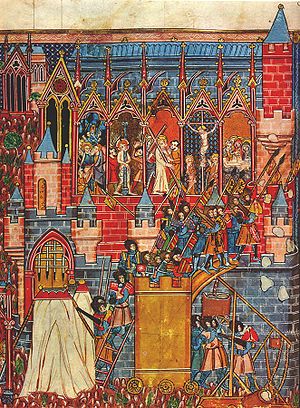
I Lombardi alla prima crociata: o nuovo incanto

The Siege of Jerusalem, 1099
(from a 12th-century chronicle)
Verdi's fourth opera, written when he was 29 years old, was penned at a time when Meyerbeer's grand operas were beginning to dominate the opera stage, and when resistance to foreign occupation was beginning to dominate Italy's political stage. Both influences are apparent in I Lombardi alla prima crociata, which the composer makes far more interesting and nuanced than Temistocle Solera's libretto, based on an epic poem (!), gives it any right to be. The most striking anachronism of Verdi's opera is its most conspicuous: there was no single word for crusade at the time of the first or indeed the second strange, sweeping, composite movements which would become known by that name (and under that name famously condemned by Steven Runciman as "one long act of intolerance in the name of God, which is the sin against the Holy Ghost.") The libretto for I Lombardi acknowledges the spirit of pilgrimage and the mixed gender of the European hosts; it also, however, claims a mercenary motive which recent historians have noted was implausible in view of the extreme expense and danger involved. Mortgages and wasting fevers were well-known hazards to the Lombard and Frankish hosts, and yet they journeyed to what they called "Christ's land," determined to possess and administer it as faithful vassals of the Lord of Lords. Verdi's music is alert both to the poignancy of pilgrim aspiration, and to the deep tragedy of the perversion of that aspiration into bloodthirstiness. The lovers Oronte and Giselda, often in text he gave them himself, are aware of the contradictions in so-called holy violence: Oronte is convinced of the truth of Giselda's faith because of her own patience and generosity of spirit. In the tremendous finale of the second act, Giselda inverts the cry of the crusaders in screaming against her father's bloodshed: "God does not will this." Michael Fabiano and Angela Meade gave impressive performances in these crucial roles, at the heart of a gratifyingly tight performance from the Opera Orchestra of New York under their respected director Eve Queler.

Thursday, December 6, 2012

Se amar non puo, rispettami: Beatrice di Tenda

Orombello e Beatrice, Pelagio Palagi, 1845/50
At Beatrice di Tenda's Venetian premiere in 1833, the audience was vociferous in expressing their resentment of what they perceived as a derivative piece, not worth their long wait for a new work by Bellini. Giuditta Pasta, the diva for whom--and at whose instigation--it was written, resorted to dramatically declaiming to the unruly carnival-goers the line intended for the tyrannical baritone: "If you cannot love me, respect me!" The audience was quieted, and the opera survived, although in relative obscurity. At Wednesday's Carnegie Hall performance, by the joint forces of the Collegiate Chorale and the American Symphony Orchestra, the audience was docile, and gave the diva of the evening, Angela Meade, the acclaim she richly deserved. I found it impossible, however, to accord the work itself more than a somewhat reserved respect. Bellini's gift for melody is on fine display, and there are some impressive musical moments, but the parts of the opera, at least on this showing, failed to cohere into a gripping whole, despite the contributions of an accomplished cast.

Saturday, February 11, 2012

Ernani: Ogni cor serba un mistero


Verdi's Ernani, a politically provocative opera which enjoyed great popular success in the years following its 1844 premiere, exists today only on the fringes of that portion of his oeuvre likely to be known through performance. The thrilling edginess which Verdi and his audiences saw in the plot (based on a play by Victor Hugo) can be obscured by its manifest implausibilities. But the music is engaging and imaginatively melodic, and Verdi's capability of suiting musical convention to the needs of his drama (and making it bend to do so, if necessary) is displayed advantageously. Pier Luigi Samaritani's 1983 production for the Met tends towards the ponderously monumental, but the cast of the current revival ensures this Ernani is an exciting night at the opera.

I admit to being relatively unfamiliar with Ernani's score, but I was pleasantly surprised by the energy and attention to detail which Marco Armiliato and the orchestra brought to it. Dramatic momentum was admirably maintained, and significant details emerged eloquently. The chorus had restrictive choreography, but contributed solid, vigorous singing, notably in the patriotic Act III chorus, "Si ridesti il Leon di Castiglia." Noteworthy was the contribution of tenor Adam Laurence Herskowitz in the role of Don Riccardo, the king's messenger. He conveyed an appropriate sense of urgency to his various announcements, with a clean, ringing sound and good diction. The opera centers, however, on the relationships--intensely personal and inevitably political--binding the four principals.

Monday, November 7, 2011

Udite, udite: Richard Tucker Foundation Gala

In his opening remarks on Sunday evening, Barry Tucker thanked the loyal audiences of the Richard Tucker Foundation Gala who made the concert a tradition. From the comparatively cheap seats, I enjoyed it for the first time, (upgrading from the Foundation's free citywide concerts.) The all-star lineup had undergone some serious shuffling in the weeks and even days preceding, but I had no reason to complain of the final results. Angela Meade was feted as the Tucker Award winner, and surrounded by colleagues of international stature (Opera Chic provides additional background.) The chosen selections relied more on star power than subtlety for their success, but the latter was not wholly lacking, and the former was often a delight. Members of the Metropolitan Opera orchestra provided sensitive support, playing with fine energy throughout under the leadership of Emmanuel Villaume. Their opening bacchanal from Samson et Dalilah was played with panache, employing sensual rubato in the woodwinds and embracing the clashing of brass and cymbal with gusto. After this orchestral prologue, the evening was turned over to the singers. The program seemed to be organized more around the singers' need for rest than around shared themes in the selections, with occasionally curious results. The overall quality, however, was high.

LinkWithin

Related Posts Plugin for WordPress, Blogger...