Showing posts with label Kathleen Kim. Show all posts

Sunday, November 25, 2012

Un Ballo in Maschera: Nell'ombre si matura

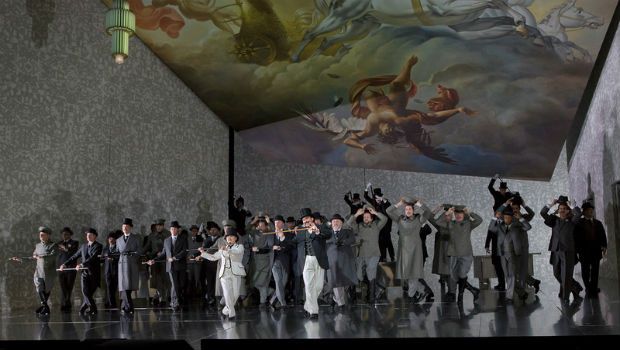
The recklessness of frivolity: David Alden's dark Ballo (Act I)
Although the visuals of David Alden's new Ballo in Maschera for the Met may be more impressive than its concept, I'm still prepared to count it as a laudable effort, and a welcome addition to the Met's generally conservative repertory of productions. I found some details questionable (e.g. dubiously consensual sex in the background of Ulrica's scene,) and some excessively literal in their symbolism (e.g. the king walking over an abyss in Act II, the three principals standing at the points of a triangle in Act III) but the concept, structured around the feckless king and emphasizing chiaroscuro contrasts, was functional, and notable for its attention to Verdi's score. Alden embraced the melodrama of plot and music, another characteristic shared with the films of the '30s and '40s which formed the production's aesthetic, but I found this often emotionally gripping, especially in the courtiers' mockery of Ulrica. As many of you may have gathered, Gentle Readers, I'd far rather see an idea executed with mixed success (or even a mixed bag of ideas) than a non-attempt at providing a meaningful staging.

In Alden's production, it is the recklessness of Gustavo (his hamartia) which drives the action. The pleasure-loving and self-dramatizing monarch flirts with the contempt of the conspirators, openly mocks the insight and the power of Ulrica (clearly he's never read the classical dramatists), dismisses his friend's advice and undervalues his courage, and isn't even particularly interested in understanding Amelia. The frivolous page, Oscar, is established as a sort of alter ego to the king: he is an Icarus figure in the staged prelude and at the masked ball, expressing his monarch's emotional states throughout. Alden emphasizes Gustavo's flaws, but does not neglect his genuine generosity, which is praised by all in the denouement. The moods and morals of the evening having been expressed in shades of grey, I was surprised by the light-flooded triumphalism of the finale, but like many an old Hollywood ending, this one leaves the future uncertain. Incidentally, the sinister splendors of the final scene (think Litvak's Mayerling) should show the Met audience that spectacle doesn't have to come coated in glitter or burdened by brocade.

Saturday, May 7, 2011

Ariadne auf Naxos: Töne, töne, süße Stimme

(c) Cory Weaver/Metropolitan Opera
This has been a good spring for Strauss at the Met.  After a luxurious Capriccio, we get Ariadne auf Naxos with an incredible cast under the baton of Fabio Luisi.  Luisi's passionate, precise conducting was a joy, evoking the disparate characters of the prologue's bustling drama, and opening out into glorious, sweeping lyricism when this was called for.  I'm not an Ariadne-expert, but I thought the orchestra was appropriately knowledgeable and gently ironic as well.  (Parenthetically, I was seated between a lady who knows the opera backwards and loves it passionately, and the personal trainer of one of the cellists, who was hearing it for the first time.  We all loved it.)  Elijah Moshinsky's production--pictures from previous runs here and here--I thought very successful in the prologue.  The opulence of the house was established, there was not-too-broad comic business for the Tenor and Prima Donna, and a detailed treatment of both relations within the comic troupe and the group of musicians, and the increasingly hostile relationship between the factions.  I wasn't entirely sure how much of the opera staging was supposed to be taken seriously; it seemed to me that Moshinsky was choosing to amplify its ambiguities, rather than interpret them. I did like the treatment of the constellations and the presentation of Najade, Dryade, and Echo, but I thought the opening up and closing of various layers of cloud backdrops got to be a bit much.  Still, the finale was musically glorious.

Wednesday, February 16, 2011

From Vision to Inheritance: Nixon in China at the Met

I wasn't sure what to expect from Nixon in China, as most of the press coverage I had read beforehand focused on the opera as event.  An event it certainly was; I thought it was also a fascinating opera.  I came out haunted by the music, humming the music, and with lots of thoughts to mull.  From an edgy opening chorus backed by ominously propulsive music to the ambiguous, elegiac conclusion, via dizzying ensembles and interchanges, a complex drama was kept taut through Adams' characteristically inventive orchestration and a fascinating libretto.

LinkWithin

Related Posts Plugin for WordPress, Blogger...