
Showing posts with label Don Carlo. Show all posts
Showing posts with label Don Carlo. Show all posts
Tuesday, April 28, 2015
Don Carlo: il di tremendo


Friday, March 8, 2013
Don Carlo: lo spirto che vacilla
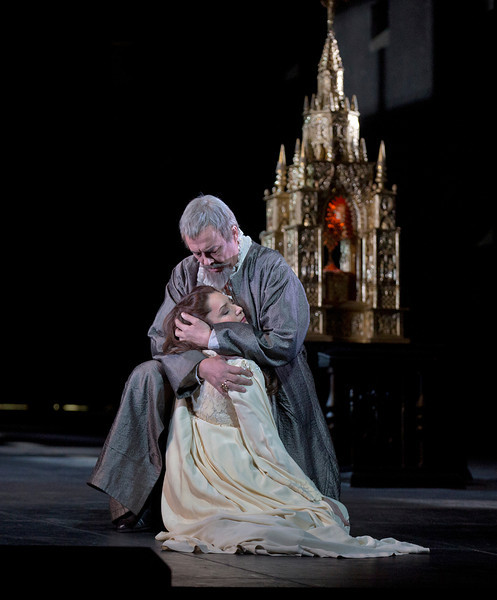 |
| Filippo (Furlanetto) mourns what might have been. Frittoli is Elisabetta. Photo (c) Met Opera |
Wednesday, November 24, 2010
Ei segua il suo destin
 |
| Auto da fe: (c) Ken Howard/Metropolitan Opera |
 in the library because it was there and looked good, found the libretto online, and listened (over and over and over again.) Nicholas Hytner's production was elegant and emotionally powerful, with stylized sets that recalled the Escorial (and environs) while evoking a powerful sense of a fate that approached inexorably, and imprisoned the complex men and women who struggled so furiously against it. Here Nicholas Hytner talks about his sense of the opera and his interpretive goals. In the first (Fontainebleau) act, for instance, it is winter, and a black path cuts a stark zig-zag path through the snow. Neither Carlo nor Elisabetta use this route, entering; but having agreed to become Filippo's wife, she is carried down it in procession. The prison-like nature of strong walls with small windows was effective throughout the rest of the opera (such a wall ascending and descending to divide the space of the stage also made scene transitions seamless.) The set for Elisabetta's garden I found jarring and strange; but that was an exception. Against this sleek, streamlined backdrop, the costumes and furnishings were deliciously detailed. Photos from the dress rehearsal may be found here; I'll add more as soon as they're available. Hytner was on hand to guide the Personenregie (is there an English word for that?) and it was amazing, drawing out the complexities of all the characters, including a hard edge for Martyr to Duty Elisabetta.
Yannick Nézet-Séguin's conducting was, of course, fast, but it was not merely fast. The orchestra did occasionally outrun the singers, or at least (to my ears) rush them, and did occasionally threaten to drown them. But there was drama in the pacing, not a mad rush through the score; details were pointed up, and the sheer sweep of Verdi's music was relished (I've said it before: I love the Met orchestra. Nézet-Séguin let them shine here.) Despite the issues in balance and pacing, I was on the edge of my seat and holding my breath most of the night, so by that standard of measurement, they were doing something very right. I worried for Roberto Alagna's Carlo during the first act, but whether it was an issue of nerves or warming up, things soon improved and I could relax. It sounds like a relatively heavy role for him, but he delivered it with passion; he does have a beautiful timbre, and his nervy, anguished Carlo was sung with unflagging energy. "Io vengo a domandar grazia alla mia regina," and the subsequent scene, was a highlight.
Friday, March 12, 2010
Egli muore! o, ciel, ei muore!
Last Sunday, as posters around the city and banners on websites insistently reminded me, the Oscars were awarded. In theory (leaving aside the probably disheartening answer of how the system of nomination actually works) this celebrates Excellence in Film Generally. And I have a confession: besides Cinematography, the acting categories are usually the only ones--if any--that really arouse my partisanship. (Related confession: I don't see many films, because if I have a choice between spending $12 on a film and $20 on an opera...!) And all this is leading up to something: what about acting in opera?
Subscribe to:
Posts (Atom)
LinkWithin
