|
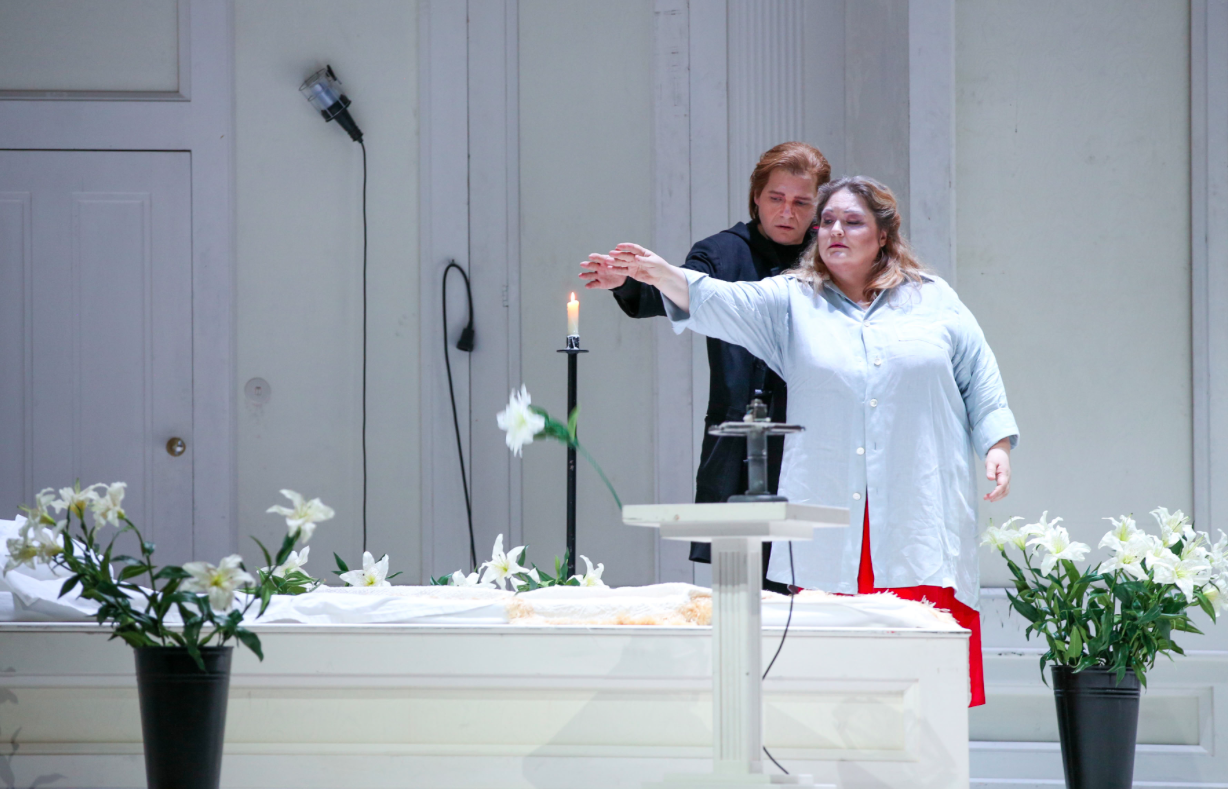
On the outside looking in: the student Arkenholz
Photo © Oper Frankfurt |
Yesterday, I attended the last performance in Oper Frankfurt's premiere run of
Die Gespenstersonate, Aribert Reimann's 1984 opera based on Strindberg's
play of the same name. Walter Sutcliffe's production, making use of a stage placed diagonally between two tribunes in the
Bockenheimer Depot, was sleek, with appropriate twists of the surreal and the claustrophobic. The space was used very well, I thought; although Strindberg's rivalry with Ibsen made the use of a dollhouse ironic, the image worked well in setting up a drama where voyeurism and manipulation are central. I also quite liked Kaspar Glarner's costuming, precise in its evocation of differing periods, alluding to the zombielike endurance of the bourgeoisie which Strindberg and Reimann dissect.
Lear being the only one of Reimann's operas I had any previous familiarity with, I was worried that I might miss a lot in the music. But while I may have missed much that would repay further study, I found
Die Gespenstersonate direct, emotionally gripping, instantly drawing the listeners into its world. Each of the figures has a distinct musical characterization, brought out vocally and in the orchestra. The small ensemble, led by Karsten Januschke, deserves high praise for a clean, richly textured performance. The strings were truly spectral, with creeping tritones not the only thing suggesting something devilish about the sinister Direktor Hummel. Low woodwinds droned menacingly; the piano and harmonium (both played by Vytis Sakuras) provided the parlor music of nightmares. Always closely bound to the text, the orchestral writing built the suspense of a drama that shows a world of jealousies and pretense, of exploitation and self-protection, a society "sick at the spring of life."