Showing posts with label Stephanie Blythe. Show all posts

Sunday, May 24, 2015

Reading List: Master Singers

I jumped at the change to review the recent volume: Master Singers: Advice from the Stage. The structured collection of commentary from professionals at varying stages of their careers is designed to bridge the gap between academic methods of singing learned in the studio, and the practice of singing on the opera and concert stage. This is not to remove one jot or tittle of the law, but rather to add to it. Advice from a starry host is then thematically organized by chapter, which adds to its usefulness for the singer. Enthusiasts, like myself, might find the most interest in the first three chapters, as they focus on the craft that results in what we see and hear.

The text is edited by Donald George and Lucy Mauro, a singer and a pianist, respectively, and both professors. A lot of work has clearly gone into this, as the chapters are subdivided into helpfully specific sections on, e.g., passaggio. Each such section is framed by a question posed to the singers--whether in person or in writing--who could then choose whether and at what length to respond. (The introduction observes, naming no names, that some answered every single question, which strikes me as positively saintly.) The conversational tone of each singer seems to be preserved with often startling immediacy; George and Mauro say that they edited the singers' words as little as possible.  The contributors, as well as topics and operas covered, are indexed and cross-indexed for reference. Although Americans predominate, the singers come from a variety of linguistic and national backgrounds, offering a helpfully diverse range of experiences and traditions. Christine Goerke, for example, in responding to a question about creating varieties of tonal color, observes that "Americans have fallen into this 'make beautiful sounds all the time' thing." Singers from multiple fachs respond, and David Daniels and Ewa Podleś add the perspectives of countertenor and contralto to those of sopranos, mezzos, tenors, baritones, and basses.

Tuesday, March 12, 2013

Stephanie Blythe sings the 20th Century at Carnegie Hall

Despite some empty seats, the Monday night audience for Stephanie Blythe and Warren Jones was one of the most warmly enthusiastic I've heard for a vocal recital. And such enthusiasm was justified: Blythe and Jones had enormous musical and personal chemistry, and Blythe united consummate comic timing with her formidable vocal gifts. The evening opened with James Legg's Twelve Poems of Emily Dickinson, a cycle written for Blythe shortly before the composer's untimely death. Blythe and Jones read the poems before performing the cycle, in place of providing a booklet with texts; I'd love to see this practice spread. Legg's evocative, richly colored settings tied the poems together in a poignant and thoughtful narrative. The asynchronous timing for voice and piano in "There's been a Death, in the Opposite House" established deftly the unsettled mood, and Legg continued to use the piano to color the text strongly, to paint thoughts shattering on stone, the hot thickness of clover, the slow glory of a sunrise. Blythe's use shading of dynamics and her wide palette of tonal color made for an emotional subtlety somehow surprising from so large a voice. The dramatic twist at the end of the cycle, from "Success is counted sweetest" to " 'Tis not that Dying hurts us so" I found thoughtful and affecting. Samuel Barber's "Three Songs," setting the poetry of James Joyce, were also new to me. While given with technical mastery and finesse by Blythe and Jones, I felt that Barber's lush neo-Romanticism sat strangely with the spare beauty of the poems ("Rain has fallen," "Sleep now," "I hear an army.") The lover's invitation to "Come among the laden trees" marks a break from the traditional bower of romance in a way that Barber's harmonies do not; but this quality, which I found jarring, was one of the cycle's attributes most appreciated by my companion. 


Tuesday, May 1, 2012

Die Walküre: der Gottheit nichtigen Glanz

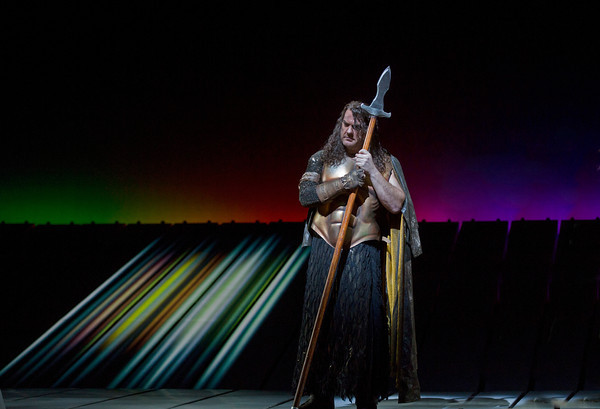
I am becoming a Walküre completist. With my mother, I attended Saturday's matinee at the Met, but will make this a brief report. Let me pass over the Lepage production in comparative silence (for once!) It is so very dull, so lacking in any apparent imagination except the visual. The only fresh insight it has inspired in me is: I really need to go to Germany. Saturday's orchestral performance seemed slightly cool, with a lyric melancholy that served the latter two acts better than the first. Coordination issues, however, were noticeably improved from the previous cycle's Walküre. Luisi and the orchestra were notably supportive of Frank van Aken, making his Met debut as Siegmund. I regret to note that the Machine's Walkürenritt configuration drew applause from the audience, but the Valkyries themselves contributed excellent work, with strong and exciting singing. (My mother opined moreover that Eve Gigliotti deserved awards for bravery, "getting back up on the horse" with a vengeance after the Machine bucked her in last year's run.)

Hans-Peter König made an impressively stentorian Hunding, coarsely possessive of Sieglinde, coarsely threatening towards Siegmund, and singing with diction that dripped with contempt. Stephanie Blythe was impressively rich-voiced as ever as Fricak; the constraints of staging her in her chariot are increasingly irksome to me. Eva-Maria Westbroek made a very touching Sieglinde. Her ardent singing was notable for beautiful tone and phrasing, especially in the first act. She sounded slightly fatigued by the end but still very expressive (I admit to tearing up at "O deckte mich Tod, dass ich's denke.") Frank Van Aken's Siegmund was indisputably valiant, and admirably engaged, but vocally underpowered. He has a bright voice which I might gladly hear in a smaller house, but here he sounded rough at the top of his range. Lack of rehearsal or nerves might account for his errors of omission and commission with the text; I found these distracting. Bryn Terfel's Wotan continues to be incredibly exciting. At Saturday's performance, his god was visibly and wildly despairing. Terfel did growl in places for effect, but sang expressively and responsively. His treatment of text--intellectually and emotionally nuanced--continues to delight me. ("Götternot!" gave me chills.) The Abschied was sung with beauty and power, and acted with profound tenderness and profound sorrow. Even as Brünnhilde begs for a softening of her sentence, Wotan reaches out as if to take her hand. Throughout the fraught dialog, Wotan himself seemed on the brink of weeping... and I sobbed. Katrina Dalayman gave a vocally solid performance as Brünnhilde, if not (to me) a terribly involving one. She sang the second act with accuracy, but without much ardor. Dalayman did bring warmth and sweetness of tone to the final scene. I was an emotional mess as the fire rose around Brünnhilde's cliff, which may be no bad way to leave a Walküre.


Curtain call photos:

Sunday, April 15, 2012

Rheingold: Vollendet das ewige Werk

Last Saturday evening saw the auspicious beginning of the Met's first complete Ring cycle in the Robert Lepage production. On every level (except that of the production) I was enormously impressed. Revisiting the production, I did feel that my initial Ring-optimism had not been entirely unwarranted: this Rheingold, complete with functional rainbow bridge, does contain some powerful theatrical images, and uses space in ways which can at least be overanalyzed as alluding to the complex and precarious networks of power within the work. But it remains, in the end, primarily a backdrop for the performers.

Monday, November 7, 2011

Udite, udite: Richard Tucker Foundation Gala

In his opening remarks on Sunday evening, Barry Tucker thanked the loyal audiences of the Richard Tucker Foundation Gala who made the concert a tradition. From the comparatively cheap seats, I enjoyed it for the first time, (upgrading from the Foundation's free citywide concerts.) The all-star lineup had undergone some serious shuffling in the weeks and even days preceding, but I had no reason to complain of the final results. Angela Meade was feted as the Tucker Award winner, and surrounded by colleagues of international stature (Opera Chic provides additional background.) The chosen selections relied more on star power than subtlety for their success, but the latter was not wholly lacking, and the former was often a delight. Members of the Metropolitan Opera orchestra provided sensitive support, playing with fine energy throughout under the leadership of Emmanuel Villaume. Their opening bacchanal from Samson et Dalilah was played with panache, employing sensual rubato in the woodwinds and embracing the clashing of brass and cymbal with gusto. After this orchestral prologue, the evening was turned over to the singers. The program seemed to be organized more around the singers' need for rest than around shared themes in the selections, with occasionally curious results. The overall quality, however, was high.

Thursday, October 14, 2010

Ihr habt nun Traurigkeit

Carnegie Hall sent me and the Beloved Flatmate a flyer advertising "A Transcendent Evening of Brahms," to feature the Alto Rhapsody, with Stephanie Blythe, and the Deutsches Requiem with soloists Erin Morley and Eric Owens; to these blandishments we were far from indifferent.  The first piece on the program was the rhapsody, a piece with which I was unfamiliar (and the program notes provided very little help.)  Subsequent attempts at research turned up fairly little (Wikipedia page here, "detailed listening guide" here.)  The Cambridge Companion to Brahms will be my next stop.  Update: see the comments section for a fascinating (and conveniently accessible) reference provided by Zerbinetta.  The evocative text was excerpted from Harzreise im Winter.  I do love Goethe, but I would never have guessed he could remind me so much of T.S. Eliot's Four Quartets.  Maybe it was the setting.  Stephanie Blythe is maintaining her perfect record of being fabulous when I've heard her.   She here produced an almost chilly sound, without sacrificing fullness, remote, while still compassionate; the voice of a Miltonian angel, perhaps.  The transition to a plea for divine mercy at the end seemed almost abrupt, given the bleakness of what had gone before, but she characterized it with equal conviction.

Tuesday, September 28, 2010

Rheingold! Rheingold!

(c) Ken Howard/Metropolitan Opera
Leuchtende Lust!  Robert Lepage's Rheingold design may not deserve to be labeled as an artistic triumph, but I do think it can be called a success.  It doesn't read against the libretto; the action is clear, and Lepage seems to be more interested in showing off Wagner's drama (and, sometimes, his own technical imagination in doing so) than imposing a heavy-handed interpretation on it.  This is not to say that it was devoid of ideas.  The use of space was creative, placing singers in arresting tableaux and dramatic interactions.  He wasn't afraid of the opera's moments of humor, but let them happen.  And we got a Riesenwurm with thrashing tail menacing Wotan from one side of the stage and fossil-like head, with malicious tongue and deadly jaws, entering from the other: es wand sich ringelnd!  There were moments where the interaction between realism and abstraction didn't sit perfectly easily, but overall it worked well.  There was, occasionally, an audible, unsettling creaking as the enormous mechanism shifted; I imagine, and hope, that something may be done to silence it.  Update: a Met gallery of production photos may be found here.

Thursday, July 29, 2010

Cara ed amabile

I should be hoarding my stipend and beefing up lecture notes in these last weeks of summer... but the Mostly Mozart festival has begun, and I could not resist its siren call!  As always in the wake of these reckless concert-related decisions, I'm inexpressibly glad I went; surely lecture notes will be the better for my brain and heart having absorbed some Mozart beforehand?   The program notes were unusually lively, as well as informative, maybe stretching a little too far in its attempts to convince us that all the evening's music shared a uniting theme both natural and profound, but still good.  Jane Moss, the festival's director, claims in the program booklet that it is hard to imagine "a more sublime and rewarding way to experience summer in New York than celebrating the genius and inspiration of Mozart," a sentiment which, while perhaps overly fulsome, I find hard to argue with.

LinkWithin

Related Posts Plugin for WordPress, Blogger...