Showing posts with label Barbara Frittoli. Show all posts

Tuesday, April 28, 2015

Don Carlo: il di tremendo

On Saturday, I went to the last performance of Don Carlo, and what will be my last performance of the Met season. It was an evening both grand and thrilling, with a musical and dramatic force that reminded me forcibly of what opera's capabilities are. The performance of the Met orchestra under Yannick Nézet-Séguin was nothing less than world-class, and was supremely exciting. They played with drive and nuance throughout, and from the beginning, Verdi's motifs were highlighted and treated with great dignity. Individual and section highlights, too, were all gorgeously handled, honoring both the forward momentum of the score, and its suspense. The singing, too, was excellent; my companion repeatedly asked who the casting director was, which drew my attention to my ignorance of this process. But those responsible certainly deserve praise. This was indeed a cast not only universally strong, but with good chemistry, and some choreography new to this iteration of Nicholas Hytner's 2009 production. More than once during the evening, I found myself thinking that the Met would do well to have more such productions in its rotation: visually striking, thoughtful in interpretation, and with a strong dramatic arc that still leaves room for adaptation to individual singers.

Friday, March 8, 2013

Don Carlo: lo spirto che vacilla
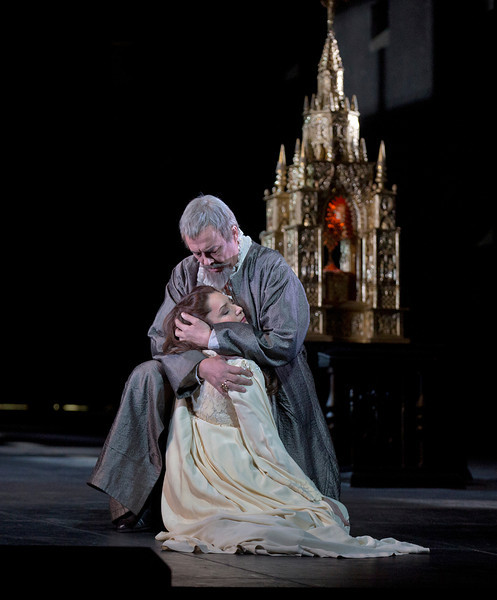
Filippo (Furlanetto) mourns what might have been.
Frittoli is Elisabetta. Photo (c) Met Opera
Wednesday's performance of Don Carlo boasted some fine singing, and, from Ferruccio Furlanetto's Filippo, excellent singing; despite this, the performance never really ignited (if you'll forgive the verb, Gentle Readers.) The principals suffered from the lack of thoughtful direction which Nicholas Hytner had given the production in its first run at the Met. For most of the evening, this merely led to slightly off reaction times, and an excess of what the Beloved Flatmate was wont to call Emotional Shorthand Falling. In the last two acts, matters became further scenically unraveled. Carlo and Rodrigo had only perfunctory contact in the latter's death scene; Elisabetta's tragic prayer lacked the choreography to support her shifts from supplication to anger, and her escalating despair. Most confusing, however, was Don Carlo's death, where he was killed in more-or-less fair fight by one of Filippo's guards. In the first New York run, it was Filippo himself who stabbed Carlo in the back, in the graphic cannibalism of a dysfunctional patriarchy. This failure to connect with the dark heart of Verdi's (yes, I'll say it) masterpiece was unfortunately mirrored--and perhaps anchored--in the pit. The deliberate tempi of Lorin Maazel's conducting brought moments of effective solemnity, but far too often lagged behind singers and weighed down the flow of Verdi's ineluctable tragedy. I would have welcomed more precision lavished on the details of the orchestration, or more rubato, or more dynamic variation, or more varied tempi (and spent, perhaps, too much time pondering these possibilities during the performance.) The orchestra achieved passages of considerable beauty, with the woodwinds distinguishing themselves, but the whole remained less than the sum of its parts.

Tuesday, December 11, 2012

Oh come un gran contento: Clemenza di Tito

The Emperor debates clemency: Filianoti as Tito (Photo (c) Ken Howard/Met Opera)
The vox populi is correct: the Met's revival of Clemenza di Tito is not only musically polished, but emotionally compelling, and stylish throughout. Jean-Pierre Ponnelle;s production employs elegant aesthetic hybridity, combining allusions to eighteenth-century Europe and ancient Rome in both the architecture and the costumes. The sets are characterized by symmetry and proportion, those shibboleths of the Augustan age, and the Personenregie is formal but not lacking in emotional intimacy. Some of the gestural conventions might have seemed stale, had they not been so convincingly employed by the singers, but as it was, I found myself moved by Ponnelle's tableaux. I especially appreciated the early distinction made between Tito's public and private personae, the staging of the emperor's Act II deliberations in an eighteenth-century gentleman's study, and the dramatic lighting for Vitellia's journey towards self-knowledge in "Non più di fiori." More frivolously, I liked the opening which sets up Vitellia's political persuasion of Sesto as pillow talk. The performance--including the late substitution of Geraldine Chauvet for the indisposed Elina Garanca in the role of Sesto--made a great case for the intellectual, emotional, and musical refinements of Mozart's work.

Saturday, October 15, 2011

Don Giovanni: Cogliere io vo’ il momento


Amid a plethora of painted shutters and dancing peasants, it was the Don himself who brought the color and life to Thursday's Don Giovanni at the Met. Michael Grandage's staging was Sevillian and serviceable. The lighting by Paule Constable reflected the progress of the unfolding day, and used chiaroscuro to suggestive effect, echoing the plot's preoccupation with identity mistaken and revealed. The casinetto is a richly appointed townhouse among the many which slid into different configurations as the action progressed. The opulent eighteenth-century costumes (Christopher Oram) made social distinctions clear. But, although the production was not entirely unreflective, I still found it somewhat unsatisfying. It was clear that Grandage was aware of the gender and class hierarchies shaping the plot, but his own ideas on these subjects weren't strongly developed in visual terms. Many episodes of the dramma giocoso were played--I thought--too close to comedy, but that may be largely a matter of taste. I found the hellfire of the finale grotesque rather than terrifying. Fine singing and exciting orchestral playing made for a dramatically engaging evening, but I wish the production had been helping more.

The Met orchestra and Fabio Luisi gave a vigorous account of the score which did not sacrifice detail to its generally fast tempi. From my vantage point, I couldn't see Maestro Luisi moving between podium and harpsichord, but transitions occurred seamlessly. The chaos of the party in the Act I finale was handled brilliantly. Delicacy in intimate or introspective sequences was savored, and the ominous chords of the Commendatore were delivered with bone-shaking relish. (To those around me who whispered during the overture: now you know the fate of malefactors; I hope you are suitably chastened. To those who were hastening down the aisles before the closing ensemble... be warned! Be warned!)

Wednesday, February 2, 2011

Boccanegra! Boccanegra!

The Met's "must-see" Simon Boccanegra was high on my spring wishlist, but I didn't make it down until the penultimate performance on Tuesday night.  Giancarlo Del Monaco's production was heavy with wood, stone, and velvet.  I do have a soft spot for fourteenth-century costumes, but the hyper-realism (especially of Amelia's garden and the Genoese council chamber) was a bit much for me.  And we never see the sea!  Of course, I'm spoiled, because my first acquaintance with this opera was made through a Christof Loy production (Frankfurt, 2007) I wasn't nearly well-informed enough to appreciate properly.  Feel free to hate me for that; rest assured I am properly ashamed.  On Tuesday, the Personenregie, or lack thereof, was an even bigger problem for me, with stand-and-sing delivery and semaphore-stylized gestures.  It was, then, All About The Singing.  Fortunately, this was strong.

LinkWithin

Related Posts Plugin for WordPress, Blogger...