Showing posts with label Il Trovatore. Show all posts

Friday, June 17, 2016

Opera in Prose (and Il Trovatore)

The progress of my summer reading list has been somewhat slowed by academic responsibility (alas) but I am currently immersed in Alexander Chee's recent The Queen of the Night, and it is so glorious that I can't wait for the eventual review to share it with you all. I got it from my local library, but it's the kind of book I'd love to own, the better to forcibly loan it to people, to say nothing of revisiting particularly lush passages of its gorgeous prose. It works (so far!) brilliantly well as a historical novel of the mid-nineteenth century, and is also a fascinating look at one woman's self-discovery... and discovery of opera. The evocation of opera in prose is, of course, a tricky thing. But it's also proved irresistibly tempting to many authors.... and bloggers. I was first drawn into the sphere of opera blogging because prose records of unique opera evenings were (and are) so much more numerous, and more accessible, than audio or visual records of them.

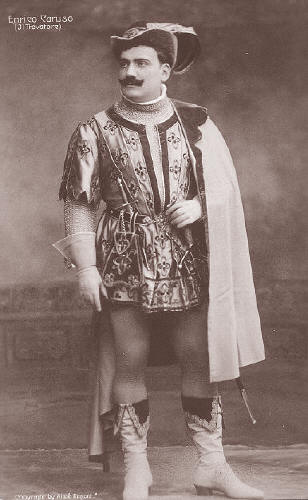
Caruso as Manrico
The dramatic use of opera in novels dates back at least to the Romantics, with Flaubert's Madame Bovary a justly famous example, and Dumas père's Le Comte de Monte-Cristo a less famous but equally fascinating one. (If you have favorite examples of opera evoked in prose, please share them!) I've been particularly intrigued by Chee's treatment of Il Trovatore, an opera he describes as "a tragedian's sleight-of-hand." The poignant ballad "Deserto sulla terra" he describes as perhaps the most beautiful song ever written for a man... which of course led me into a process of re-exploring the opera and this aria.
Friday, October 5, 2012

Il Trovatore: Dolci s'udiro e flebili gli accordi


Thursday night's Trovatore revival found the Met's forces in reassuringly fine form: under Daniele Callegari, the orchestra played with passion and precision, and the cast was without a weak link, contributing strong and stylish singing. The only thing missing was, for me, the ineffable spark that would have been needed to set the performance ablaze. Still, it made for a most musically satisfying evening. David McVicar's 2009 production, its visuals inspired by Goya's famous Black Paintings, creates an appropriate backdrop for the brutal story. The "gypsies" are here armed partisans under Manrico's command. Unfortunately (at least in this revival, and I don't recall significant differences from the production's first run) McVicar's exploration of the violence of nineteenth-century Spain doesn't go much deeper than this. The choreography is mostly traditional; although attentive to the music, McVicar doesn't seem to give hints as to whether Azucena or Ferrando is telling a more truthful version of past events; of how Di Luna's other subjects are affected by his rule; of what events have led to this combustible situation with all the characters living on their nerves. (A few camp followers and piles of rubble do not a commentary on sexual and political violence make.) In McVicar's favor, I will say that recent experiences have led me to appreciate cohesive visual language and characterization as qualities not to be dismissed lightly, and there are several striking touches in the staging.

LinkWithin

Related Posts Plugin for WordPress, Blogger...