Showing posts with label history. Show all posts

Thursday, February 22, 2018

Semi-Scholarly Summary: Bringing Back Euridice

Photo (c) Cantanti Project/Lucas Godlewski

It is a truth universally acknowledged that claimants to the title of First Opera are many, though Monteverdi's Orfeo usually makes it into the textbooks. This weekend, NYC will get the Cantanti Project's performance of the earliest extant operatic score. As a historian, I like the phrase "first extant operatic score": it fills the mouth and rolls off the tongue. Not only is Giulio Caccini's Euridice thus a landmark in the hectically productive years of the early seventeenth century (it was published in 1600), it is a highly self-conscious manifesto about the power of music.

Conductor Dylan Sauerwald, who will conduct the performances, has argued that, although "lines in music history are usually blurry... the baroque was an explosion." Not only was Caccini visibly influential in this creative explosion, he was determined to be. His Euridice, written to a libretto also used by Peri, was on the only possible topic for a composer seeking to recapture the power harnessed by the ancient Greeks -- that of music to create harmony, to inspire madness, and indeed to overcome death itself. From the 1580s onwards, the philosophers and artists of Florentine salons had been having vigorous debates about what music should do, and what music could be -- if only their own age could recapture the genius of the ancients. I confess that, even as a habitual operagoer who grew up on Greek mythology as retold by Bulfinch and Hamilton, I observed the early operatic fascination with Orpheus and Euridice without having the penny drop: that it was chosen precisely because it was the narrative of how skillful poetry, skillfully set against music, could break the heart and change the world.

Sunday, November 26, 2017

Dante's Music of Paradise

Dante and the Divine (Gustav Doré)
I recently finished teaching Dante's Divine Comedy. Predictably, I made much of how the poem uses music. Hell has only unholy noise: crashing stones, groans, shouts, and, famously, a demon who "made a trumpet of his ass" in Inferno 21. When Dante and Virgil finally make it to Purgatory, they are welcomed with the blessedly familiar sounds of the Te Deum. Unsurprisingly, Paradise features the poem's most dense and ecstatic music. As Dante ascends further into heavenly light and heavenly truth, he is also, increasingly, surrounded by singing. Dante's paradise is filled not only with "the glory of the One who moves the universe" (Paradiso I:1-2) but with saints who dance for joy, and angels who sing in more-than-human voices. The music of Dante's Paradise is dense, sweet, and unlike anything he has ever heard, though it often sets liturgical texts that he knows very well.

Thanks to a student, I recently learned that the Swiss composer Helena Winckelman has taken on the challenge of imagining and creating music for Dante's quintessentially indescribable Paradise. 18 voices, an unsurprising harp, and a delightfully surprising contrabass clarinet sing melodies that, especially at the beginning, circle each other like the circles of Paradise. In the close textures of the music -- several sets of harmonies overlapping with each other, sometimes with combination tones -- there is something of a sense of human incapability. Winckelman's use of spectral composition techniques is not only an aural adventure; it's also a homage to Dante. Turning light into language is what Dante is doing throughout Paradiso, trying to express the inexpressible, pushing his chosen medium of expression to its limits.

Tuesday, May 2, 2017

Semi-Scholarly Summary: Cyrano de Bergerac

This evening sees the opening of Franco Alfano's Cyrano de Bergerac at the Met. It's being marketed as Puccini-like, but the comparison, in my view, over-simplifies the work of both composers. To me, Alfano's Cyrano seems a curious blend of romantic structure and dramatic spectacle, and experimentation in orchestral explorations of the central characters' psyches. I'd be inclined to say that it provides, as Alexandra Wilson has suggested for the late works of Puccini, a sort of alternate vision of how modern opera might have developed in the Italian tradition. From a scholarly perspective, it's received comparatively little attention, even when measured against Alfano's other works. I was surprised to discover this, given my personal fascination with how Alfano's opera functions as an adaptation of Edmond Rostand's 1898 play, which is itself a homage to the five-act dramas of France's golden age of theatre in the seventeenth century. I grew up with an edition illustrated by Dubout, and, later, wore out a VHS of the Gérard Dépardieu film; this is one opera I came to via its source text, rather than the other way around.

Cyrano de Bergerac, subtitled as a commedia eroica, was first performed in the Paris of 1936. I thought that the choice to write an opera based on a heroic fighter of doomed causes in the increasingly totalitarian Europe of the 1930s might have been a political one; but Alfano's ties to Mussolini belie this naively romantic hypothesis. The libretto, which preserves much of Rostand's gorgeously ornate language, is by Henri Cain, a frequent librettist of Massenet's, whose texts include Cendrillon, La Navarraise, and Don Quichotte. For me, as an aficionado of the play, it is curious to hear a text with such strong rhythms, such strong music of its own, orchestrated for the opera stage. But the results are often strikingly poignant. One of the things I find most interesting about Cyrano, in fact, is how the music sometimes undermines the apparent optimism of the text. Trumpets promise discord and warlike tumult even as Cyrano and Christian, the piece's rival tenors, embrace for the first time. When the two men promise brotherhood, the orchestra foretells disaster.

Friday, December 2, 2016

What about Callas? Comparing Generations of Opera Singers

I may regret engaging with one of the opera world's most inflammatory questions, but it is one that has been nagging at my consciousness with increasing frequency -- and increasing insistence -- as I spend longer as an opera audience member. It is this: how do, or ought to, opera audiences discuss opera singers across time? The exigencies of musical performance, and of everything else contributing to an operatic career, mean that one operagoer usually hears several generations of opera singers within a lifetime. And to my great chagrin, this long and rich experience seems more often used to make categorical and usually negative statements than to share enthusiasm. As the very existence of this blog testifies, I'm passionately interested in contemporary and historical performance, and in analysis of what contributes to trends in that performance. And, combining indomitable optimism with scholarly zeal, I'm convinced that there must be a productive mode of performing oral histories of opera, that honors both musicians and the audiences who flock, with legendary and sometimes notorious devotion, to hear them.

Callas as Tosca
The anniversary of Callas' birth seems an appropriate time to flesh out my long-hoarded thoughts on this subject. For Maria Callas, of glorious memory, of eternally astonishing voice, is often cited as the paragon to crown all paragons. There's an astonishing variety of roles for which, in discussions of their performance history, her name is inevitably mentioned, in accents of hushed or ecstatic reverence. She is, for many, the diva, La Divina, ne plus ultra. I'm not exempt from the impulse to adore. Her Tosca was the first CD set I bought for myself, and others have joined it since (there's a fuller panegyric here.) In part, perhaps, because of her preternaturally polished off-stage glamour, Callas has come to be a potent and multivalent symbol. She is, sometimes, the essential Diva, the goddess, having become the perfect woman by her transcendence -- or transmutation? -- of female fickleness and frailty. She is, sometimes, the symbol of glories past, never to be attained by the present and degenerate generation. She is, sometimes, the incarnation of opera's astonishing ability to simultaneously surmount and express the anguish of the human condition.

Sunday, October 16, 2016

Serpent and Fire: Anna Prohaska's Mythical Queens

I've been fascinated with Anna Prohaska since this came out several years ago. Her latest album, Serpent and Fire, displays a similar flair for the theatrical, and still more range of vocal color. The title alludes to two great queens of myth and history, Dido and Cleopatra; the disc explores how they were characterized on the operatic stage. I had never before considered the fact that these two larger-than-life figures proved so popular in early opera, and now I can't stop thinking about it (or listening to the CD.) The brief essay accompanying the disc--on the different operatic styles developing in the seventeenth century, and their different approaches to portraying the queens--argues that there is "nichts von das Ewig-Weibliche" in this popularity; this may be an excessively optimistic assessment. True, the queens are very different from each other. Moreover, as the disc showcases, the ways they were dramatically and vocally characterized could vary widely. Still, I find it suggestive that these two powerful and alluring queens of myth/history were so frequently staged at a time when state power, as embodied by the rulers of Europe, was threatened, redefined, and (to a considerable degree) gendered male. What did it mean to show these queens conquering and conquered? I've written elsewhere about the uses of Anne Boleyn as romantic heroine; it strikes me that a similar (more scholarly) investigation into these questions would be warranted. Prohaska's musical exploration is very welcome, covering three languages, two different settings of a Metastasio libretto, and showcasing her impressive range of vocal technique and emotional expression.

Friday, February 5, 2016

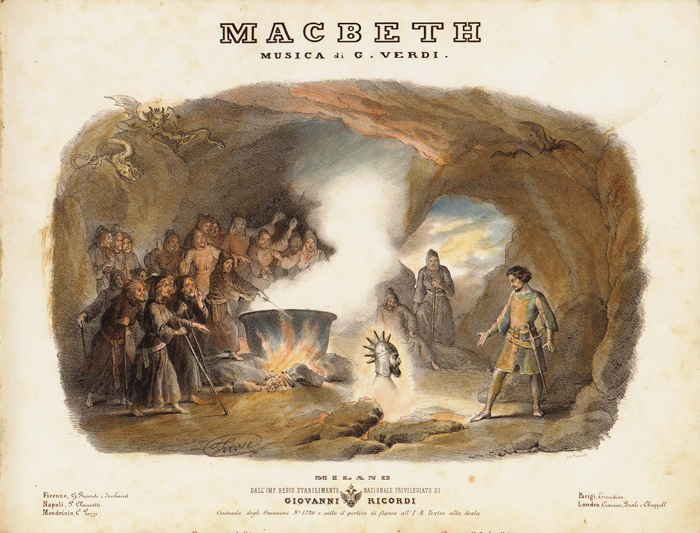
Semi-Scholarly Summary: Verdi's Macbeth

As an itinerant scholar, I've recently written a small piece about Verdi's Macbeth. The commissioning body doesn't know what it's unleashed. Among other things, it gave me the idea of starting a series of semi-scholarly summaries here, featuring historical background, colorful anecdotes, and a highly subjective selection of recommended reading and listening. As has been intermittently obvious on this blog, going to the research library as preparation for attending an opera performance is my idea of a good time. It would seem that I have a kindred spirit in Verdi himself; he paid a great deal of attention to the historical setting of Shakespeare's Macbeth, writing to his publisher and set-designer about political details of eleventh-century England and Scotland.

Macbeth was Verdi's own favorite opera at the time of writing. In 1864, however, when undertaking substantial revisions, he wrote of parts of it as "weak, or even worse, lacking in character." The mid-twentieth century saw a brief revival of the 1847 version, and in recent years, both versions have found place on the operatic stage. The work's very unconventionalities - to judge by essays and interviews - helped it to a mini-boom in the early years of the twenty-first century. (I've written about performances I've seen at the Met here and here.) Macbeth was Verdi's first foray into adapting Shakespeare, and he was unsurprisingly perfectionistic in working with Piave on the libretto, intent on having language echo feeling and fit with musical form.

Wednesday, June 10, 2015

Tristan und Isolde: an appreciation

Twitter informed me this morning that it was the 150th anniversary of Tristan und Isolde's postponed and scandalous premiere. I felt impelled to pour out some of my own feelings about Tristan (and collect some relevant resources on it) here. Even without a Twitter account, one can enjoy the videos, images, and anecdotes of #Tristan150. Tristan has inspired me with stereotypically ecstatic fervor since I first encountered it. Almost a decade ago, it was my first live Wagner; seven years ago, it was the first opera I saw at the Met; and the brilliant performance I got to see last year in Frankfurt still resonates freshly. In between those landmarks in my own opera-going experience, I acquired several recordings and a libretto from secondhand shops, and, one memorable semester, was thoroughly distracted from a week of lecturing on the fourteenth century by those timeless chords of unappeased yearning echoing from a music history class down the hall. Since Tristan is an opera so resolutely profound, so rich in possible theatrical representations, herewith a few links. The entire Konwitschny production, with Waltraud Meier radiant at its heart, is available to view here. Definitely the Opera's thoughtful commentary on the Sellars/Viola production is here. A review of Chérau's 2007 production for La Scala--with the justified observation that "a perfect Tristan is probably beyond mere mortals"--is here.

Even in inevitably imperfect performances, it is inevitably haunting. I cherish the memory of having heard Christine Goerke sing the Liebestod in a school auditorium. I'm inclined to agree with Nietzsche's assessment: there is nothing else quite like it in its mysterious perfection. I will close, though, with a famous assessment by a very different author: Mark Twain. His biting wit is on full display in his account of Bayreuth's 1891 season, but the satirical mood of his assessments of Parsifal and Tannhäuser is not in evidence in his account of Tristan. And in his account of Met audiences, I recognize a kindred spirit. Also instantly recognizable is his testimony that a good Wagner performance can leave one "in no fit condition to do anything."

Wednesday, November 6, 2013

Wolfram von Eschenbach, beginne!

The adventures of Siegfried.
Even in the midst of my researches, Gentle Readers, I find myself reminded of opera. This week, I discovered (while looking for much less flashy legal texts) that manuscripts for several of Wagner's source texts have been digitized. So whether you have a hankering for the thrill of reading a handwritten copy of Das Nibelungenlied (as who does not?) or just want to look at some beautiful images, I have links for you. First up: Das Nibelungenlied. Pictured is the first section post-prologue, The Adventures of Siegfried (Aventiure von Sifride.) Good news for all my fellow Walküre-lovers: the first thing we're told is that "Siegfried was a true child of royalty, whose father was called Siegmund, his mother Sieglinde." If you want a line-by-line rendition of the text pictured in readable type, go here; if you want a transcript of the whole thing based on Handschrift A (pictured,) go here; if you want to look at the whole manuscript, go here. If this has piqued your interest, but you just want to read it in English, don't worry; you can do that here.

Next: Wolfram von Eschenbach's Parzival, for triple Wagner-opera points.

Monday, January 7, 2013

Andrea Chenier: e forse per questo solo v'amo

Not only do I like Umberto Giordano's Andrea Chenier, but I will defend it as a barely-guilty pleasure. The libretto by Luigi Illica boasts fairly sophisticated and quite funny French Revolution jokes (as well as several historical howlers. The sometimes too-rich melodies and their instrumentation may feel perhaps a little too predictable, a little too emotionally manipulative... but what a pleasure it can be to be emotionally manipulated! The work premiered in 1896, just after the centenary of the French Revolution, after a century profoundly marked by its shadow, and issues of gender and class are vividly, cruelly highlighted in the drama. The whole thing is more subtle than The Scarlet Pimpernel, and can be just as much fun, as a quasi-historical and hyper-romantic romp (I'd compare it to Scaramouche, a less famous novel which I loved even more than the Pimpernel when I was fourteen. But I digress.) Given its due, I believe that the score serves not only to move the melodramatic plot along with thrilling speed, but to make vivid the political and emotional tensions which are intertwined at its heart. I felt, however, that Sunday's performance by the Opera Orchestra of New York lacked romantic and revolutionary fire. Debuting the title role under the handicap of a cold, Roberto Alagna lacked much of his usual elan, and the conducting lacked finesse. Rosalind Elias' Madelon was a highlight, and George Petean was a great discovery as the fascinating Carlo Gerard, but the evening as a whole buckled (to borrow a phrase) more often than it swashed.

Saturday, November 26, 2011

Goethe, Gounod, and Faust

"French composers love those German sufferers that then they can bring to joy." --Jonas Kaufmann (Opera News interview, 2011)

"Die unbegreiflich hohen Werke / sind herrlich wie am ersten Tag." - Faust 249-250

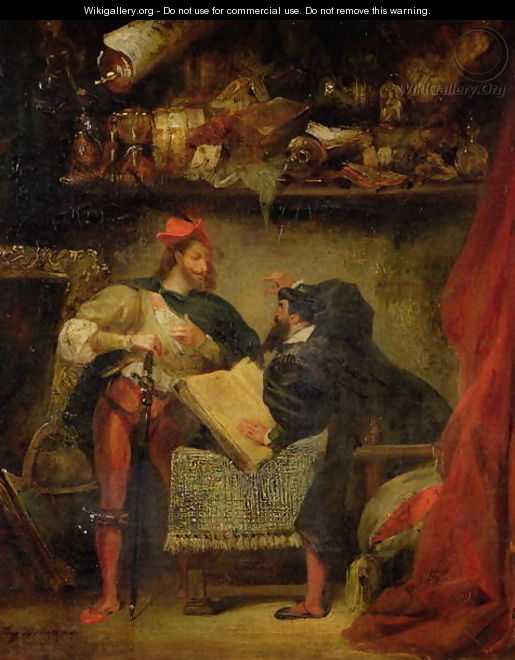
Delacroix, "Mephistopheles devant Faust," 1826
Gounod's Faust was the first work performed at the Metropolitan Opera House, in 1883. The 1859 opera enjoyed an almost unrivaled popularity in the late nineteenth and early twentieth centuries; George Bernard Shaw famously complained that a professional critic in London had to spend approximately a decade of a twelve-year career listening to Faust, and that he himself had been nearly blinded by prolonged exposure to Mephistopheles' red spotlight (his full Faust-assessment can be found in this book.) In Gaston Leroux' Phantom of the Opera, Faust is the opera chosen to represent both vocal virtuosity and dangerous sensuality (a connection emphasized in this film adaptation.) In Jean Renoir's film about WWI, Grand Illusion
, it is presented as plausible that "Anges Purs" would be known by every French officer. Critical interpretations of the opera often cluster around the question: how did Faust achieve such status?

Saturday, November 5, 2011

Se vuol ballare: operatic histories of the French Revolution

Verily, Gentle Readers, opera follows me around, even into the fastnesses of the library. I have been spending the past week immersed in the historiography of the French Revolution, and uncovering some intriguing aspects of opera history in the process. The eighteenth-century opera house was a theater of political representation and an arena for political debate; the disappearance of the ancien regime glories of Lully and Rameau were precipitated more by changes in public mood than changes in musical taste. The public debates over the style of Gluck vs. that of Piccini were as heated as more overtly political disputes (if not quite at the level of the mid-century querelle des bouffons.) The 1774 premiere of Iphigenie en Aulide caused furor not only because of its style, but also because of its subject matter. (Go here to hear Clytemnestre defy the authority of a king and father.) Piccini's rococo dramas were immensely popular. His Italian style, however, was decried by those who wanted natural simplicity and national character in their music. Here an excerpt from Piccini's 1760 work "La Cecchina, ossia la buona figliuola:"


As seen in the above clip, the opera flirts with social transgression despite the subtitle: La Cecchina, a sweet-tempered maidservant, is in love with a marquis. Shall their union be prevented by class boundaries? Fortunately not... as she turns out to be the daughter of a baron. Rousseau himself penned a musical drama entitled Le Devin du Village, extolling sentiment and simplicity. Gretry, meanwhile, was quoted with inflammatory effect at a military banquet, where an aria from Richard Coeur-de-Lion ("O Richard, o mon roi") was sung in commiseration with Louis XVI at "the universe being arrayed against him." And so, indeed, it might have seemed to be. The much-touted changes in mentality which facilitated the social revolutions of the end of the century find eloquent utterance in Mozart. After years of defying tyranny in opera seria, Mozart has Figaro kick over the cart, with a little help from Beaumarchais:

Saturday, August 27, 2011

Mistress, Queen, Romantic Heroine: The Many Roles of Anne Boleyn

Anne Boleyn: 16th century portrait
Anne Boleyn has proved as fascinating to posterity as she was to Henry VIII.  Scholars and dilettantes, poets and painters, have been fascinated by the second of the (in)famous English king's wives, the first to be executed... and that after accusations of plotting regicide, and committing adultery with no fewer than five men, including her own brother.  The subject is temptingly sensational, as a glance at a list of fictional works concerning the unfortunate queen demonstrates. The debates are virtually inexhaustible: how credible did the charges against her have to be? were they only a means to a desired end? desired by whom? I won't pretend to answer all these questions, but in honor of the 1 month countdown to the Met Opera's season opening performance of Donizetti's opera (I'm excited!) I present a brief summary of Anne's political and posthumous career.

Among the many historical inaccuracies of Donizetti's thoroughly Romantic opera, perhaps the most striking is the unanimous sympathy expressed by the chorus of courtiers for the queen herself. In actual fact, the factionalism of Henry's court was lively, bitter, and, in some scholarly interpretations, the chief cause of Anne Boleyn's downfall and eventual death.  During the years of Anne's favor with the king (longer than their marriage) members of her family and their allies were granted influential positions; such influence attracted envy, and in the years of Anne's uneasy position as Henry's mistress, it would be all too easy to claim that the king's judgment had been led astray by his passion. Even after her marriage and accession to the throne, even after the death of Katherine of Aragon, there were those who persistently referred to her as "the Concubine." What of Anne herself? Much ink, scholarly and otherwise, has been spilled in attempting to analyze her character and her motives. I personally find her more credible as player than pawn.  In fictional accounts of her story, naturally enough, legal innocence has been equated with good character, the definition of which is, of course, relative.   Modern novelists have read between the lines of her story to find a vivacious heroine whose attempts at self-expression and self-assertion brought her downfall.  For the Romantic movement which influenced Donizetti, however, she was a heroine of a very different sort.

Tuesday, October 5, 2010

Der Sänger klugen Weisen

Der Tannhäuser, Codex Manesse
Univ. Heidelberg: Cod. pal. Germ. 848
October already, and the academic year is rushing me towards the central Middle Ages, and, this week, a curious confluence of my professional and opera-related passions, as I come to the study of courtly love.  Suddenly Tannhäuser and the Sängerkrieg are appearing with mention of manuscripts instead of musical motifs.  Although the Minnesänger are not a specialty of mine, I have been fond of them ever since an undergraduate course on high medieval German literature.  A digital facsimile of the gorgeous Codex Manesse, a.k.a. Große Heidelberger Liederhandschrift, may be found here, full of poetry and portraits, including those of several of Wagner's protagonists.

Shamefully flighty, I wandered from the paths of focused scholarship into a rereading of the Tannhäuser libretto, where I was charmed to find a connection of the narrative with nature very reminiscent of much medieval secular poetry, as well as (of course) different types of "courtly love."  (Recommendations of favorite Tannhäuser recordings are eagerly solicited, as I am acquiring an itch for deeper acquaintance with the work.)  Scholarly ink has been spilled on the relationship of Wagner's drama to the historical originals of his characters, and their music.  The historical Walther von der Vogelweide, I suspect, would hardly have been disconcerted by Tannhäuser's passionate declaration.  Here, for instance, is one of his most famous songs, praising the pleasures of a lovers' tryst under a linden tree. Wolfram von Eschenbach's lieder are charming (at least to me!), as well as somewhat more earth-bound than "O Du mein holder Abendstern."  The latter, however, is hardly less firmly associated with Wolfram for me.  I love Thomas Quasthoff's interpretation, but this version by Bryn Terfel, shared on Opera Cake, is a current favorite, a perfect antidote to stress or distress.

Monday, January 25, 2010

Vissi d'arte, vissi d'amore

Poor Tosca's cri de coeur has perhaps suffered from being so very beautiful. It's become--perhaps it has always been--a showpiece. We're accustomed to hearing it as a proof of technical facility and artistic accomplishment. And I admit, I know I've sat back in a university recital hall thinking, "Fine, show me," instead of honorably doing my best to think of the devout, passionate woman caught in an impossible situation in 1804 Rome. Tosca has garnered praise and blame for its melodramatic tendencies, and I'm not denying that a soprano being asked for sexual favors (ahem) by a corrupt baritone police chief in order to save her tenor lover from execution has, to put it mildly, rather an air of the contrived about it. But who can remain unmoved when Tosca sings what has sometimes been called her credo: her almost childlike enumeration of her good deeds, her unquestioning giving of herself in love, in charity, in song, ending with the heartbroken, unanswerable "why?"

Monday, January 18, 2010

Dich grüsste mein Herz mit heiligem Grau'n

If opera tends to be a love-it-or-hate-it art form, surely it has no more polarizing practitioner than that prickly, erratic, quite possibly insane man, Richard Wagner. A musical critic and priest once delivered a lecture series on Wagner tellingly subtitled "The Terrible Man and his Truthful Art." (Available for purchase here.) The man himself was famously inspired by Nietzsche, and the movements of anarchism and nihilism. In turn, Wagner's music inspired Ludwig II of Bavaria to build what is arguably Europe's most recognizable castle (complete with Wagnerian murals and an awesome grotto). It inspired George Eliot, and Marcel Proust, not to mention countless writers of movie and TV music. And yes, it also was embraced by the man whom the inimitable Charlie Chaplin is spoofing here, accompanied by the Lohengrin overture.

LinkWithin

Related Posts Plugin for WordPress, Blogger...