
Showing posts with label Gerald Finley. Show all posts
Showing posts with label Gerald Finley. Show all posts
Tuesday, January 24, 2017
In the Stream of Life: Gerald Finley sings Sibelius


Saturday, July 20, 2013
Owen Wingrave: You forget, you are the enemy too
 |
| Finley and Savidge: debating duty |
The Arthaus DVD released earlier this year is of a 2001 for-television production: strangely, it seemed not quite formatted for square home screens. (More background on the 1971 work may be found here; original broadcast here.) Over forty years after the work's premiere, the idea of writing an opera for television still seems rather like a media experiment which might be productively repeated. The disc is mostly frill-less (and though there were credits for titles designers, I couldn't see that subtitling was an option) but it does include an hour-long documentary. I know comparatively little about Britten's biography, so enjoyed it thoroughly and without the ability to assess what elisions or overbold interpretative strokes may have undermined its accuracy or orthodoxy. Perhaps it was the fault of the screen I watched it on that no names for the interviewees appeared. It incorporates delightful footage, from rehearsals (numerous) to home footage of recorder-playing and playing with dogs in the backyard. It makes no mention of Owen Wingrave itself, however, despite the fact that the opera, to a libretto by Myfanwy Piper, focuses the narrative on the problem of the individual against and within society (unsurprising to those who know, or even know of Peter Grimes.)
Monday, June 10, 2013
Vieni fuori: Dallapiccola's Prigioniero with the NYPhil
I went to Saturday's concert with the New York Philharmonic for the sake of Luigi Dallapiccola's rarely performed Il Prigioniero, but ended up being entranced by the Prokoviev violin concerto which preceded it, as well. Alan Gilbert and his orchestra were on very fine form. The degree of subtlety which they achieved in the concerto, and the sheer variety of orchestral textures in the opera, both were very impressive. I thought the latter might have used a little more dynamic restraint, but I don't know the score, and the overwhelming quality of the fortissimi may have been just what was called for.
Prokoviev's first violin concerto is singularly lovely; in this performance, it also registered as uneasy and elegiac. Its unusual form and unusual melodic patterns seemed to be gesturing towards an inarticulable truth. Lisa Batiashvili played with clarity and, in the first and third movements, with a haunting, remote melancholy of tone. Within the melancholy of the first movement she found extraordinary nuance, using the melodic progressions to move from near-anger to reflection sensual and sad as a rainy day, expressing questions of hope and fear. The strings supporting her were soft and smooth, the winds skillful and sympathetic in their echoing of the solo line. Gilbert emphasized the aggressive plurality of conflicting orchestral voices in the scherzo, with malicious pizzicato strings, wild winds, and dangerous brass. Batiashvili too embraced the unsettling mischief of the movement, varying her bowing technique, sometimes sweeping or bouncing against the strings, sometimes playing with almost delirious fluidity. Against the driven rhythms of the strings, the anxious questioning of the woodwinds, the plunging brass in the third movement, the dreamy romanticism of the solo violin wins an improbable victory. The intensity of the opera, in the second half, was of a different nature.
Prokoviev's first violin concerto is singularly lovely; in this performance, it also registered as uneasy and elegiac. Its unusual form and unusual melodic patterns seemed to be gesturing towards an inarticulable truth. Lisa Batiashvili played with clarity and, in the first and third movements, with a haunting, remote melancholy of tone. Within the melancholy of the first movement she found extraordinary nuance, using the melodic progressions to move from near-anger to reflection sensual and sad as a rainy day, expressing questions of hope and fear. The strings supporting her were soft and smooth, the winds skillful and sympathetic in their echoing of the solo line. Gilbert emphasized the aggressive plurality of conflicting orchestral voices in the scherzo, with malicious pizzicato strings, wild winds, and dangerous brass. Batiashvili too embraced the unsettling mischief of the movement, varying her bowing technique, sometimes sweeping or bouncing against the strings, sometimes playing with almost delirious fluidity. Against the driven rhythms of the strings, the anxious questioning of the woodwinds, the plunging brass in the third movement, the dreamy romanticism of the solo violin wins an improbable victory. The intensity of the opera, in the second half, was of a different nature.
Monday, November 12, 2012
Godiam, godiam: Richard Tucker Gala 2012
No small part of the Richard Tucker Gala's charm lies in its oddities and incongruities. An endearingly informal introduction embraces the audience as an almost timeless opera-going community, in a tone suited to a gathering of friends. The gala itself, filled with singers fortuitously present in New York City, presents a cornucopia of opera excerpts with no clear organizing principle, except perhaps the preferences of the singers. This year, honoree Ailyn Pérez thoroughly charmed an audience who seemed determined to express their rapture by applauding not only early and long, but also in the middle of scenes. Members of the Met orchestra played with noisy gusto for Patrick Summers, whose efforts at keeping orchestra and singers in sync were not always successful. Out of this cheerful chaos, Gentle Readers, I have distilled several lessons.
Friday, November 9, 2012
Per sistema infedeli, per genio capricciosi: Le Nozze di Figaro

Thursday, March 8, 2012
Va là, che sei il grand'uom: Don Giovanni
In the three times I've seen Michael Grandage's new Don Giovanni for the Met, I've progressed from disappointment, to frustration, to outright resentment of its lack of substance. (Is there a modified Kübler-Ross model for coping with bad opera productions?) Its visual clichés I find increasingly reminiscent of Phantom of the Opera: red velvet, ostentatious chandeliers, torch-bearing crowds with pitchforks, and, not least, theatrical blasts of flame. For the sake of Gerald Finley's Don, and Bryn Terfel's Leporello, however, I went. Both gave vivid vocal performances of great beauty... and both had, apparently, decided to fill the dramaturgical vacuum with bass-baritonal hijinks. They were supported by very fine singing from the rest of the cast. Andrew Davis' conducting was fleet and energized, but alert to the dark undercurrents in the music. The dramatic propulsion provided by the orchestra (which could also be slyly insinuating, when such was called for) was most welcome.
Saturday, December 18, 2010
Si j’étais Dieu, j'aurais pitié du coeur des hommes
I went into the season premiere of Debussy's Pelléas et Mélisande imperfectly prepared, but eager; I came out shattered. The Cambridge handbook to the work was my cramming resource. The recording I ordered from the NYPL a few weeks ago didn't arrive, so my musical preparation was unfortunately limited to excerpts (and picking out motifs from that invaluable handbook on the piano.) Go here if you need a quick synopsis. I can't speak to what the musical atmosphere of the opera usually is, what inflections or tempi are customarily given to the score. Under Sir Simon Rattle, the Met orchestra created a dark tapestry of sound that reflected the piece's changing moods and atmospheres, from claustrophobic caverns (here, scaffolding; still stifling) to mysterious seascapes, while maintaining a sense of tension fueled by the desperate actions of people trying to find their fate (or flee it.) Space was also given for the sounds of silence, through hushed pauses in the music and deliciously drawn out pianissimi. We heard not only the sounds of the sea, but the sounds of light and darkness, of doubt and desire. Although there were a few rustlers, and what seemed like excessive coughing in the few instances where the curtain was lowered between scenes, the audience seemed to be sensitive to the delicacy and tension of the piece; with an exception for Yniold and Golaud's scene at the window, applause was limited to the intervals, and was not premature.
was my cramming resource. The recording I ordered from the NYPL a few weeks ago didn't arrive, so my musical preparation was unfortunately limited to excerpts (and picking out motifs from that invaluable handbook on the piano.) Go here if you need a quick synopsis. I can't speak to what the musical atmosphere of the opera usually is, what inflections or tempi are customarily given to the score. Under Sir Simon Rattle, the Met orchestra created a dark tapestry of sound that reflected the piece's changing moods and atmospheres, from claustrophobic caverns (here, scaffolding; still stifling) to mysterious seascapes, while maintaining a sense of tension fueled by the desperate actions of people trying to find their fate (or flee it.) Space was also given for the sounds of silence, through hushed pauses in the music and deliciously drawn out pianissimi. We heard not only the sounds of the sea, but the sounds of light and darkness, of doubt and desire. Although there were a few rustlers, and what seemed like excessive coughing in the few instances where the curtain was lowered between scenes, the audience seemed to be sensitive to the delicacy and tension of the piece; with an exception for Yniold and Golaud's scene at the window, applause was limited to the intervals, and was not premature.Friday, November 12, 2010
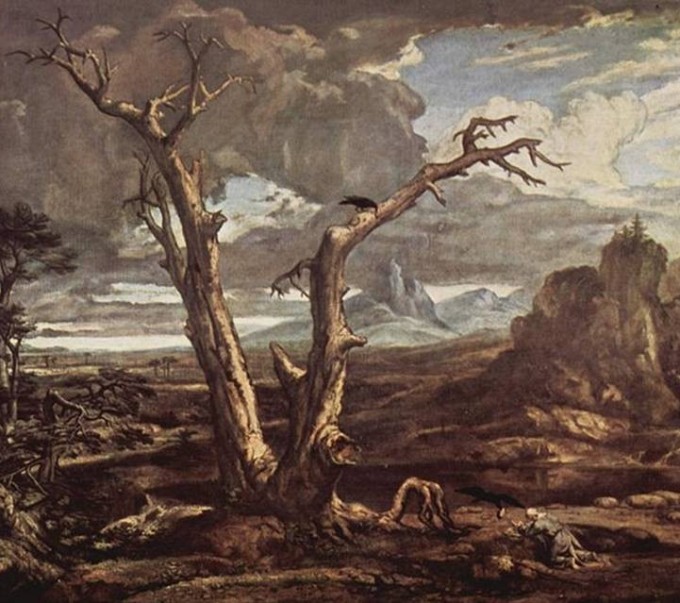
Then did Elijah the prophet break forth: Mendelssohn at the NYPhil
Subscribe to:
Posts (Atom)
LinkWithin
