| Palais Garnier |
Showing posts with label interval adventures. Show all posts
Thursday, July 21, 2016
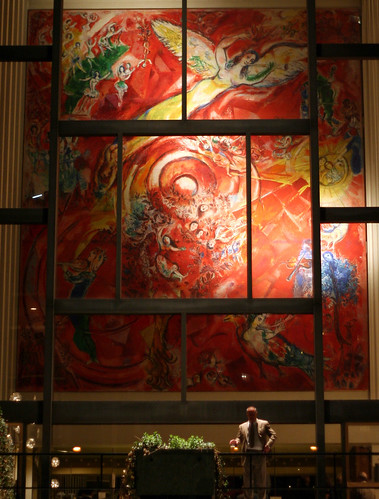
Interval Adventures: L'Opéra Garnier
Friday, June 7, 2013
Interval Adventures: Westsider Records
I'm not quite sure why it took a cloudburst and a spare half hour before a performance to drive me into Westsider Records, as this pleasing warren of dusty shelves is barely a stone's throw from the Met. Once there, I browsed over the CDs, regretfully passed by the LP selection (taking out Fischer-Dieskau in Reimann's Lear for the sake of handling it) and found my way to the helpfully-labeled shelf of opera books. Now I confess, Gentle Readers, that I have a weakness for opera libretti. They're so useful! So cheap! So slender, and easily squeezed onto overladen shelves! The fun of unearthing them from secondhand stacks like the one pictured is a bonus. All this to say that I climbed up on a conveniently located bar stool and, having admired representative samples of roughly a century of libretto design, triumphantly carried off several additions to my collection.
A Tristan libretto fills a lacuna in my Wagner collection, and I found the Art Nouveau design irresistible.
I purchased a Lucia di Lammermoor libretto in the same style primarily for the sake of this full page ad: Nicely done, Knabe Pianos.
My discoveries then skip several decades, to this stark (and purse-sized!) 1961 Peter Grimes.
Later in the '60s comes this: a reminder of the Met's touring company, with a long description of how the under-construction Kennedy Center was funded and dedicated on the back cover.
Apparently, the Opera Orchestra of New York used to provide commemorative libretti at each of its performances! Not a few of these have found their way to Westsider Records; most of them seem to have been underwritten by Rolex. Some of them featured a photo of Eve Queler on the cover; some, like this one, had a design inspired by the opera in question. This sleek edition of the sublimely ridiculous La Gioconda libretto was too good to pass up.
I need to do further research to find out what year saw this gala performance of Tancredi... with Marilyn Horne!
Last but not least, a libretto from a performance of the too-rare Freischütz in the NYPhil's anniversary season under Sir Colin Davis' baton.
Really, it's a good thing I'm moving soon, or who knows what else might follow me home.
Friday, April 12, 2013
Interval Adventures: Visiting Verdi Square

Thanks to Italian-American philanthropy of the early twentieth century, Papa Verdi has a square named after him and a statue in his honor at 72nd Street. Subway commuters and park bench occupants usually seem surprised when I stand still to admire it, but since it's a short walk from the Met, I do so fairly often. As can be seen in the righthand photo above, it is in the grandest tradition of monumental nineteenth-century sculpture. If Verdi were on his plinth surrounded by lyres alone, I'd find it far less interesting... but what gives it its charm, in my opinion, are the figures surrounding Verdi. Grouped around the benevolent master are four of his characters. Whether they seem to be immersed in their own narratives or doing affectionate homage may depend on the angle of light, or one's point of view. The vividness of their expressions makes me hope that the sculptor was an admirer of the composer and his wonderfully human creations. One of the reasons that I keep returning to the sculpture, though, is that I'm still in some doubt about the identity of the statue at the back of Verdi's column; perhaps you, Gentle Readers, can help clarify the matter.
Sunday, October 9, 2011
Interval Adventures: Wagner with William Berger
![]() |
| Josef Hoffmann: Das Rheingold |
This past week, the Beloved Flatmate and I enjoyed the rarity of a Friday night out... listening to a talk on staging the Ring! Thanks to the Met Opera student program, this was free of charge for us; it may have been for the larger public as well, but I wasn't able to find that information. Our entertaining (yes, really) and informative speaker was William Berger, author of, inter alia, Wagner Without Fear. Mr. Berger, diplomatic throughout, offered a historical overview of Ring stagings, divided into three categories, which he purposefully created and compromised almost in the same breath. (The Beloved Flatmate and I were taking mental notes on pedagogy, too.) Our three sample productions were all from Bayreuth: 1876, Josef Hoffmann; 1951, Wieland Wagner; and 1976, Patrice Chéreau. They were characterized, respectively, as representative, abstract, and conceptual... but before we got too far into all that, we began, appropriately enough, in the River Rhine.
Saturday, January 22, 2011
Interval Adventures: I Go To Opera Boot Camp
| Ominous but helpfully labeled stairway. |
Saturday, November 13, 2010
Interval Adventures: Am I a musician?
While waiting for Nick Phan's recital to begin last night (post on that soon!), an Old Opera Lady who was the only other person half an hour early addressed me. I think we exchanged some bromides before she asked: "Are you a singer?" "Only in church," I answered. "Oh," she said, and the conversation was over. Exchanges at the reception after the recital followed a similar, and familiar pattern. No, this isn't one of my first times at an opera (is my enthusiasm that unusual? is open delight not socially acceptable?); no, I'm not a singer/musician. When I say I'm a graduate student, the confused interlocutor perks up. "Oh, so you're doing a degree in music!" No. Oh.
I am unclassified. Unclassifiable? If, in these situations, I were to answer that I am a singer, a musician, I would be seriously misleading these people. I play the piano, but not very well. I have sung in university choirs, but only those without strict auditions (I tried the latter, and failed.) I am the cantor of the weekly psalm, but for a congregation whose musically literate members could be counted on one's fingers. (Two months, and two traumatic debacles: a cracked note, and one terrible time of simply not finding the intervals in the first iteration of the refrain. The vicar probably notices. The organist, a deeply passionate and professionally active musician, certainly does, and is kind enough to console and advise. Others compliment me.) But even if/though I am "not a musician," does this disqualify me from being a serious audience member? Interlocutors tend to be surprised if it is once established that yes, I can read a score, or yes, I am familiar with a selection of singers and recordings from the 1950s onward.
Saturday, October 2, 2010
Interval Adventures: traditionalists and twentysomethings
| Verdi, portrait by Giovanni Boldini, 1886 |
In the second interval, we encountered a startling apparition. He was full of Dark Prophecies about the Future, yet personally, as he told us, from the Past. The beloved flatmate and I decided on Imprecating Opera Specter as his official title. The I.O.S. materialized at our elbow to tell one of our ducklings, who was (rather touchingly over-)dressed in his family tartan, that he should really be at Lucia di Lammermoor. "I have been coming here for decades," he said, rather lugubriously, "and it used to be that everyone on stage was dressed that way." I pointed out that Mary Zimmerman's production still had the chorus in hunting costume, if non-ubiquitous kilts. Or I started to. "Do not mention that name!" boomed the Opera Specter. "That woman is death!" He then unleashed upon the bewildered opera ducklings a torrent of invective against all the "minimalist, abstract, updated, modern Eurotrash" which creeps into the Met like a disease. "Mary Zimmerman!" he exclaimed, returning to his original target. "And her ilk. They make a nonsense of the works. I hope you're not her daughter!" I took my opportunity, and spoke up. "When it comes to La Sonnambula," I said, "I thought that it was less coherent and therefore less effective than it could have been. But Lucia, while it may not be a brilliant production, I thought was inoffensive." (I don't think it's brilliant, but I rather liked the incorporation of the over-the-top Gothic visual vocabulary of Sir Walter Scott and his contemporaries. Whether through silent cowardice or discreet valor, I did not say so.) "Well," said the I.O.S., "well, you're right, it wasn't too bad." And he melted away to his seat, leaving the beloved flatmate and me to opine, sotto voce, to the ducklings that things could be minimalist without being abstract and modern without being either, and that no aesthetic had a monopoly on bad productions. It was quite an adventure.
Subscribe to:
Posts (Atom)