Showing posts with label New York Choral Society. Show all posts

Tuesday, April 9, 2013

I Lombardi alla prima crociata: o nuovo incanto

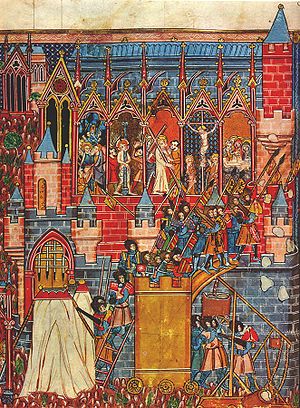
The Siege of Jerusalem, 1099
(from a 12th-century chronicle)
Verdi's fourth opera, written when he was 29 years old, was penned at a time when Meyerbeer's grand operas were beginning to dominate the opera stage, and when resistance to foreign occupation was beginning to dominate Italy's political stage. Both influences are apparent in I Lombardi alla prima crociata, which the composer makes far more interesting and nuanced than Temistocle Solera's libretto, based on an epic poem (!), gives it any right to be. The most striking anachronism of Verdi's opera is its most conspicuous: there was no single word for crusade at the time of the first or indeed the second strange, sweeping, composite movements which would become known by that name (and under that name famously condemned by Steven Runciman as "one long act of intolerance in the name of God, which is the sin against the Holy Ghost.") The libretto for I Lombardi acknowledges the spirit of pilgrimage and the mixed gender of the European hosts; it also, however, claims a mercenary motive which recent historians have noted was implausible in view of the extreme expense and danger involved. Mortgages and wasting fevers were well-known hazards to the Lombard and Frankish hosts, and yet they journeyed to what they called "Christ's land," determined to possess and administer it as faithful vassals of the Lord of Lords. Verdi's music is alert both to the poignancy of pilgrim aspiration, and to the deep tragedy of the perversion of that aspiration into bloodthirstiness. The lovers Oronte and Giselda, often in text he gave them himself, are aware of the contradictions in so-called holy violence: Oronte is convinced of the truth of Giselda's faith because of her own patience and generosity of spirit. In the tremendous finale of the second act, Giselda inverts the cry of the crusaders in screaming against her father's bloodshed: "God does not will this." Michael Fabiano and Angela Meade gave impressive performances in these crucial roles, at the heart of a gratifyingly tight performance from the Opera Orchestra of New York under their respected director Eve Queler.

Monday, November 12, 2012

Godiam, godiam: Richard Tucker Gala 2012

No small part of the Richard Tucker Gala's charm lies in its oddities and incongruities. An endearingly informal introduction embraces the audience as an almost timeless opera-going community, in a tone suited to a gathering of friends. The gala itself, filled with singers fortuitously present in New York City, presents a cornucopia of opera excerpts with no clear organizing principle, except perhaps the preferences of the singers. This year, honoree Ailyn Pérez thoroughly charmed an audience who seemed determined to express their rapture by applauding not only early and long, but also in the middle of scenes. Members of the Met orchestra played with noisy gusto for Patrick Summers, whose efforts at keeping orchestra and singers in sync were not always successful. Out of this cheerful chaos, Gentle Readers, I have distilled several lessons.

Tuesday, January 31, 2012

Rienzi: Sage an, hast deine Sendung du vollbracht?

Opera Orchestra of New York: Chauvet, Matos, Storey (c) AP Photo
Wagner's 1842 opera Rienzi is a heady cocktail of medieval history and political idealism, shaken together in grand operatic fashion (libretto here.) Hardly a curiosity from a noted composer's juvenilia, Rienzi was among Wagner's most popular operas during his own lifetime. Music historian Carl Wilhelm Bauck, writing in the 1860s, characterized Rienzi as possessing "an unusual power, a living spirit, [and] a design of massive, even at times imposing dimensions, and that this all springs from an imagination that surrounds all that enters its purview with burning colors." Another early review praised its "energy of feeling and warmth of imagination." That it is rarely performed, and still more rarely staged, may be partly due to the demands of this form: elaborate processions--and a cast of dimensions to make Cecil B. DeMille proud--do not come cheap. There is also the question of how to piece the opera together; the original manuscript has been "lost, presumed destroyed" since the Second World War, so some cuts are inevitable and, given its massive length (over 8000 bars) further editing is a commonplace. The three-hour version given by the Opera Orchestra of New York (slightly shorter than the EMI recording) was missing some ambassadors and a ballet, but the former are easily omitted from the elaborate plot, and the latter perhaps a prudent excision from this concert performance. (I didn't notice specifics of other cuts; Zerbinetta's report on Likely Impossibilities will almost certainly have a more detailed and thoughtful consideration of these issues.) What of the work itself? Like the early critics cited above, I was drawn in by its musical and dramatic vividness. Many of Wagner's characteristically rich harmonies are present, as are his concerns with the individual's relationship to social institutions. But all of this inhabits, in structural and stylistic terms, the world of grand opera--most decidedly, the world of Meyerbeer--rather than the late nineteenth-century orchestral landscape which Wagner himself did so much to create.

Monday, November 7, 2011

Udite, udite: Richard Tucker Foundation Gala

In his opening remarks on Sunday evening, Barry Tucker thanked the loyal audiences of the Richard Tucker Foundation Gala who made the concert a tradition. From the comparatively cheap seats, I enjoyed it for the first time, (upgrading from the Foundation's free citywide concerts.) The all-star lineup had undergone some serious shuffling in the weeks and even days preceding, but I had no reason to complain of the final results. Angela Meade was feted as the Tucker Award winner, and surrounded by colleagues of international stature (Opera Chic provides additional background.) The chosen selections relied more on star power than subtlety for their success, but the latter was not wholly lacking, and the former was often a delight. Members of the Metropolitan Opera orchestra provided sensitive support, playing with fine energy throughout under the leadership of Emmanuel Villaume. Their opening bacchanal from Samson et Dalilah was played with panache, employing sensual rubato in the woodwinds and embracing the clashing of brass and cymbal with gusto. After this orchestral prologue, the evening was turned over to the singers. The program seemed to be organized more around the singers' need for rest than around shared themes in the selections, with occasionally curious results. The overall quality, however, was high.

Saturday, February 26, 2011

Rossini on a Rainy Day: Petite Messe Solennelle with the New York Choral Society

Bon Dieu; la voilà terminée, cette pauvre petite messe. Est-ce bien de la musique sacrée que je viens de faire, ou bien de la sacré musique ? J'étais né pour l'opera buffa, tu le sais bien ! Peu de science, un peu de cœur, tout est là. Sois donc béni et accorde-moi le Paradis.  -- Gioachino Rossini, dedication to Petite Messe Solennelle

I was rescued from the doldrums of a rainy Friday by the generosity of Taminophile, who magnanimously made it known that he had a spare ticket to Rossini's Petite Messe at Lincoln Center.  I jumped at the chance, and had the very great pleasure of--finally!--meeting the charming Taminophile, discussing bel canto, and listening to Rossini! I have conscientiously not read his blog post on it yet, but you all should (not only is he charming, but he knows a lot more about Rossini than I do.)  My homework on the 1863 piece--which, although I'm familiar with movements from it, I don't think I'd previously heard in its entirety--was facilitated by this Philip Gossett article, so I could appreciate it without feeling too clueless.  And it was exquisitely lovely; I'm at a loss to know why it isn't more often performed, especially as Rossini's original call for twelve singers would seem to be well within the reach of any church with a well-developed music program.  There were, I admit, a few moments where I had to remind myself that repetition and embroidery are key hallmarks of the Rossini style, and I just needed to sit back and relax and bask in it.  And bask I did.

LinkWithin

Related Posts Plugin for WordPress, Blogger...