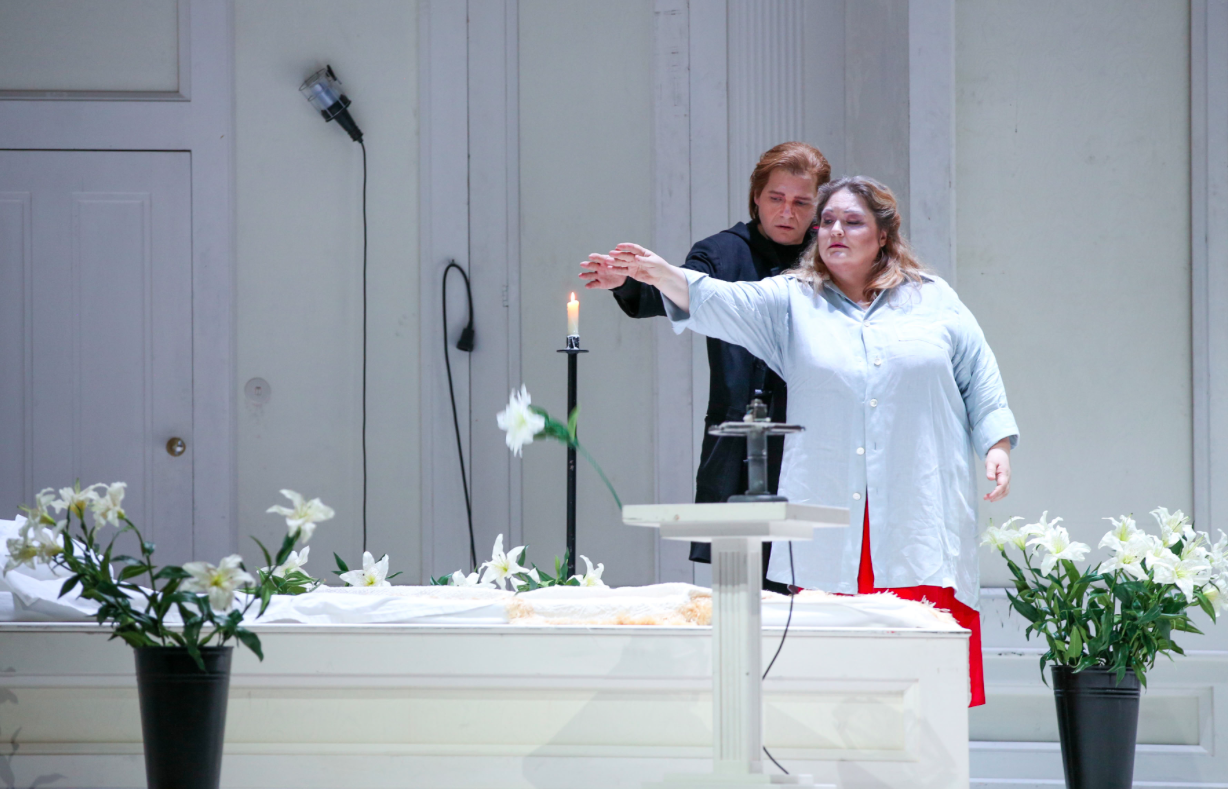
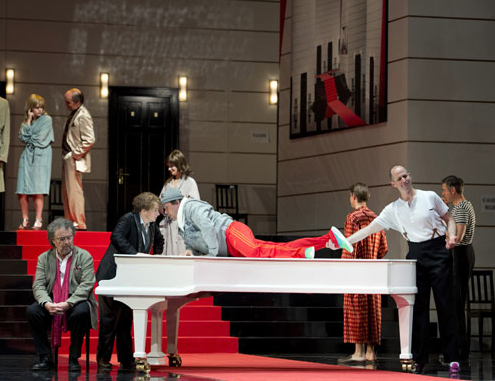
Showing posts with label Oper Frankfurt. Show all posts

Tuesday, January 13, 2015

Nights at the Opera: 2014


However belatedly, I decided to round up a personal "best of" list for the last calendar year. It's always an enjoyable experience of revisiting... particularly poignant for me as I looked back on the last of my German opera-going (for now.) Due to my own relative restraint (not to say remissness) in attending, I've limited myself to a top three in my usual categories.

Standout performances:

Tanja Ariane Baumgartner. Selecting one of her performances was difficult, as she was one of the most reliably exciting singers in my Frankfurt season. But her Charlotte, in Werther, was not only richly sung, but intensely intelligent and intensely sensual; showing Charlotte as a lively, trammeled spirit, rather than a domestic saint, was much appreciated by me!

Anja Silja. She's still got it. She may have invented it. In Aribert Reimann's Gespenstersonate, she made parrot noises and commented on the human condition, and I was thrilled and terrified.

Saturday, May 3, 2014

Trug des Herzens, Traum der Ahnung: Tristan und Isolde in Frankfurt

Liebesnacht: Ryan/Wilson in Act II
Photo © Oper Frankfurt/Wolfgang Runkel
It seemed appropriate to me to begin the month of May with Frankfurt's Tristan und Isolde, an opera I've loved since hearing it cold as my first live Wagner. Frankfurt's current run boasts not only an impressive pair of lovers in Lance Ryan and Jennifer Wilson, but strong performances in further roles, and a rich reading of the score from conductor Stefan Blunier. Christof Nel's atmospheric production is a darkly pessimistic one, suggesting that there can be no comfort this side of death, and even that is denied to Isolde. The man next to me dozed stertorously through much of the first act, and whispered more than once in the second two… but I was gripped and moved.

Sunday, April 27, 2014

Ma la legge non ode consiglio: La Gazza Ladra in Frankfurt

La Gazza Ladra and the theater of justice
Photo © Oper Frankfurt/ Wolfgang Runkel
I confess that, in trying to summarize the plot of La Gazza Ladra (Die Diebische Elster on Frankfurt's posters,) I've often fallen back on over-simplications: "A bird steals silverware; confusion ensues; star-crossed lovers live happily ever after, eventually." But although this is not inaccurate, it is misleading. The late-nineteenth-century assessment of Rossini as a composer of cheerful, even superficial music, has clung stubbornly to this rarely-performed work, the overture to which has been used as musical shorthand for sinister insouciance. The new production by David Alden, which I saw on Saturday, is designed to strip all that away, following instead a darker vision, realized well by singers and orchestra. Rossini created a happy ending for the opera, but petty and systematic tyrannies, offhand and official acts of oppression, characterize its unfolding. The composer used a ripped-from-the-headlines plot; the unjustly accused maidservant in the original episode was, in fact, executed. Rossini wrote at a time when much of Italy was under occupation, which would have influenced how the sinister brutality (and absurdity) of officialdom in the opera was perceived.

Pippo and the Magpie
© Oper Frankfurt/Wolfgang Runkel
Alden sets his production approximately a century after the opera's 1817 premiere, using a predominantly black-to-white palette (significantly, mostly in shades of gray) and doing much with individual characterizations, as well as clever use of stagecraft. Everyone here is in danger of being crushed: the bourgeois couple, where the woman presides over her realm in brittle denial of the fact that her power is not absolute, and the man uses his wealth as a means to escape, wearing the clothes of a young and forward-thinking man, and drinking like a man with no future. There is Pippo, whose often inexplicable conduct is here motivated by the traumas he has suffered wandering a war-torn landscape, the magpie his only companion. The podestà is more acutely aware than anyone of how easily his iron rule could be toppled, how necessary his theater of power is. Then there are our young lovers, miraculous optimists: Ninetta who believes in the power of honesty to save her, who views the return of her lover and her father with nothing but joy; and Giannetto, who is as fearless in fighting for domestic justice as he is reputed to have been on the battlefield. The performance was notably well sung. This and the thoughtful, nuanced, and darkly humorous engagement with the opera's libretto, combined with--in close collaboration with--a biting, energetic reading of the score under the leadership of Henrik Nánási, helped me hear Rossini's music in new ways.

Saturday, March 1, 2014

Nimm noch nicht Abschied: Daphne in Frankfurt

Apollo and Daphne. Photo © Oper Frankfurt/Barbara Aumüller
Last night, I got to see the first performance in this season's revival of Daphne in Frankfurt. The 2010 production by Claus Guth, who also supervised the revival, was of stunning beauty and poignancy, and a strong cast, led by the luminous Maria Bengtsson in the title role, gave moving performances. This was my first live Daphne, and one that helped me understand the opera as a coherent whole. Strauss's exquisite music is bound with an enigmatically layered libretto by Joseph Gregor, and haunted by the circumstances of its creation in 1937-38. Guth's production created an intimate narrative about Daphne's search for truth, and attempts to escape from violence, which managed (I thought) to suggest even the possibility of hope for society as well as the individual in the sublime conclusion. We see Daphne as an old woman (Corinna Schnabel) who visits the home of her youth, now in a state of abandonment and decay, and thus revisits the events of that youth (taking place around the time of the opera's creation.) The rooms of Peneios' and Gaea's household are the backdrop for the unfolding of a powerful drama which is as much allegory as myth, where Daphne attempts in solitude to avoid the violence of male society that Strauss and Gregor so frighteningly evoke. But she can get no closer to utopia than a world of paper birds and cut branches. One of the things which the production accomplishes with remarkable, redemptive success is showing that, while Apollo's and Leukippos' sexual aggression towards Daphne is reprehensible, deserving of the punishment which the god meets out to the youth and to himself, neither Apollo or Leukippos is always-already a rapist: the violence which Daphne so fears is a choice, not a disposition. This was a huge relief for me as audience member, and allows the scenes of emotional intimacy to be seen and heard as genuine, not coercive; Daphne's sense of betrayal by the god is genuine, not a belated realization of falsehood. The drama unfolds gradually, making its way despite all violence, despite all betrayal, to that transcendent finale.

Wednesday, February 19, 2014

Edgar: O gloria, o voluttà

Oper Frankfurt assembled a luxurious cast for two concert performances of Puccini's second opera this week. Not knowing when I'd get the chance to hear Edgar live again, I jumped at the chance to do so, especially since it also offered the opportunity to hear Angela Meade again, and Bryan Hymel for the first time. Mezzo Tanja Ariane Baumgartner joined them in making the most of the music, and making the principal characters both more plausible and more sympathetic than they are as written. What struck me first on listening to recordings of Edgar was the theatrical pacing and use of the orchestra colors. In Michele Girardi's chapter (in here)  covering the work, though, the focus was on the patent weaknesses of the libretto. According to Girardi, Fontana committed "gross linguistic and metrical sins," forcing the composer to "attempt the impossible in making up for for plot deficiencies with music." Although it's not Puccini's most bold or sophisticated music, I did find the libretto harder to ignore in performance than in recordings, and often hard to excuse. The opening scene offers a representative example: the woodwinds, growing in number, evoke waking birds, while a breeze rustles through the strings; chimes are succeeded by a clear bell… and then the chorus comes in and tells us that it is dawn, that the last star has disappeared, and that a faraway bell is ringing. (I couldn't help contrasting it mentally with the gorgeous naturalism of Bohème's Act III opening.) The plot of Edgar centers on the eponymous hero, nominally torn between the soprano who sings aubades about almond blossoms and the mezzo who was raised by traveling Moors (!) and sings about survival of the fittest and about torrid kisses. He seems more interested in Byronic introspection than in either of them, though, symbolically burning down his house when he takes up with the mezzo at the end of Act I, going off to join nationalist endeavors as an act of repentance and self-purification for taking up with the mezzo at the end of Act II, and staging his own funeral as an aesthetic and social experiment in Act III. There's a baritone who hovers around the edges of the drama, being in love with the mezzo and leading the soldiers, in both cases for reasons which are unclear. At the work's climax, the mezzo is tricked by the tenor and then excoriated by the hypocritical chorus, so she stabs the soprano in the back. In short, it's the kind of drama that begs for a concert performance (or for a really good critical production.) And Frankfurt's concert performance was of a very fine caliber indeed.

Sunday, February 9, 2014

Verbrechen und Geheimnisse und Schuld: Reimann's Gespenstersonate

On the outside looking in: the student Arkenholz
Photo © Oper Frankfurt
Yesterday, I attended the last performance in Oper Frankfurt's premiere run of Die Gespenstersonate, Aribert Reimann's 1984 opera based on Strindberg's play of the same name. Walter Sutcliffe's production, making use of a stage placed diagonally between two tribunes in the Bockenheimer Depot, was sleek, with appropriate twists of the surreal and the claustrophobic. The space was used very well, I thought; although Strindberg's rivalry with Ibsen made the use of a dollhouse ironic, the image worked well in setting up a drama where voyeurism and manipulation are central. I also quite liked Kaspar Glarner's costuming, precise in its evocation of differing periods, alluding to the zombielike endurance of the bourgeoisie which Strindberg and Reimann dissect. Lear being the only one of Reimann's operas I had any previous familiarity with, I was worried that I might miss a lot in the music. But while I may have missed much that would repay further study, I found Die Gespenstersonate direct, emotionally gripping, instantly drawing the listeners into its world. Each of the figures has a distinct musical characterization, brought out vocally and in the orchestra. The small ensemble, led by Karsten Januschke, deserves high praise for a clean, richly textured performance. The strings were truly spectral, with creeping tritones not the only thing suggesting something devilish about the sinister Direktor Hummel. Low woodwinds droned menacingly; the piano and harmonium (both played by Vytis Sakuras) provided the parlor music of nightmares. Always closely bound to the text, the orchestral writing built the suspense of a drama that shows a world of jealousies and pretense, of exploitation and self-protection, a society "sick at the spring of life."

Sunday, January 26, 2014

Le coeur se creuse: Werther in Frankfurt

Order vs. the artist: Werther, Act I
Photo © Oper Frankfurt/Wolfgang Runkel
Until last night, Werther belonged to the category of operas I'd never seen live, despite its being solidly established as part of the standard repertoire. I'm glad to have amended this under such favorable conditions: Frankfurt's current revival boasts not only an excellent cast, but a cool, intelligent production by Willy Decker that provides a welcome counterweight to the emotionalism of Massenet's score. Decker's visual language is straightforward and effective, dividing the nature where Werther absorbs experience and sensation from the Bailli's house by a sliding wall. The Bailli's reference to it as "his kingdom" appears as a hollow reference to a pretense of bourgeois order which he cannot uphold: the image of his dead wife has a stronger presence than any of the living in this repressed and depressive atmosphere. The emotions in the score are officially forbidden by the bourgeois society on stage: Massenet is writing in and for the time of Ibsen, not that of Goethe. The children's toy houses reappear as the village of Act II; Albert and Charlotte are separated as they are bound by the enormous dining table where they preside over all the parishioners. I particularly liked that Decker's production creates many silent, musically sensitive interactions among the characters which helped give a clear emotional through-line between the opera's episodes. Credit is due to the revival director, Alan Barnes, for making poignantly clear how each of the opera's characters is imprisoned. Even the Bailli is depressed rather than feckless; Schmitt and Johann function like Shakespearean mutes, personifying the unimaginative apathy which, as Goethe's protagonist observes, can be as dangerous as malice. It is they who bring the messages which interrupt Werther and Charlotte's attempts to break free of their prescribed social roles. Charlotte, for all the calm which Albert praises, has a lively intellectual life, and is aware, with painful intensity, of the emotional life which she is being denied. And for once we see a Werther whose Todessehnsucht is present (and credible) from the outset: he devotes himself to art and nature alike; but he is exhausted by the constant effort of maintaining his refusal to compromise.

Monday, January 6, 2014

Ich sehe klar: Enescu's Oedipe in Frankfurt

Oedipus and the Thebans Photo © Oper Frankfurt/Monika Rittershaus
On Friday, I went to Oper Frankfurt's run of Georg Enescu's rarely performed and richly textured Oedipe (synopsis here.) Hans Neuenfels' powerful new production created suspense and ambiguity in this most famous of stories about inevitability. (The fourth act, in which Enescu finds redemption for Sophocles' tragic protagonist, is omitted here.) The space in which the drama takes place is enclosed with layers of equation-covered blackboards which Oedipus tries to read like hieroglyphs. We see Oedipus first thus: as a grown man, an academic deciphering mysteries of systems and probabilities, an observer of the scene in Laios' palace. The cradle is an egg--symbol of life--which remains mysterious and unnamed. But the apparent order praised by the uniformly clad chorus is disrupted by prophecy, and Oedipus resolves to act: to enter the story, rather than observing it; a parallel impulse for the researcher as for the warrior who desires freedom from his fate. But this quest for autonomy is impeded not least by social impulses towards categorization: Shepherd, Priest, King. Costumes from different periods of history (notably in Jocasta's gowns) allude to this dangerous tendency. Even the Erinnye- like rockers who appear to resist control abet the bullying cruelty of Laios. One of the production's most chilling moments is when, as the plagued Thebans beg their king for aid, for an answer to their questions, for an end to their pain, Oedipus finds himself back in a lecture hall, equations crowding the walls, the Thebans crowded onto benches, and he himself powerless in a white coat by the gleaming metal gurney which is only temporarily without the burden of a corpse. But the production does not insist that freedom is illusory; the highly charged interactions between Oedipus and Merope raise the question of whether Tiresias' prophecy functions with the power of suggestion, or indeed is based on insight into character. Is it Oedipus' obsession with fate that drives him, rather than the fate itself? The opera's central question--how free are we?--hangs painfully suspended.

Friday, October 25, 2013

Tannhäuser: dem unsren sei dein Lied nicht fern

Desire and the dangers of female archetypes: Tannhäuser Act III. Photo (c) Oper Frankfurt


I only made it into Thursday's performance of Tannhäuser by the skin of my teeth, nabbing the last rush ticket about four minutes before curtain. Frankfurt's house was packed, eager, and informed, respectfully silent during the performance, and busily chatting about this and other Tannhäusers during the intervals. The adrenaline rush of ticket-getting may have contributed to my sensitivity, but I found the treatment of the score by the orchestra under Constantin Trinks never less than exciting and compelling. Although I did not find all aspects of Vera Nemirova’s production equally convincing, it was both intellectually sophisticated and viscerally moving. Its greatest achievement was in handling Wagner’s presentation of dichotomous feminine ideals, exposing the perniciousness and inevitable violence of such attitudes. This was achieved by teasing out many of the other ideas in the score (Dresden version) and libretto. I appreciated that religious faith was not treated as intrinsically foolish or deluded, as I appreciated Nemirova’s refusal to treat the sentimental piety of the text as though it were both profound and axiomatic. Instead of a fictionalized thirteenth century, Nemirova creates a fictionalized 1960s for the drama of desire, conviction, and community. 

Friday, October 11, 2013

Lieben, hassen, hoffen, zagen: Ariadne auf Naxos in Frankfurt


Artistic philosophies go head to head. Photo (c) Oper Frankfurt/Monika Rittershaus
Brigitte Fassbaender's new production of Ariadne auf Naxos for Frankfurt's opera house has me falling in love with Strauss's opera all over again. It works on multiple narrative levels, as perhaps any production of Ariadne must if it is to work at all. The hectic backstage activity of the prologue is organized around the poignantly relevant struggles of opera to function as heilige Kunst when treated as commercial product (musikalisches Handwerk, as the Haushofmeister dismissively puts it.) The production was musically sensitive and creative throughout, beginning during the overture with a dance only half seen. The curtain (black, bisected with a red line) was raised just enough to show us feet and calves, some instantly identifiable, some not, dancing waltzes and Charlestons in shifting pairings, at least one of which was of two women.  When the curtain is fully raised on the house of the richest man in Vienna, we're in the improvised back stage area, with half a dozen dressing rooms opening off a central hall. There's a suggestion of surrealism provided by a painting on the wall (see above) and lines that draw the eye strongly. Thus, while there were often multiple vignettes occurring simultaneously, I never felt overwhelmed.

The mercurial musical moods of the prologue were handled deftly: the conversation (if it can be called that when people are talking past each other) between the Haushofmeister and the Musiklehrer was unusually moving, but there were also moments of sly humor. There is at least the possibility that while the Komponist muses on art after his altercation with the lackey, absolutely everyone else is having sex behind closed doors. Although there are moments of sympathy between the artistic factions, tempers are running high when the entrance of the guests forces the end of the prologue. When the curtain opens again on the opera, everything was just different enough that I asked myself whether it was a dream landscape; I don't think it was, necessarily, but it was reminiscent of one, perhaps by Hitchcock, where individuals are forced into unaccustomed relationships with their surroundings. Ariadne's thread, that symbol of navigating perils, has been broken in pieces, and the denizens of the island make to mend it. At the outset, the efforts of the commedia troupe to insert themselves in the action are grotesquely miscalculated, but gradual adjustment takes place so that genuine interactions become the basis of a rapprochement. This may sound banal, but was sensitive and nuanced. The Komponist's vision, of course, is not fully realized; but working together, the artists--with the formerly opposed groups integrated--achieve something like transcendence.
Perfecting perspective: divinity of music. Photo (c) Oper Frankfurt/Monika Rittershaus

Wednesday, September 25, 2013

Joy of Creation: Sir John Tomlinson sings Michelangelo in Frankfurt

When putting Sir John Tomlinson's lieder recital on my calendar, I anticipated being immersed in a world of antiheroes and demigods. Instead, Tomlinson used the Michelangelo settings of Britten, Wolf, and Shostakovich to meditate on the fragile beauties of humanity (full program available here.) With Tomlinson's artistic choices--and persona--the angst I associate with the cycles faded into the background, and insight laboriously carved from experience took center stage instead. The audience was far from filling the house ("almost insulting," said a lady in front of me who had brought her CD booklet to follow along) but genuinely attentive and well-mannered. To my surprise, the stage was furnished with more than a piano: a table and chair, an easel, and a large chest of the sort ubiquitous in early modern urban residences; given the themes of the evening, the latter might be construed to suggest a coffin. Sir John himself was clad in a very distinguished ensemble reminiscent of the belle epoque, with cuffed trousers, waistcoat, and silk cravat; over this he donned a painter's smock which might belong to any century. If not representing Buonarotti, then, did he stand in for The Artist? Any artist? In the end, I felt the trappings were extrinsic to the story he told, which was one of closely observing humanity, celebrating and comforting our mortality by revealing it anew.

Sunday, September 15, 2013

Enflammons son courroux: Les vêpres siciliennes in Frankfurt

Repression and resistance. Photo (c) Opera Frankfurt/Thilo Beu
The scenario of Verdi's Vêpres siciliennes, with pervasive corruption and radical resistance (and doubts about what forms resistance should take) is only nominally medieval; Verdi moved the action from the 16th century to the 13th in order that the opera might safely serve as a political rallying cry in his own day, and the twentieth and twenty-first centuries have certainly offered all too many instances of similar oppression and violence. The music is itself permeated by this violence. Although written in the Meyerbeerian tradition of grand opera, the unsettled, unsettling orchestration and structure are unmistakably Verdi's own. The opening chords foretell no good; in this production, a gunshot proceeds them, explaining the foreboding. This deed is done in silence and darkness; but as it turns out, it is not (only) a characteristic abuse of power. When the thugs have gone, men and women of all ages materialize, at first singly and then in greater numbers, to furtively lay candles and flowers at the site of the murder. The photograph pinned above these tributes is that of Helene's brother, the murdered Frederic. (I give the French names, as Die Sizilianische Vesper was here given in its original language.) The production of Jens-Daniel Herzog for Oper Frankfurt sets the narrative amid Germany's own political upheavals of the 1960s and 70s; the turning points of the action, like the psychological states of the characters, are always attuned to what's going on in the orchestra. I personally found that Herzog's production made me more alert to the tensions among the revolutionaries, and to the musical representations thereof, than I'd been in previously listening to the piece. The political background never becomes more clearly defined than it is by Verdi and Scribe, but thanks to strong ensemble work and good relations between stage and pit, the emotional and psychological narratives of the piece were vividly realized.

LinkWithin

Related Posts Plugin for WordPress, Blogger...