Showing posts with label background. Show all posts

Tuesday, May 2, 2017

Semi-Scholarly Summary: Cyrano de Bergerac

This evening sees the opening of Franco Alfano's Cyrano de Bergerac at the Met. It's being marketed as Puccini-like, but the comparison, in my view, over-simplifies the work of both composers. To me, Alfano's Cyrano seems a curious blend of romantic structure and dramatic spectacle, and experimentation in orchestral explorations of the central characters' psyches. I'd be inclined to say that it provides, as Alexandra Wilson has suggested for the late works of Puccini, a sort of alternate vision of how modern opera might have developed in the Italian tradition. From a scholarly perspective, it's received comparatively little attention, even when measured against Alfano's other works. I was surprised to discover this, given my personal fascination with how Alfano's opera functions as an adaptation of Edmond Rostand's 1898 play, which is itself a homage to the five-act dramas of France's golden age of theatre in the seventeenth century. I grew up with an edition illustrated by Dubout, and, later, wore out a VHS of the Gérard Dépardieu film; this is one opera I came to via its source text, rather than the other way around.

Cyrano de Bergerac, subtitled as a commedia eroica, was first performed in the Paris of 1936. I thought that the choice to write an opera based on a heroic fighter of doomed causes in the increasingly totalitarian Europe of the 1930s might have been a political one; but Alfano's ties to Mussolini belie this naively romantic hypothesis. The libretto, which preserves much of Rostand's gorgeously ornate language, is by Henri Cain, a frequent librettist of Massenet's, whose texts include Cendrillon, La Navarraise, and Don Quichotte. For me, as an aficionado of the play, it is curious to hear a text with such strong rhythms, such strong music of its own, orchestrated for the opera stage. But the results are often strikingly poignant. One of the things I find most interesting about Cyrano, in fact, is how the music sometimes undermines the apparent optimism of the text. Trumpets promise discord and warlike tumult even as Cyrano and Christian, the piece's rival tenors, embrace for the first time. When the two men promise brotherhood, the orchestra foretells disaster.

Friday, January 20, 2017

New Year's Resolutions (the Opera Obsession edition)

In place of my usual end-of-year round-up, I decided to declare New Year's Resolutions for this blog. That I'm only finalizing them now is indicative of how many things I'm juggling at the moment. I'm still in professional limbo and far from an opera house (alas!) Still, I enjoy this space and the discussions it starts, so here, Gentle Readers, are my resolutions, as an opera blogger without an opera house in 2017.

1.  Continued CD reviews. Keeping up with new opera and recital releases is always a worthy resolve, I think... and it opens space for delightful discussions.

2. More Semi-Scholarly Summaries. I have long pondered how I can best blend my experience in doing historical research, and my obsession with opera. This kind of post seems like a good start.

3. Reading Roundups, in part because I don't read other opera blogs as regularly as I would like. I'd like to both read and share more thoughtful writing in the new year.

4. MetOnDemand Misc. Thanks to the generosity of the Beloved Flatmate (emerita) I have a MetOnDemand subscription! As I explore the service's impressive offerings, I plan to share highlights and possible reflections on the form of delivery.

5. Live events when possible... I have a ticket to an upcoming Kate Aldrich recital, so my year in music will be off to a good start.

Friday, December 2, 2016

What about Callas? Comparing Generations of Opera Singers

I may regret engaging with one of the opera world's most inflammatory questions, but it is one that has been nagging at my consciousness with increasing frequency -- and increasing insistence -- as I spend longer as an opera audience member. It is this: how do, or ought to, opera audiences discuss opera singers across time? The exigencies of musical performance, and of everything else contributing to an operatic career, mean that one operagoer usually hears several generations of opera singers within a lifetime. And to my great chagrin, this long and rich experience seems more often used to make categorical and usually negative statements than to share enthusiasm. As the very existence of this blog testifies, I'm passionately interested in contemporary and historical performance, and in analysis of what contributes to trends in that performance. And, combining indomitable optimism with scholarly zeal, I'm convinced that there must be a productive mode of performing oral histories of opera, that honors both musicians and the audiences who flock, with legendary and sometimes notorious devotion, to hear them.

Callas as Tosca
The anniversary of Callas' birth seems an appropriate time to flesh out my long-hoarded thoughts on this subject. For Maria Callas, of glorious memory, of eternally astonishing voice, is often cited as the paragon to crown all paragons. There's an astonishing variety of roles for which, in discussions of their performance history, her name is inevitably mentioned, in accents of hushed or ecstatic reverence. She is, for many, the diva, La Divina, ne plus ultra. I'm not exempt from the impulse to adore. Her Tosca was the first CD set I bought for myself, and others have joined it since (there's a fuller panegyric here.) In part, perhaps, because of her preternaturally polished off-stage glamour, Callas has come to be a potent and multivalent symbol. She is, sometimes, the essential Diva, the goddess, having become the perfect woman by her transcendence -- or transmutation? -- of female fickleness and frailty. She is, sometimes, the symbol of glories past, never to be attained by the present and degenerate generation. She is, sometimes, the incarnation of opera's astonishing ability to simultaneously surmount and express the anguish of the human condition.

Tuesday, September 20, 2016

Operatic Ephemera: Tristan at the Met

In about a month's time, I will see the Met's new Tristan und Isolde with my mother (her conversion from opera-skeptic to budding Wagnerite is chronicled here.) We're both very excited. After I described the plot to her, she said she thought she'd like to look at the words, and asked if they were printed anywhere. I joyfully assured her that they were, and promised to lend her my libretto. In digging it out of my untidy collection, I discovered that I own not the modern red-and-white edition, but something far more interesting: this fabulous artifact. It includes a full-page endorsement of Knabe pianos by Göta Ljungberg, and a deliberately archaic English translation, oddly sprinkled with pseudo-medievalism. ("O, er weiss wohl warum!" becomes "Oh! he wots well the cause.") The missteps may be many, but Isolde's contemplation of the waves in the Liebestod, asking "Shall I sip them, / dive within them, / to my panting / breathing win them?" struck me as surprisingly effective in its ecstatic eroticism.

The libretto also includes an "extra": a piano version of the Liebesnacht! I was fascinated by this, richly evocative of an audience expected to have the skills and desire to take the music home with them in this way, whether to an upright piano in a corner or to a far grander instrument and leisure to play it in. But even more interesting to me was the note by the libretto's first owner: "March 16, 1934 -- At the Metropolitan with my most beloved cousin -- The greatest performance -- Tristan + Isolde / Henry + Julie Grün."


Friday, June 17, 2016

Opera in Prose (and Il Trovatore)

The progress of my summer reading list has been somewhat slowed by academic responsibility (alas) but I am currently immersed in Alexander Chee's recent The Queen of the Night, and it is so glorious that I can't wait for the eventual review to share it with you all. I got it from my local library, but it's the kind of book I'd love to own, the better to forcibly loan it to people, to say nothing of revisiting particularly lush passages of its gorgeous prose. It works (so far!) brilliantly well as a historical novel of the mid-nineteenth century, and is also a fascinating look at one woman's self-discovery... and discovery of opera. The evocation of opera in prose is, of course, a tricky thing. But it's also proved irresistibly tempting to many authors.... and bloggers. I was first drawn into the sphere of opera blogging because prose records of unique opera evenings were (and are) so much more numerous, and more accessible, than audio or visual records of them.

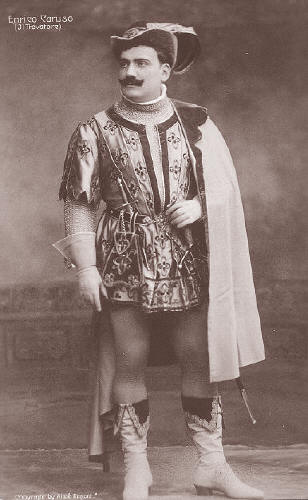
Caruso as Manrico
The dramatic use of opera in novels dates back at least to the Romantics, with Flaubert's Madame Bovary a justly famous example, and Dumas père's Le Comte de Monte-Cristo a less famous but equally fascinating one. (If you have favorite examples of opera evoked in prose, please share them!) I've been particularly intrigued by Chee's treatment of Il Trovatore, an opera he describes as "a tragedian's sleight-of-hand." The poignant ballad "Deserto sulla terra" he describes as perhaps the most beautiful song ever written for a man... which of course led me into a process of re-exploring the opera and this aria.

Tuesday, May 31, 2016

Reading List: The Real Traviata

René Weis' new monograph on Marie Duplessis makes big claims even before getting past the title page. Marie Duplessis, the charismatic and consumptive courtesan of nineteenth-century Paris, has long fascinated readers of Dumas' novel and lovers of Verdi's opera... to say nothing of Garbo devotees. I'm not exempt from the fascination, and have been disappointed by the comparative dearth of scholarly attention paid to her. I was eager to see what Weis would make of her history and her legend.

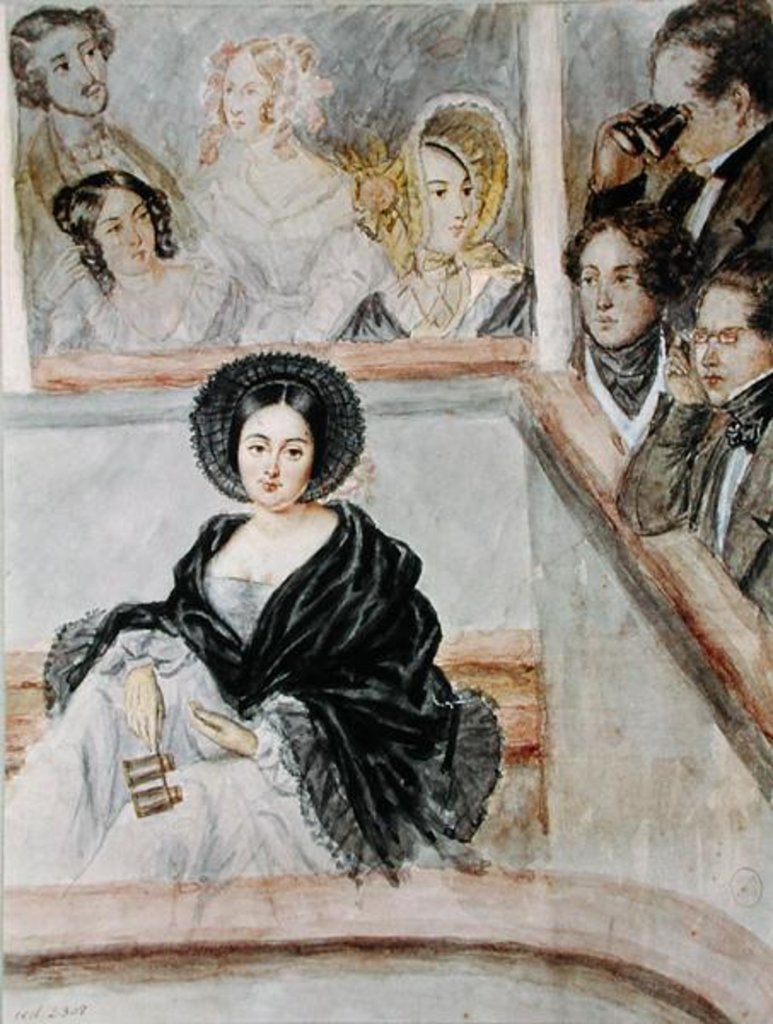
Marie Duplessis at the theatre
As should surprise no one, I'm always interested in recovering women's histories from their romanticized legends. Moreover, there are so many layers to the ways in which the character of Marguerite was created and recreated, that -- possibly with professional bias -- I felt eager to read an academic approach to excavating Duplessis' history. The possessions of Marguerite, auctioned in the opening of Dumas' novel, and that of Zeffirelli's Traviata film, are famously based on those of Duplessis. The edition of La Dame aux Camélias I read included a rather sentimental preface, retailing the nineteenth century's fascination with its own romanticized version of Marguerite/Marie's history. Personally, I think Dumas fils and Verdi are both much less sentimental than their reception gives them credit for. On the whole, Weis' work bears testimony to remarkably resourceful research in attempting to create an accurate portrait of Marie, using her own correspondence, the testimonies of contemporaries, and a wealth of detail about the world in which she lived: riding horses, furnishing apartments, and, not least, consuming culture, as a regular attendee of the opera and theatre, and an avid reader. I was fascinated by this vision of an intelligent woman, both sincerely enjoying a variety of pursuits, and crafting, as a demimondaine, an elaborate public persona. The Real Traviata is an impressively researched work; Weis mined multiple archives for diverse sources, and uses Duplessis' laundry lists, library inventories, and shopping receipts take their place alongside her extensive correspondence, and the posthumous narrative sources which are at once challenging and indispensable. The book is available here, for 30% off the list price with this code: AAFLYG6

Saturday, August 8, 2015

Opera Obsession: the wilderness year(s?)

Brace yourselves, Gentle Readers: this post may be answering a question nobody is asking. The question is: what is happening to this blog? If you are regular readers (bless you, I don't deserve you) you may have been asking this for some time. Herewith, I attempt to answer... and I ask some questions of you, in turn. As I've mentioned on occasion, I'm working on a Ph.D.; somewhat to my own surprise, the longer this degree goes on, the greater the amount of my time it seems to absorb. Less surprisingly, the longer it goes on, the more impecunious I become... and the larger the realities of job-hunting loom on my horizon, restraining my natural impulses towards the purchase of opera tickets. So much for the recent past of this blog; now for its immediate future. Being temporarily without funding, I have been forced to leave NYC for the coming academic year. I hope this is only a temporary exile; justified though I feel my complaining about the Met's excessively conservative programming to be, it's not the only show in town, and I will miss the city's rich operatic offerings, from the site-specific productions of new and rare works at Gotham Chamber Opera, to the intimate and creative work of Amore Opera, to the Bronx Opera in my own borough... and beyond. So, what will I be doing with this space? This, Gentle Readers, is where I ask for your input on my ideas.

Thursday, December 22, 2011

Nights at the Opera: 2011

Time blurs strangely together towards the end of the academic term, and I can't quite believe it's late December already... but I seem to have seen my last opera of the year, so it must be true. To cheer the longest night of the year, here's 2011's non-hierarchical, gleefully subjective round up of some of the past year's highlights: great nights, standout performances, and exploring the city's many opportunities for opera.

5 Great Nights

Not without difficulty, I've picked out a handful of the nights that reminded me of opera's glorious possibilities, by surprising me with their musical excellence and emotional immediacy. In alphabetical order:

Atys, Brooklyn Academy of Music. I saw this glorious gem in September, and it set a standard that the rest of the autumn never quite reached. The ensemble work of Les Arts Florissants was precise, elegant, and passionate, evoking seventeenth-century splendor and creating timeless enchantment. The production is now available on DVD.


Bluebeard's Castle, with the New York Philharmonic. Including a concert performance may seem like bending the rules, but so much of Bluebeard is about perception and imagination that I thought it worked well. Lighting was used well, and the musical values were superb. Esa-Pekka Salonen drew fiery and subtle playing from the orchestra, Gabor Bretz was a charismatic Bluebeard, and Michelle DeYoung a stunning Judith, emotionally rich and vocally luxurious.

Don Giovanni, with the Budapest Festival Orchestra. This production, seen at the Mostly Mozart festival, has been the year's most talked-of among my friends, often to the detriment of more costly and less creative endeavors. Ivan Fischer was behind the idea which had the cast clad in contemporary evening dress, moving among dancers who formed the sets, reflecting the titular antihero's view of the world. There were allusions to classicism and romanticism, there was very fine singing, especially from Laura Aikin as Donna Anna, and Fischer led the BFO in a hair-raising, fire-and-brimstone reading of the score in its Prague version.

Die Walküre, at the Met under James Levine. I'm breaking a bigger rule here, and ignoring the (non-)contribution of the production. But the performances I saw gave me a list of indelible moments--the twist of anguish in grüße mir Wälse, for instance--and their dramatic sweep was irresistible. The orchestra gave of their best under Levine's leadership, and the performances were deeply moving, from Siegmund and Sieglinde's first entranced encounter to the finale through which I sobbed. Twice.

Wozzeck, another highlight of Levine's curtailed spring schedule at the Met, a stunning, searing performance of Berg's claustrophobic masterpiece. All of the singers inhabited their roles fully, and sang them excellently.

Saturday, August 27, 2011

Mistress, Queen, Romantic Heroine: The Many Roles of Anne Boleyn

Anne Boleyn: 16th century portrait
Anne Boleyn has proved as fascinating to posterity as she was to Henry VIII.  Scholars and dilettantes, poets and painters, have been fascinated by the second of the (in)famous English king's wives, the first to be executed... and that after accusations of plotting regicide, and committing adultery with no fewer than five men, including her own brother.  The subject is temptingly sensational, as a glance at a list of fictional works concerning the unfortunate queen demonstrates. The debates are virtually inexhaustible: how credible did the charges against her have to be? were they only a means to a desired end? desired by whom? I won't pretend to answer all these questions, but in honor of the 1 month countdown to the Met Opera's season opening performance of Donizetti's opera (I'm excited!) I present a brief summary of Anne's political and posthumous career.

Among the many historical inaccuracies of Donizetti's thoroughly Romantic opera, perhaps the most striking is the unanimous sympathy expressed by the chorus of courtiers for the queen herself. In actual fact, the factionalism of Henry's court was lively, bitter, and, in some scholarly interpretations, the chief cause of Anne Boleyn's downfall and eventual death.  During the years of Anne's favor with the king (longer than their marriage) members of her family and their allies were granted influential positions; such influence attracted envy, and in the years of Anne's uneasy position as Henry's mistress, it would be all too easy to claim that the king's judgment had been led astray by his passion. Even after her marriage and accession to the throne, even after the death of Katherine of Aragon, there were those who persistently referred to her as "the Concubine." What of Anne herself? Much ink, scholarly and otherwise, has been spilled in attempting to analyze her character and her motives. I personally find her more credible as player than pawn.  In fictional accounts of her story, naturally enough, legal innocence has been equated with good character, the definition of which is, of course, relative.   Modern novelists have read between the lines of her story to find a vivacious heroine whose attempts at self-expression and self-assertion brought her downfall.  For the Romantic movement which influenced Donizetti, however, she was a heroine of a very different sort.

Monday, January 3, 2011

2011: The Delights of Anticipation

I am currently making lists of all the operas I want to attend in the coming months, instead of lists of the hundreds of books I will have to read before comprehensive exams in the fall.  Ah well.  The Twelve Days of Christmas aren't over yet, so I'm digging my heels in and luxuriating in holiday relaxation.  One niggling question is: do I want to play a rousing game of "collect them all!" with the Met's current season?  I am not feeling particularly inspired by Armida, but should I go for the sake of coloratura?  Despite having seen Tosca twice last season, I might go again for love of Sondra Radvanovsky (I've seen her in Trovatore and Stiffelio, and she was fabulous both times.)  There are other will-I-won't-I debates, but I'll spare you my dithering, and borrow a thought from Likely Impossibilities: if there are Met or other NYC operas that you think I absolutely must not miss, let me know in the comments and I'll do my best to fit them into schedule and budget!

Friday, December 31, 2010

Nights at the Opera: 2010

Fast away the old year passes.  So, what were my favorite nights at the opera in 2010?  Although it's not as organized or as hierarchical as a top ten list, I have come up with five favorite everything-has-gone-right nights, and five standout performances, from a whirlwind year of becoming increasingly obsessed with opera.

Tuesday, November 2, 2010

Oh, sventata, sventata, la chiave della stanza...

I had planned, Gentle Readers, to venture forth to Don Pasquale tonight, as the Met's cast bids fair to handle Donizetti with vocal and comedic agility.  However, the door to my own bohemian garret, never what one could call straight on its hinges, has developed a problem with the lock.  So, until Benoit, er, my landlord gets around to dealing with it, the Beloved Flatmate and I are taking turns sitting at home to let the other one in from the cold world of the library and lecture hall.  No Opera Outings for us.  My apologies for the unexpected hiatus... in addition to Don Pasquale, Intermezzo and Così are planned for the near future.

Saturday, October 2, 2010

Interval Adventures: traditionalists and twentysomethings

Verdi, portrait by Giovanni Boldini, 1886
At Rigoletto on Wednesday night, much of my energy was occupied with herding ducklings (i.e. one undergraduate and two freshly-minted M.A. students who were enthusiastic opera novices) in the intervals, but this paid off, as their reactions to the evening ranged from quite pleased to rhapsodic and starry-eyed.  To be fair, they didn't really need herding, but I felt a sense of Solemn Responsibility, as well as the enthusiast's desire to make sure they saw "The Triumph of Music" and benefited from the Ezio Pinza water fountains.

In the second interval, we encountered a startling apparition.  He was full of Dark Prophecies about the Future, yet personally, as he told us, from the Past.  The beloved flatmate and I decided on Imprecating Opera Specter as his official title.  The I.O.S. materialized at our elbow to tell one of our ducklings, who was (rather touchingly over-)dressed in his family tartan, that he should really be at Lucia di Lammermoor.  "I have been coming here for decades," he said, rather lugubriously, "and it used to be that everyone on stage was dressed that way."  I pointed out that Mary Zimmerman's production still had the chorus in hunting costume, if non-ubiquitous kilts.  Or I started to.  "Do not mention that name!" boomed the Opera Specter.  "That woman is death!"  He then unleashed upon the bewildered opera ducklings a torrent of invective against all the "minimalist, abstract, updated, modern Eurotrash" which creeps into the Met like a disease.  "Mary Zimmerman!" he exclaimed, returning to his original target.  "And her ilk.  They make a nonsense of the works.  I hope you're not her daughter!"  I took my opportunity, and spoke up. "When it comes to La Sonnambula," I said, "I thought that it was less coherent and therefore less effective than it could have been.  But Lucia, while it may not be a brilliant production, I thought was inoffensive."  (I don't think it's brilliant, but I rather liked the incorporation of the over-the-top Gothic visual vocabulary of Sir Walter Scott and his contemporaries.  Whether through silent cowardice or discreet valor, I did not say so.) "Well," said the I.O.S., "well, you're right, it wasn't too bad."  And he melted away to his seat, leaving the beloved flatmate and me to opine, sotto voce, to the ducklings that things could be minimalist without being abstract and modern without being either, and that no aesthetic had a monopoly on bad productions.  It was quite an adventure.

Saturday, July 24, 2010

Summertime, and the livin' is easy

A week of blog silence, and what do I have to show for it?  Well, a revised syllabus for a course I'm teaching in the autumn, for one thing.  But of course hours spent debating the merits of potential reading assignments don't have to take place in silence.  Cecilia Bartoli, (who, I am tempted to believe, can do no wrong) has a record of Mozart arias which, to me, is the aural equivalent of a really, really good cappuccino, at once soothing and stimulating (effortless vocal acrobatics like perfectly steamed milk?  Maybe that simile shouldn't be stretched too far.)

Last Sunday, I was given a real treat: not only did I get to see the exciting 1970 Karl Böhm Fidelio for the first time, but I got to do it in the company of a friend who was at least as excited about it as I was.  The extreme closeups of the television filming I found occasionally jarring (possibly in part because of Marzelline's anachronistic eye makeup?) but it was a moving performance.  Josef Greindl's Rocco, here, I found much more vivid and engaging than in the 1963 video I mentioned earlier.  My heart still belongs to Christa Ludwig, but Gwyneth Jones' Leonore was fresh of voice and firm of purpose (go here for her "Abscheulicher!")  James King's Florestan was, I thought, of irresistible vocal beauty.  The chorus wowed me: they were lump-in-the-throat expressive as well as impressively precise, and not only that, but the prisoners' pathos survived the camera close-up with flying colors.  Böhm's orchestra seemed to be an expression of the characters' heartbeats, their most private thoughts translated into sweeps of sound.  A few of the spoken dialogs were omitted, and I missed them (I like my Singspiel!) but the entire thing had a breathless emotional urgency which I loved.

Tuesday, July 13, 2010

Il faut relire ensemble

I really do have other interests besides opera and the study of medieval history... cooking, for instance, and fencing, to cite examples which may add verisimilitude to an otherwise unconvincing narrative.  But sometimes my opera obsession will not be sated by recordings alone.  Being an avid reader of novels whenever possible, I turn to fiction, with, so far, mixed success, but mostly a lot of searching without finding. Gentle Readers, do you have favorite novels which touch on this favorite art form?  Recommendations are eagerly solicited.  Some of my discoveries are below.

Monday, June 28, 2010

Tout autour de toi


I'm still an opera review in arrears (Massenet's Manon at Rome's Teatro dell'Opera) but have mysteriously contracted consumption, or at least an illness which prevents me from being able to think clearly or having the desire to do anything, really.  However, to cheer myself up, forthwith some happy reminiscences.  One might think that a trek of several hundreds of miles through the farms and villages of northern Spain might not be the most likely place to meet opera-lovers.  And yet... I did!  Pictured above is the courtyard of a pilgrim hostel in the tiny town of Rabanal del Camino.  On this day of walking, I was a bit injured, so lagged behind and ended up falling in step with Claudine, a retired French nurse with whom I ended up discussing life, death, botany... and opera!  In her retirement, she is taking Greek and singing lessons (impressive!)  So we sang together, a French pilgrim song she taught me, and then (with mixed success on remembering the words, but with gusto!) the Habanera and Seguidille.  We also discussed how much we like Cecilia Bartoli, of whom I attach a video because one can never have too much Cecilia Bartoli.

Friday, June 25, 2010

Nun lass' ich ruhn den Wanderstab

I admit, it feels very strange to be back in the Bronx, in front of my laptop. This was, of course, the first thing played on my stereo this morning (returning to New York last night, I did little more than drink water, take a shower, and collapse into my own sheets.)


The Camino de Santiago was beautiful. In the event, the choice to take two weeks to become gradually re-accustomed to cities, large numbers of people, and motorized transport proved most fortunate. It seems very strange to think, on the one hand, that the time of walking took only just three weeks; but it also seems strange to reflect on how much has happened in the world, and the various communities I left behind, in that time.

The concept and practice of pilgrimage shelters a number of strange ideas and strange practices. I do feel that I had many experiences which can be communicated only with difficulty, if at all. But although there was much about walking the camino that seemed mystical, and the transcendent came in unexpected ways, it also felt like the most natural thing in the world. I'm already feeling as though I'm sounding either sententious or impenetrable, or possibly both. So I'm going to stop writing and post some pretty pictures.

Wednesday, May 19, 2010

Zu dir wall' ich

On short notice, I must announce a long-planned, but still insufficiently prepared-for interruption in the torrent of opera-obsessed posting here. The reason is an exciting and terrifying one. I am leaving tomorrow to walk 300 miles (480 km) in about three weeks, on the Camino de Santiago in northern Spain. After that, my flatmate (faithful companion in opera-going, among other things) and I are planning to spend a little less than two weeks taking advantage of having paid for airplane tickets to our ancestral continent. Nebulous plans include Rome (hopefully with Massenet's Manon!) and Paris. Of course, the stress of writing papers and going to an enormous, exhausting academic conference has kept us from booking any sort of accommodation. So we will have adventures! and presuming I'm still in one piece, things should pick up again here in late June.

Friday, January 15, 2010

Chi son? Chi son?

My name is Lucia, but no one calls me Mimi. I can't answer the question of how I came to be interested in -- obsessed with -- opera except very vaguely, or through reciting a string of small anecdotes so long as to create tedium for the listener. I only know that I retain surprisingly sharp memories of the tidbits of opera which I was fortuitously exposed to in my youth, via public television broadasts or creaky VHS tapes. I had an upbringing steeped in classical music, with opera being a strange exception, represented only by a handful of LPs. Maybe it was partly the frisson of the forbidden which roused my curiosity. Maybe it was simply the beauty of the music which accompanied the public radio scheduling alerts during the French program I listened to on Saturday mornings though high school.

Si Puo?

Almost any introduction seems overly grandiose for a blog intended to fulfill a very personal desire: sharing what I love about opera, and what I'm learning about it. Why not keep an opera journal instead? Because I believe that you, ladies and gentlemen, signore e signori, sehr geehrte Damen und Herren, mesdames et messieurs, fellow opera-lovers or skeptical opera-avoiders, have a lot to give me. This might mean taking a second to confirm across cyberspace that you, too, get choked up every single time you hear "O hehrstes Wunder!" It might mean correcting me in egregious error (please do!), or exulting in some semi-obscure tidbit, telling me you think I'm dead wrong (or right), or sharing something--a name, a recording, a resource--that I haven't found yet. Whatever it may turn out to be, I am excited by the possibilities. Andiam!

LinkWithin

Related Posts Plugin for WordPress, Blogger...