
Showing posts with label Fanciulla del West. Show all posts
Showing posts with label Fanciulla del West. Show all posts
Sunday, September 13, 2015
Jonas Kaufmann's Puccini album: making the familiar unexpected


Thursday, March 28, 2013
Aspergimi d'issopo e sarò mondo: Puccini's "Girl" and her gospel
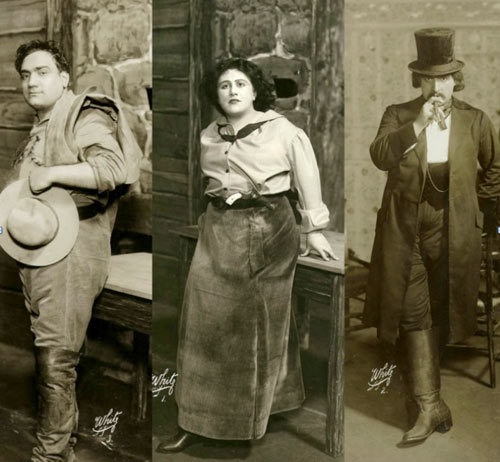 |
| Fanciulla del West's first cast (1910) |
 ) that this text and Minnie's gloss of it provide brilliant foreshadowing and a point of reference for Minnie's own growth over the course of the opera. Her confidence that no one lies beyond the reach of redemption is challenged when her idolized hero, the gallant Johnson, is revealed to be an infamous bandit, no common thief but the leader of a gang. Minnie's used to seeing--and cultivating--the good in the rough-mannered and often desperate miners. And it's not, in the event, the fact that Johnson is a bandit on which her confidence in her own worldview shatters; this she forgives him, after recovering from her first shock. But that the man to whom she has given her long-guarded heart should have lied to her, should have abused her innocence... this she cannot accept. That she finds her way--first by instinct, then by reason--to the truer understanding of grace which enables her happy ending is celebrated in the triumphantly lush orchestration of the opera's finale. But this scriptural reference does not occur in isolation; Puccini's penultimate opera is imbued throughout with spiritual language. Minnie speaks of wanting to knock at the threshold of heaven, riding in the mountains; the man she loves is constantly calling her blessed. I have a theory that biblical echoes are used by the composer in providing an alternate foreshadowing: a dark vision of the future which Minnie and Johnson only narrowly avoid. Brace yourselves, Gentle Readers, as I wade again into the murky waters of opera and religion.
Thursday, September 1, 2011
Dov'è eravamo? September miscellany
September is upon us, Gentle Readers, and with it the return of additional academic responsibilities. This autumn will be the second half of my preparation time for the oral exams for which I have been studying throughout the summer. I'm also teaching two classes, full to bursting with students who need to acquire skills, and who I hope will acquire some enthusiasm for the subject. I know, it's nothing to do with you... except that all this activity will probably result in a somewhat pared-back blogging schedule. The other possibility is that I will go slightly insane and attempt to take refuge in my familiar rituals of attending classical music events, resulting in a frenzy of emotionally overwrought responses to same. Stay tuned to find out what happens! In any case, I'll be enjoying the glorious golden weather and the autumn fruit, and I hope you'll be able to do likewise. I'll take this opportunity to note that subscribing to posts in some form (whether by RSS feed or following the blog) will save you the trouble of checking back for posts that aren't here. For now, though, Gentle Readers, I leave you with Keats and Rilke, and one of the few lesson scenes in opera which does not involve disguises and/or crazy hijinks.
Monday, December 20, 2010
Fanciulla bis

Sitting in the balcony instead of family circle, I got a better view of some of the production's lighting effects, which worked nicely both to evoke the passage of time in this opera which is so shaped by it in the libretto, and to underscore the dramatic trajectory. I am still bothered by the production's fussiness. I saw more clearly this time why the bar brawl starts: I think it's touched off by an inebriated fellow at the bar. I still don't think it makes a lick of sense (to borrow the idiom of the genre.) And I really dislike the fact that Minnie is made to brandish her Bible in Act III. I think it takes away from the celebration of how unexpectedly disruptive the transformations effected by transcendent moral pronouncements can be. A few touches were altered: Nick's handing a Havana cigar to Johnson/Ramerrez at the end was more subtly handled, and therefore more sweet than distracting. And Rance, in that final tableau, picks up Minnie's pistol but doesn't level it at the lovers, rather staring at it like a man who has lost his bearings, then sinking to his knees, devastated.
Monday, December 13, 2010
Whiskey per tutti! Fanciulla Centennial at the Met

 , in college, my sophomore self just couldn't get past California miners shouting "Hello! Hello!" and singing rousing choruses of "Doodah doodah day" in a Puccini opera. The lexicon of John Wayne films meeting Puccini (and exciting, experimental Puccini at that) threw me for a loop. But I kept listening (finding Corelli, Frazzoni, and Gobbi
 along the way,) and I'm glad I did; I love the sweep of the music and its rich harmonies, and the drama keeps revealing more details. So I was thrilled to have my first live Fanciulla one hundred years to the day from its premiere at the Met. (There's a nifty website in honor of the occasion with all sorts of goodies--interviews, pictures, scholarly articles!--which I just discovered this week.) I had some quibbles with the production, but Nicola Luisotti cherished the details of the score, the Met chorus made a great camp of miners, Marcello Giordani was a very sympathetic bandit, and perhaps most importantly, Deborah Voigt sang and acted Minnie with a commitment which made it clear that she loves Minnie, and believes passionately in her courage and its significance.
Subscribe to:
Posts (Atom)
LinkWithin
