
Showing posts with label Dmitri Hvorostovsky. Show all posts
Showing posts with label Dmitri Hvorostovsky. Show all posts
Tuesday, April 28, 2015
Don Carlo: il di tremendo


Friday, March 8, 2013
Don Carlo: lo spirto che vacilla
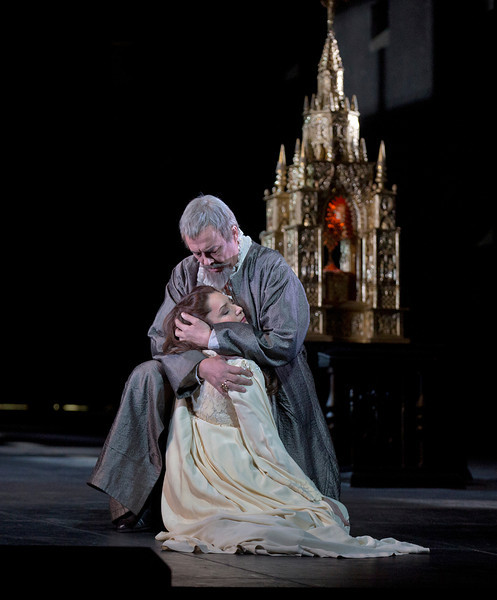 |
| Filippo (Furlanetto) mourns what might have been. Frittoli is Elisabetta. Photo (c) Met Opera |
Sunday, November 25, 2012
Un Ballo in Maschera: Nell'ombre si matura
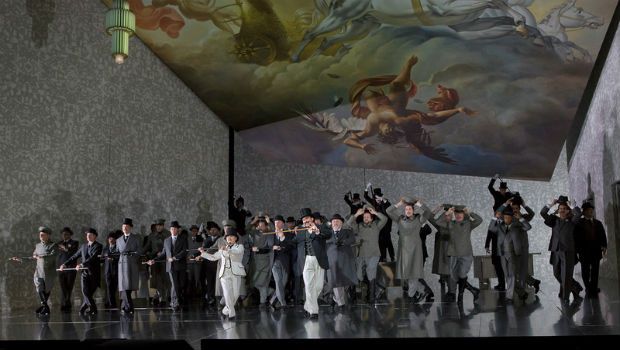 |
| The recklessness of frivolity: David Alden's dark Ballo (Act I) |
In Alden's production, it is the recklessness of Gustavo (his hamartia) which drives the action. The pleasure-loving and self-dramatizing monarch flirts with the contempt of the conspirators, openly mocks the insight and the power of Ulrica (clearly he's never read the classical dramatists), dismisses his friend's advice and undervalues his courage, and isn't even particularly interested in understanding Amelia. The frivolous page, Oscar, is established as a sort of alter ego to the king: he is an Icarus figure in the staged prelude and at the masked ball, expressing his monarch's emotional states throughout. Alden emphasizes Gustavo's flaws, but does not neglect his genuine generosity, which is praised by all in the denouement. The moods and morals of the evening having been expressed in shades of grey, I was surprised by the light-flooded triumphalism of the finale, but like many an old Hollywood ending, this one leaves the future uncertain. Incidentally, the sinister splendors of the final scene (think Litvak's Mayerling
 ) should show the Met audience that spectacle doesn't have to come coated in glitter or burdened by brocade.
Thursday, April 19, 2012
Della traviata sorridi al desio

Among the heartless party guests, Kyle Pfortmiller distinguished himself as the Marchese d'Obigny, with a distinctive, richly-colored sound. Luigi Roni's Grenvil had forceful presence, and nuanced the tone of his silent interactions with Dessay well; it caused a shiver when he finally sang. Maria Zifchak was a vocally solid and sympathetic Annina. Dmitri Hvorostovsky did not seem to be at his effortless-sounding best but still sang a charismatic, vocally rich and dramatically nuanced Germont père. His interpretation offered chilling insights. A question begged by the libretto is, if Papa Germont knows how great the sacrifice he asks of Violetta is, if his opinion of her is transformed, what keeps him from reconsidering? Hvorostovsky answers this question: he really doesn't believe her. All Violetta's utterances are interpreted through what he "knows" about her already. He laughs at her--laughs!--when she says she's dying; for him, speaking of her sacrifice is a charade of good manners, helping her maintain a polite fiction of virtue. It is only at the very end--"Addio"--that his confidence is shaken, as he turns for an instant to regard her, his hat already in his hand. His scene with Alfredo I found very moving. Hvorostovsky's pause at the threshold, contemplating the stripped furniture, raised the possibility that he had come back to stop Violetta; at the least, he's surprised to find her already gone. "Di Provenza il mar il suol" was luxuriant, with the radiant sun of Alfredo's native soil in his father's voice. Not without reason, Germont is convinced that his plea to his son cannot fail. This aristocratic assurance was equally apparent in the finale of Act II, and aptly shaken in Act III, although the dignity of his bearing and authority of his sound were undimmed.
Saturday, February 11, 2012
Ernani: Ogni cor serba un mistero

Verdi's Ernani, a politically provocative opera which enjoyed great popular success in the years following its 1844 premiere, exists today only on the fringes of that portion of his oeuvre likely to be known through performance. The thrilling edginess which Verdi and his audiences saw in the plot (based on a play by Victor Hugo) can be obscured by its manifest implausibilities. But the music is engaging and imaginatively melodic, and Verdi's capability of suiting musical convention to the needs of his drama (and making it bend to do so, if necessary) is displayed advantageously. Pier Luigi Samaritani's 1983 production for the Met tends towards the ponderously monumental, but the cast of the current revival ensures this Ernani is an exciting night at the opera.
I admit to being relatively unfamiliar with Ernani's score, but I was pleasantly surprised by the energy and attention to detail which Marco Armiliato and the orchestra brought to it. Dramatic momentum was admirably maintained, and significant details emerged eloquently. The chorus had restrictive choreography, but contributed solid, vigorous singing, notably in the patriotic Act III chorus, "Si ridesti il Leon di Castiglia." Noteworthy was the contribution of tenor Adam Laurence Herskowitz in the role of Don Riccardo, the king's messenger. He conveyed an appropriate sense of urgency to his various announcements, with a clean, ringing sound and good diction. The opera centers, however, on the relationships--intensely personal and inevitably political--binding the four principals.
Wednesday, February 2, 2011
Boccanegra! Boccanegra!

Subscribe to:
Posts (Atom)
LinkWithin
