Showing posts with label Simon Keenlyside. Show all posts

Sunday, May 24, 2015

Reading List: Master Singers

I jumped at the change to review the recent volume: Master Singers: Advice from the Stage. The structured collection of commentary from professionals at varying stages of their careers is designed to bridge the gap between academic methods of singing learned in the studio, and the practice of singing on the opera and concert stage. This is not to remove one jot or tittle of the law, but rather to add to it. Advice from a starry host is then thematically organized by chapter, which adds to its usefulness for the singer. Enthusiasts, like myself, might find the most interest in the first three chapters, as they focus on the craft that results in what we see and hear.

The text is edited by Donald George and Lucy Mauro, a singer and a pianist, respectively, and both professors. A lot of work has clearly gone into this, as the chapters are subdivided into helpfully specific sections on, e.g., passaggio. Each such section is framed by a question posed to the singers--whether in person or in writing--who could then choose whether and at what length to respond. (The introduction observes, naming no names, that some answered every single question, which strikes me as positively saintly.) The conversational tone of each singer seems to be preserved with often startling immediacy; George and Mauro say that they edited the singers' words as little as possible.  The contributors, as well as topics and operas covered, are indexed and cross-indexed for reference. Although Americans predominate, the singers come from a variety of linguistic and national backgrounds, offering a helpfully diverse range of experiences and traditions. Christine Goerke, for example, in responding to a question about creating varieties of tonal color, observes that "Americans have fallen into this 'make beautiful sounds all the time' thing." Singers from multiple fachs respond, and David Daniels and Ewa Podleś add the perspectives of countertenor and contralto to those of sopranos, mezzos, tenors, baritones, and basses.

Tuesday, November 20, 2012

Er läuft wie ein offenes Messer durch die Welt: Salonen leads Wozzeck at Lincoln Center

Twentieth-century trauma: Simon Keenlyside as Wozzeck
Photo (c) Lincoln Center/Stephanie Berger
The performance of Alban Berg's Wozzeck given by Esa-Pekka Salonen and the Philharmonia orchestra on Monday was of a lucid beauty that did nothing to diminish the impact of the work's bitter, brutal narrative. Salonen and the orchestra gave a reading of the score that was dynamically and expressively nuanced, richly textured without being dense. The relationship between orchestra and singers was symbiotic, creating an atmosphere that was unremittingly intense throughout the changes of mood between scenes. In the performance of Simon Keenlyside in the title role, the anxiety and anguish present throughout the opera seemed to find their distillation.

Wednesday, October 24, 2012

Something rich and strange: Adès' Tempest at the Met

Opening of the Tempest  Photo (c) Met Opera/Ken Howard
In the mythical, mystical world of Thomas Adès' Tempest, there are rich aural experiences associated with the island and its denizens: wild storms and eerie calm; smooth, politic betrayal and innocence so profound as to be unwittingly cruel. Allusive orchestrations are given unexpected twists. In the overture--a tempest that drew on the storms of operatic history while possessing a distinctive texture--there were echoes of late romanticism in the brass, and perhaps inevitable reminiscences of the sea interludes from Peter Grimes. The orchestra is also used creatively to evoke different characters and their emotional states (sometimes in ways that seem at odds with the doggerel libretto.) Caliban, on the rare occasions when he isn't in coercive situations, has some of the most beautiful music in the opera. Ariel gets unearthly winds, Ferdinand and Miranda gracefully intertwining lines, the courtiers of Milan and Naples more formal exchanges structured around declamation. These rich dynamics (which cannot be easy to create with both precision and impulsive energy) were richly realized by the Met orchestra under the baton of the composer. Despite all this excitement, the dramatic pacing of the opera seemed uneven to me. After the stormy beginnings, the action seemed somewhat becalmed until the second act. My perception of this, however, may have been adversely affected by the production, which had Miranda and Prospero sitting alone on a slightly raked stage for most of Act I, where others came to join them. The prompter's box, of course, belongs to Prospero.

Robert Lepage's production (located often inside a model of La Scala as it was in the eighteenth century) was not infrequently thoughtful, but it was not coherently so. Many of its most interesting ideas appeared in the final tableau, where I saw for the first time serious engagement with the reasons for presenting the drama inside an opera house. The chorus exults in their pardon: do we go to the opera to get our sins forgiven? Do we need to go through the harrowing of hell to receive this absolution? Ferdinand and Miranda are radiant and radiantly illuminated on the stage. Is this what we want to be promised--the future of the young lovers--at any cost, and no matter how artificially engineered? Here (at last) it became fully apparent that Prospero's theater is a trap to him as well as to those he manipulates with and in it. For the most part, however, I couldn't see that Lepage was doing much beyond spatially confusing the narrative. If layering of narratives was going on, I couldn't make it out: however artificial the tableaux he stages, Prospero's dilemma, and his corrosive anger, are stunningly real. Some of the incoherencies must be attributed to the plot as well as the production. Why is the full court of Naples (and Milan) under sail? And why does Prospero drown them only to resuscitate them? The further question raised by Lepage's production--what does this say about the reanimation of the dead by theatrical art--was left hanging. Caliban also fared badly; the production clad and choreographed him as a simian savage, and the rest of the island inhabitants fared not much better. (I literally cringed during some of the dance sequences; postcolonialism takes harder work than casual appropriation of stereotypes.) The libretto, too, though significantly altered from the Shakespearean plot  (and replacing his verse with halting rhymes) has Caliban as lustful, treacherous, gullible, and prey to base desires. Those who denigrate him can of course be viewed as unreliable and manipulative narrators, but this doesn't fully solve the problem. The sea-change the drama undergoes at the hands of Adès and librettist Meredith Oakes creates scenarios rich and strange indeed.

Tuesday, August 14, 2012

Viva la liberta: Don Giovanni at the ROH

Keenlyside as Don Giovanni.
Photo (c) Catherine Ashmore
I confess I approached the DVD of Francesca Zambello's Don Giovanni for Covent Garden with some skepticism. For one thing, I wasn't sure how Zambello would handle a work of Don Giovanni's density. For another, I had trouble imagining Simon Keenlyside's assumption of the Don. Keenlyside is an accomplished and intelligent musician whom I've been moved by in a number of roles... as thoroughly nice, if not actually self-sacrificingly noble characters. My skepticism, however, proved unjustified. It takes a little time for Zambello's directorial perspective to become clear, but the story that she has Mozart's opera tell is an interesting one, with the three women as joint protagonists with the Don himself. (This works surprisingly well.) And Keenlyside, in addition to singing with elegance and gusto, created a thoroughly amoral Don: cunning and exuberant, and boundless in sensual appetites (until the curtain calls, when he gave his Leporello an impromptu bear hug and helped the frail Sir Charles Mackerras on a step created by the sets. Niceness will out!) That said: the production may judge Don Giovanni too charitably, and I may judge the production itself too charitably, having been recently bored and bored again by Michael Grandage's kitschy creation for the Met. These caveats in place, I must say that I thoroughly enjoyed it. More subtle visual cues could have helped put across more precise ideas, but the casting was very fine, Mackerras' conducting was a joy, and the singers were admirably committed to portrayals of their characters specific to Zambello's concept.

Tuesday, October 25, 2011

Poetry in the Pity: Britten's War Requiem with the LSO

I was not in the forefront of the standing ovation for Sunday's performance of the War Requiem. This was because I was shaking and my legs had gone rubbery. My Really Shameful Confession is that, in listening to recordings, my admiration for the ambition and intelligence of the piece remained somewhat detached, not to say dutiful. The reading provided by Gianandrea Noseda and the London Symphony Orchestra was taut and unsparing. Strings shivered; there were fearful fanfares and sad bugles; the percussion was appropriately terrifying. There were angular, angry crescendos that were as much barbed wire as cathedral spires; pianissimi hushed with reverence, and hushed with fear. The London Symphony Chorus was likewise superb, with sharp diction, impressive dynamic nuance, and great attention to the needs of the text (the eerie "Dies irae" comes to mind particularly.) The American Boychoir, performing offstage, contributed sensitive work as well.

Wednesday, November 24, 2010

Ei segua il suo destin

Auto da fe: (c) Ken Howard/Metropolitan Opera
With some trepidation and a lot of excitement, I headed downtown to catch the Monday night premiere of Don Carlo at the Met.  I first got to know Don Carlo through what may loosely be called my pre-blog modus operandi: I grabbed a recording in the library because it was there and looked good, found the libretto online, and listened (over and over and over again.)  Nicholas Hytner's production was elegant and emotionally powerful, with stylized sets that recalled the Escorial (and environs) while evoking a powerful sense of a fate that approached inexorably, and imprisoned the complex men and women who struggled so furiously against it.  Here Nicholas Hytner talks about his sense of the opera and his interpretive goals.  In the first (Fontainebleau) act, for instance, it is winter, and a black path cuts a stark zig-zag path through the snow.  Neither Carlo nor Elisabetta use this route, entering; but having agreed to become Filippo's wife, she is carried down it in procession.  The prison-like nature of strong walls with small windows was effective throughout the rest of the opera (such a wall ascending and descending to divide the space of the stage also made scene transitions seamless.)  The set for Elisabetta's garden I found jarring and strange; but that was an exception.  Against this sleek, streamlined backdrop, the costumes and furnishings were deliciously detailed.  Photos from the dress rehearsal may be found here; I'll add more as soon as they're available.  Hytner was on hand to guide the Personenregie (is there an English word for that?) and it was amazing, drawing out the complexities of all the characters, including a hard edge for Martyr to Duty Elisabetta.

Yannick Nézet-Séguin's conducting was, of course, fast, but it was not merely fast.  The orchestra did occasionally outrun the singers, or at least (to my ears) rush them, and did occasionally threaten to drown them.  But there was drama in the pacing, not a mad rush through the score; details were pointed up, and the sheer sweep of Verdi's music was relished (I've said it before: I love the Met orchestra. Nézet-Séguin let them shine here.)  Despite the issues in balance and pacing, I was on the edge of my seat and holding my breath most of the night, so by that standard of measurement, they were doing something very right.  I worried for Roberto Alagna's Carlo during the first act, but whether it was an issue of nerves or warming up, things soon improved and I could relax.  It sounds like a relatively heavy role for him, but he delivered it with passion; he does have a beautiful timbre, and his nervy, anguished Carlo was sung with unflagging energy. "Io vengo a domandar grazia alla mia regina," and the subsequent scene, was a highlight.

Tuesday, April 6, 2010

Les plus sages sont les fous

Monday night's performance of Ambroise Thomas' "Hamlet" set me reeling, and not just--not even mostly--because I have the Shakespearean text quasi-memorized, its complex dramas held close to my heart. For one thing, I was taking in much of the music for the first time; NOT ideal, but what's a girl to do when the NYPL collections are non-circulating? For another, the Caurier-Leiser production was making a lot of interesting choices which kept me busily thinking. For another, the elegantly stylized costumes were making similarly provocative choices; Hamlet, for instance, was initially dressed in white (appropriately vulnerable and disheveled, pale as his shirt, but not in the trappings and the suits of woe), and Gertrude's hair and makeup were strongly reminiscent of a caricatured 1950s trophy wife. For another, there was the pungent, unmistakable smell of burning shortly before the interval... disquieting, especially when accompanied by the growing rustle of several hundred people shifting and whispering, the disturbance of several dozen people self-evacuating, and the businesslike, unanticipated activities of ushers in the darkness. The New York Fire Department was in evidence at the interval, but we were told that a light cover had begun to smoke and smolder but had been quickly doused with no danger to the public. A non-event, but added still further to the disquiet of the evening!

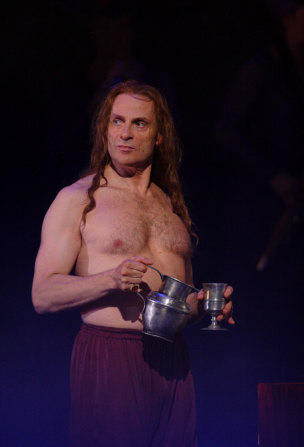
For it was a disquieting evening. The battlements of Elsinore might have been an innocuous stone gray slightly overgrown with moss, but their streaky color increasingly came to look like something stagnant, putrid... yes, rotten. The initially innocuous-seeming, even welcoming interior walls, with rosy brick and white paint gently netted with pink (suitable to Vaguely 19th Century setting) began first to look as though dripping with blood, and then began to inch closer to the protagonists, once literally swinging across to bar Hamlet's exit from a scene. "Denmark's a prison..." No liberty in this nutshell. This, the stark lighting, and the spare choreography made the whole thing a rather Brechtian (to use the term loosely) experience of being encouraged to sit back and think rather than lean forward and lose oneself. The banquet, appropriately in my view, formed the dramatic highlight of the evening, brilliantly staged with the "Murder of Gonzago" an obscene, offensive farce, shadows of dumbshow-king and dumbshow-queen looming grotesquely over the seated Claudius and Gertrude. When Keenlyside then leapt up onto the banqueting table and started scattering glassware, I think I stopped breathing, as he shouted and gibbered and repeated, chillingly, snatches of the drinking song he had earlier shared with the players. Here he is wrapped in the wine-soaked tablecloth. Different from Shakespeare. Shocking. Absolutely effective.

LinkWithin

Related Posts Plugin for WordPress, Blogger...