I love Virgil's Aeneid. Even moderate attention will reveal its rich imagery, and the exciting rhythms of its language. Closer attention reveals the brilliant balance between control and destructive passion, the unexpected twists that are exactly right, the detail which can seem almost onerously dense, until suddenly the moment comes that reveals its overwhelming collective power. Not otherwise, Berlioz's Troyens, also a work of vast proportions and great beauty, manages to weave together episodes of widely differing orchestral and dramatic textures into a whole packed with dense detail and unexpected musical twists, a whole that feels inevitable as perhaps only an epic can. Monday's performance at the Met, though, seemed an imperfect translation of this grandeur, too often halting, too infrequently reckless. Many of its elements were very good indeed, but the driving force to turn these into a satisfyingly overwhelming whole was lacking.
Francesca Zambello's production, while often visually striking, had a tendency to heavy-handed symbolism. Some of her choreographic choices, notably in the presence of other couples on stage during the Nuit d'ivresse, suggested the possibility of an anti-imperialist reading that would also address the gendering of conquest and the conquered... but I didn't find these developed strongly (to my disappointment.) That Carthage should look so like the feminized Oriental Other and then fail to get postcolonial reflections from the production surprised me. The successes--Hector's bloody spirit, the relationship between x and his young wife--were of lesser overall significance. Fabio Luisi's conducting caressed many of the beauties of Berlioz' score, and the woodwinds played with special sensitivity. I felt, however, that a sense of irresistible impulsion, even of impulsiveness, would have made the orchestral contribution much stronger as a whole. It wasn't as bad as translations that turn breathtaking enjambments into end-stopped lines, but it left a similar impression of opportunities lost. Still, there were moments when it kindled into brilliance.
Francesca Zambello's production, while often visually striking, had a tendency to heavy-handed symbolism. Some of her choreographic choices, notably in the presence of other couples on stage during the Nuit d'ivresse, suggested the possibility of an anti-imperialist reading that would also address the gendering of conquest and the conquered... but I didn't find these developed strongly (to my disappointment.) That Carthage should look so like the feminized Oriental Other and then fail to get postcolonial reflections from the production surprised me. The successes--Hector's bloody spirit, the relationship between x and his young wife--were of lesser overall significance. Fabio Luisi's conducting caressed many of the beauties of Berlioz' score, and the woodwinds played with special sensitivity. I felt, however, that a sense of irresistible impulsion, even of impulsiveness, would have made the orchestral contribution much stronger as a whole. It wasn't as bad as translations that turn breathtaking enjambments into end-stopped lines, but it left a similar impression of opportunities lost. Still, there were moments when it kindled into brilliance.


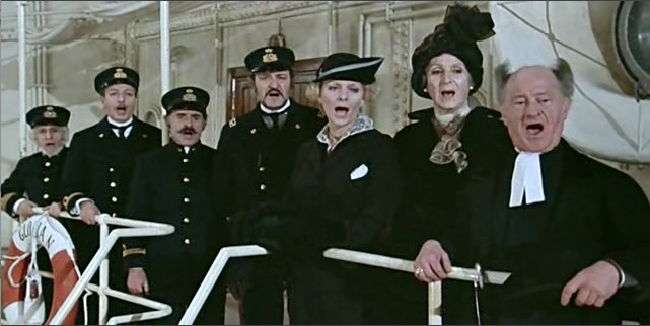
 " Now, this, I loved! Not only does it include musical extracts in an illustrative way, it sometimes gives them alternate texts (unfortunately for my inadequate Italian, they weren't subtitled, but I still found it fascinating.) The "normal" proceedings of the film often erupt into choruses at significant moments. And not only opera, but dreamy piano pieces, lively folk music, and even
