The recklessness of frivolity: David Alden's dark Ballo (Act I)
Although the visuals of David Alden's new Ballo in Maschera for the Met may be more impressive than its concept, I'm still prepared to count it as a laudable effort, and a welcome addition to the Met's generally conservative repertory of productions. I found some details questionable (e.g. dubiously consensual sex in the background of Ulrica's scene,) and some excessively literal in their symbolism (e.g. the king walking over an abyss in Act II, the three principals standing at the points of a triangle in Act III) but the concept, structured around the feckless king and emphasizing chiaroscuro contrasts, was functional, and notable for its attention to Verdi's score. Alden embraced the melodrama of plot and music, another characteristic shared with the films of the '30s and '40s which formed the production's aesthetic, but I found this often emotionally gripping, especially in the courtiers' mockery of Ulrica. As many of you may have gathered, Gentle Readers, I'd far rather see an idea executed with mixed success (or even a mixed bag of ideas) than a non-attempt at providing a meaningful staging.
In Alden's production, it is the recklessness of Gustavo (his hamartia) which drives the action. The pleasure-loving and self-dramatizing monarch flirts with the contempt of the conspirators, openly mocks the insight and the power of Ulrica (clearly he's never read the classical dramatists), dismisses his friend's advice and undervalues his courage, and isn't even particularly interested in understanding Amelia. The frivolous page, Oscar, is established as a sort of alter ego to the king: he is an Icarus figure in the staged prelude and at the masked ball, expressing his monarch's emotional states throughout. Alden emphasizes Gustavo's flaws, but does not neglect his genuine generosity, which is praised by all in the denouement. The moods and morals of the evening having been expressed in shades of grey, I was surprised by the light-flooded triumphalism of the finale, but like many an old Hollywood ending, this one leaves the future uncertain. Incidentally, the sinister splendors of the final scene (think Litvak's Mayerling) should show the Met audience that spectacle doesn't have to come coated in glitter or burdened by brocade.
Although Carmen is still under my skin, I had a pleasant musical interlude on Saturday: the graduate recital of one my oldest friends, no less! A soprano, she chose madness as the theme of her recital, and it was tremendous fun, as well as, for me, a surprising experience to sit and hear someone whom I know quite well open their mouth, strike an attitude, and create a vivid characterization through difficult repertoire. (I have talented friends... so thrilling!) A standout was, unsurprisingly, the mad scene of Ambroise Thomas' Ophelie; you can find Mady Mesplé singing it here.
This recital was also the occasion of a discovery for me: Richard Strauss' Ophelia-Lieder which (Really Shameful Confession) I did not know at all, despite my love for Strauss, Shakespeare, and Lieder. Shocking. Searching for them to hear again via YouTube, I found surprisingly little, but I did find a gripping rendition of all three ("Wie erkenn' ich mein Treulieb," "Guten Morgen, 's ist Sanktvalentinstag," "Sie trugen ihn auf der Bahre bloß") by Camilla Tilling. Which brought me to the question, who is Camilla Tilling? IMG Artists tells me that she is a Swedish soprano in a still young career, a "versatile concert artist and committed recitalist." Poaching on White Shirt territory, here she is in "Si io non moro a questi accenti" with Joyce DiDonato, and here she is singing "Saper vorreste," in what strikes me as a pleasingly stylized production by Gilbert Deflo for the Opera National de Paris:
I still remember listening to Ballo for the first time, absolutely cold, and thinking: Oscar, no, don't taunt him; you're going to die!!! I do believe that Ballo was the opera which started me on the path to Verdi-love, first through the recording above, and then through Callas, Di Stefano, and Bastianinilive at La Scala. A few clicks of research reveal that this production only seems to be available on DVD under less-than-completely-official circumstances. It also appears to be on YouTube, having been broadcast on French television. All very mysterious.
Strauss discoveries and Verdi productions are all I have for now, except for a very warm welcome to readers who have found their way here from the Carmen review at Likely Impossibilities (recommended generally for a more musically savvy and hilariously irreverent take on all things operatic than my own.) I hope you stick around (and say hello, if you feel like it.) If you have found your way to this post while searching for reviews of Jonas Kaufmann's recent performances at the Met, here are my Tosca and Carmen reviews; Carmen now has audio, thanks to YouTube user Macbett0. Wenn deutsche Zusammenfassungen oder Übersetzungen von diesen (oder sogar anderen!) Rezensionen wunschenswert wären, bitte sagen Sie es in den "Comments"! A closing tidbit: at the reception on Saturday, I was asked by a friendly acquaintance (with whom I was animatedly discussing Jon Vickers), "Warum bist du keine Musikerin? Du strahlst ja!" Why am I not a musician, when opera (apparently) makes me glow? Well, the answer to that question is possibly that, when I was supposed to be practicing the piano, there was always a book I wanted to be reading. So I turned into an opera-going medievalist.
Update: just as I was going back from the world of opera news to the world of medieval monasticism, what should I find (via Intermezzo) but THIS:
...I'm still not sure whether I'm excited or afraid, but I think I'm excited. And I like the costumes.
It's true that I have the very great fortune to live in a metropolis which boasts one of the world's great opera houses. For an opera-obsessed little girl in a big city, there may be no better place of refuge than the Met, with its sleek opulence, its friendly staff, and reliably glorious music (not to mention tickets for $20 and under at any non-gala performance.) However, when one is obsessed with opera, there are always more worlds to conquer. Right now, all over the world, opera is happening. While I cheerfully embrace the lofty-goals, low-income existence of a graduate student, there are times when I wish I could fly to Milan for Rigoletto, or budget a week at Bayreuth.
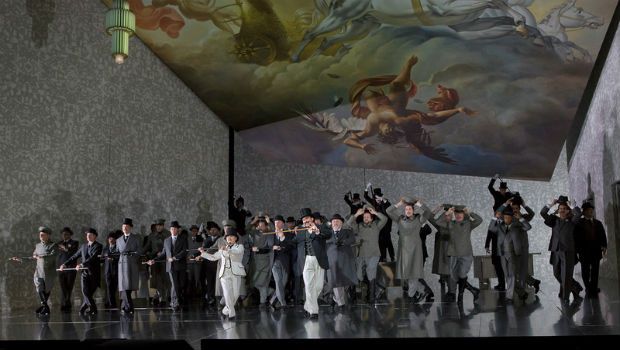
 ) should show the Met audience that spectacle doesn't have to come coated in glitter or burdened by brocade.

