 |
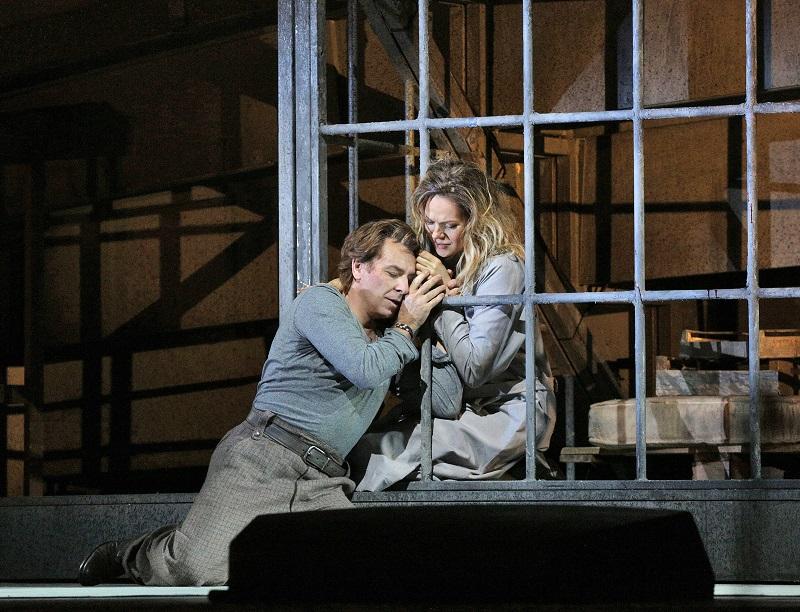
| Thwarted lovers: Alagna and Opolais in Act III (Photo (c) Ken Howard/Met Opera) |
Showing posts with label Roberto Alagna. Show all posts
Showing posts with label Roberto Alagna. Show all posts
Friday, March 4, 2016
Il tempo vola... baciami! Manon Lescaut at the Met


Monday, January 7, 2013
Andrea Chenier: e forse per questo solo v'amo

 , and can be just as much fun, as a quasi-historical and hyper-romantic romp (I'd compare it to Scaramouche
 , a less famous novel which I loved even more than the Pimpernel when I was fourteen. But I digress.) Given its due, I believe that the score serves not only to move the melodramatic plot along with thrilling speed, but to make vivid the political and emotional tensions which are intertwined at its heart. I felt, however, that Sunday's performance by the Opera Orchestra of New York lacked romantic and revolutionary fire. Debuting the title role under the handicap of a cold, Roberto Alagna lacked much of his usual elan, and the conducting lacked finesse. Rosalind Elias' Madelon was a highlight, and George Petean was a great discovery as the fascinating Carlo Gerard, but the evening as a whole buckled (to borrow a phrase) more often than it swashed.
Wednesday, November 24, 2010
Ei segua il suo destin
 |
| Auto da fe: (c) Ken Howard/Metropolitan Opera |
 in the library because it was there and looked good, found the libretto online, and listened (over and over and over again.) Nicholas Hytner's production was elegant and emotionally powerful, with stylized sets that recalled the Escorial (and environs) while evoking a powerful sense of a fate that approached inexorably, and imprisoned the complex men and women who struggled so furiously against it. Here Nicholas Hytner talks about his sense of the opera and his interpretive goals. In the first (Fontainebleau) act, for instance, it is winter, and a black path cuts a stark zig-zag path through the snow. Neither Carlo nor Elisabetta use this route, entering; but having agreed to become Filippo's wife, she is carried down it in procession. The prison-like nature of strong walls with small windows was effective throughout the rest of the opera (such a wall ascending and descending to divide the space of the stage also made scene transitions seamless.) The set for Elisabetta's garden I found jarring and strange; but that was an exception. Against this sleek, streamlined backdrop, the costumes and furnishings were deliciously detailed. Photos from the dress rehearsal may be found here; I'll add more as soon as they're available. Hytner was on hand to guide the Personenregie (is there an English word for that?) and it was amazing, drawing out the complexities of all the characters, including a hard edge for Martyr to Duty Elisabetta.
Yannick Nézet-Séguin's conducting was, of course, fast, but it was not merely fast. The orchestra did occasionally outrun the singers, or at least (to my ears) rush them, and did occasionally threaten to drown them. But there was drama in the pacing, not a mad rush through the score; details were pointed up, and the sheer sweep of Verdi's music was relished (I've said it before: I love the Met orchestra. Nézet-Séguin let them shine here.) Despite the issues in balance and pacing, I was on the edge of my seat and holding my breath most of the night, so by that standard of measurement, they were doing something very right. I worried for Roberto Alagna's Carlo during the first act, but whether it was an issue of nerves or warming up, things soon improved and I could relax. It sounds like a relatively heavy role for him, but he delivered it with passion; he does have a beautiful timbre, and his nervy, anguished Carlo was sung with unflagging energy. "Io vengo a domandar grazia alla mia regina," and the subsequent scene, was a highlight.
Thursday, October 28, 2010
Love, Death, and Local Color: Cavalleria and La Navarraise
 |
| I blame the scaffolding for the lighting. I could also claim it's an artistic effect. |
Usual caveats in place about the fact that I am feeling my way into the vocabulary, not to mention the more technical aspects of musical appreciation, I found the singing of Cavalleria curiously uneven. The sexiest thing about Lola was her red dress (nerves, maybe?) Alfio, Carlos Almaguer, seemed to have a nice timbre, but this was masked by a tendency to bellow, which affected intelligibility as well. Veteran artist Mignon Dunn was a treat as Mamma Lucia, vividly characterized and sung. Maria Guleghina sang a Santuzza I wanted to like more than I did. With a warm tone and dramatic commitment she created a Santuzza with uncommon understanding of herself and Turiddu, and a resulting gentleness which was quasi-matronly. Even phrases like "Turiddu mi tolsi l'onore" were more informed by fond memory than by present anguish. (Quite a contrast with Waltraud Meier, who created a Santuzza straight out of a Greek tragedy, fierce and rawly passionate.) Interesting as she was, though, she was occasionally inaccurate, and more than occasionally nigh-inaudible, which I found puzzling and disappointing. Alagna sounded darker, stronger, and more focused than when I heard him in a run of Cav/Pag at the Met last spring. (And I heard him from the orchestra, thanks to rush tickets, so the potential problem of his not-very-large voice getting lost should have been obviated?) At any rate, I was quite impressed. Curiously, he was the only performer on book for Cavalleria and I missed the unrestrained energy of his on-stage Turiddu. Still, he sang vividly, and "Mamma, quel vino" was sung with a sob in the voice, urgent with desperation and remorse.
Subscribe to:
Posts (Atom)
LinkWithin
