Showing posts with label semi-scholarly summary. Show all posts

Thursday, February 22, 2018

Semi-Scholarly Summary: Bringing Back Euridice

Photo (c) Cantanti Project/Lucas Godlewski

It is a truth universally acknowledged that claimants to the title of First Opera are many, though Monteverdi's Orfeo usually makes it into the textbooks. This weekend, NYC will get the Cantanti Project's performance of the earliest extant operatic score. As a historian, I like the phrase "first extant operatic score": it fills the mouth and rolls off the tongue. Not only is Giulio Caccini's Euridice thus a landmark in the hectically productive years of the early seventeenth century (it was published in 1600), it is a highly self-conscious manifesto about the power of music.

Conductor Dylan Sauerwald, who will conduct the performances, has argued that, although "lines in music history are usually blurry... the baroque was an explosion." Not only was Caccini visibly influential in this creative explosion, he was determined to be. His Euridice, written to a libretto also used by Peri, was on the only possible topic for a composer seeking to recapture the power harnessed by the ancient Greeks -- that of music to create harmony, to inspire madness, and indeed to overcome death itself. From the 1580s onwards, the philosophers and artists of Florentine salons had been having vigorous debates about what music should do, and what music could be -- if only their own age could recapture the genius of the ancients. I confess that, even as a habitual operagoer who grew up on Greek mythology as retold by Bulfinch and Hamilton, I observed the early operatic fascination with Orpheus and Euridice without having the penny drop: that it was chosen precisely because it was the narrative of how skillful poetry, skillfully set against music, could break the heart and change the world.

Tuesday, May 2, 2017

Semi-Scholarly Summary: Cyrano de Bergerac

This evening sees the opening of Franco Alfano's Cyrano de Bergerac at the Met. It's being marketed as Puccini-like, but the comparison, in my view, over-simplifies the work of both composers. To me, Alfano's Cyrano seems a curious blend of romantic structure and dramatic spectacle, and experimentation in orchestral explorations of the central characters' psyches. I'd be inclined to say that it provides, as Alexandra Wilson has suggested for the late works of Puccini, a sort of alternate vision of how modern opera might have developed in the Italian tradition. From a scholarly perspective, it's received comparatively little attention, even when measured against Alfano's other works. I was surprised to discover this, given my personal fascination with how Alfano's opera functions as an adaptation of Edmond Rostand's 1898 play, which is itself a homage to the five-act dramas of France's golden age of theatre in the seventeenth century. I grew up with an edition illustrated by Dubout, and, later, wore out a VHS of the Gérard Dépardieu film; this is one opera I came to via its source text, rather than the other way around.

Cyrano de Bergerac, subtitled as a commedia eroica, was first performed in the Paris of 1936. I thought that the choice to write an opera based on a heroic fighter of doomed causes in the increasingly totalitarian Europe of the 1930s might have been a political one; but Alfano's ties to Mussolini belie this naively romantic hypothesis. The libretto, which preserves much of Rostand's gorgeously ornate language, is by Henri Cain, a frequent librettist of Massenet's, whose texts include Cendrillon, La Navarraise, and Don Quichotte. For me, as an aficionado of the play, it is curious to hear a text with such strong rhythms, such strong music of its own, orchestrated for the opera stage. But the results are often strikingly poignant. One of the things I find most interesting about Cyrano, in fact, is how the music sometimes undermines the apparent optimism of the text. Trumpets promise discord and warlike tumult even as Cyrano and Christian, the piece's rival tenors, embrace for the first time. When the two men promise brotherhood, the orchestra foretells disaster.

Friday, February 5, 2016

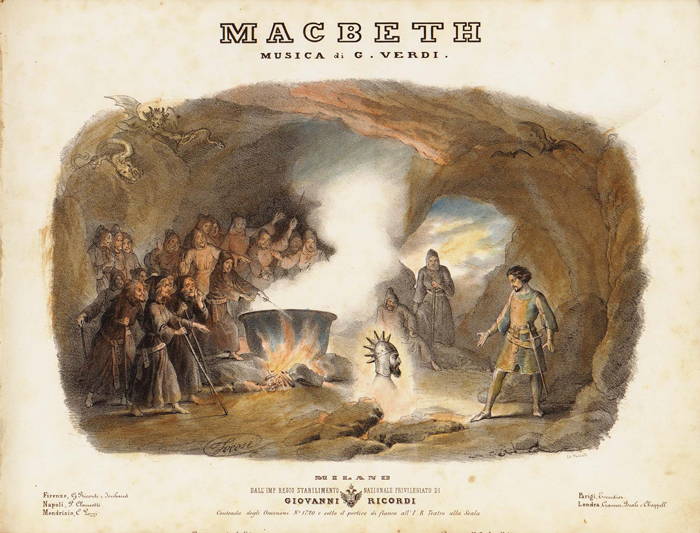
Semi-Scholarly Summary: Verdi's Macbeth

As an itinerant scholar, I've recently written a small piece about Verdi's Macbeth. The commissioning body doesn't know what it's unleashed. Among other things, it gave me the idea of starting a series of semi-scholarly summaries here, featuring historical background, colorful anecdotes, and a highly subjective selection of recommended reading and listening. As has been intermittently obvious on this blog, going to the research library as preparation for attending an opera performance is my idea of a good time. It would seem that I have a kindred spirit in Verdi himself; he paid a great deal of attention to the historical setting of Shakespeare's Macbeth, writing to his publisher and set-designer about political details of eleventh-century England and Scotland.

Macbeth was Verdi's own favorite opera at the time of writing. In 1864, however, when undertaking substantial revisions, he wrote of parts of it as "weak, or even worse, lacking in character." The mid-twentieth century saw a brief revival of the 1847 version, and in recent years, both versions have found place on the operatic stage. The work's very unconventionalities - to judge by essays and interviews - helped it to a mini-boom in the early years of the twenty-first century. (I've written about performances I've seen at the Met here and here.) Macbeth was Verdi's first foray into adapting Shakespeare, and he was unsurprisingly perfectionistic in working with Piave on the libretto, intent on having language echo feeling and fit with musical form.

Saturday, November 26, 2011

Goethe, Gounod, and Faust

"French composers love those German sufferers that then they can bring to joy." --Jonas Kaufmann (Opera News interview, 2011)

"Die unbegreiflich hohen Werke / sind herrlich wie am ersten Tag." - Faust 249-250

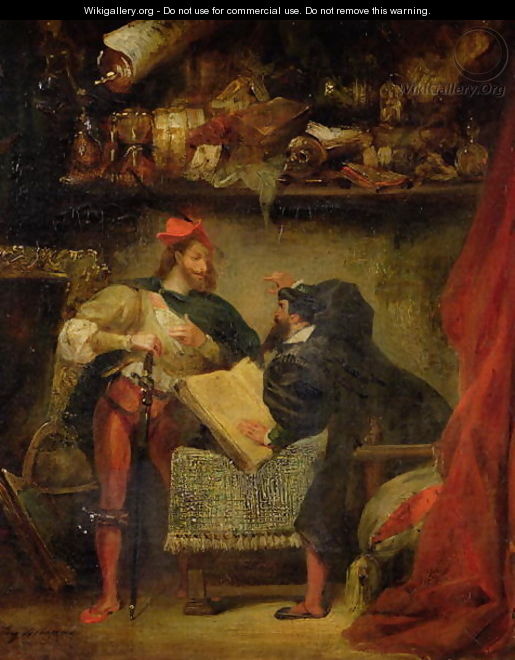
Delacroix, "Mephistopheles devant Faust," 1826
Gounod's Faust was the first work performed at the Metropolitan Opera House, in 1883. The 1859 opera enjoyed an almost unrivaled popularity in the late nineteenth and early twentieth centuries; George Bernard Shaw famously complained that a professional critic in London had to spend approximately a decade of a twelve-year career listening to Faust, and that he himself had been nearly blinded by prolonged exposure to Mephistopheles' red spotlight (his full Faust-assessment can be found in this book.) In Gaston Leroux' Phantom of the Opera, Faust is the opera chosen to represent both vocal virtuosity and dangerous sensuality (a connection emphasized in this film adaptation.) In Jean Renoir's film about WWI, Grand Illusion
, it is presented as plausible that "Anges Purs" would be known by every French officer. Critical interpretations of the opera often cluster around the question: how did Faust achieve such status?

Saturday, August 27, 2011

Mistress, Queen, Romantic Heroine: The Many Roles of Anne Boleyn

Anne Boleyn: 16th century portrait
Anne Boleyn has proved as fascinating to posterity as she was to Henry VIII.  Scholars and dilettantes, poets and painters, have been fascinated by the second of the (in)famous English king's wives, the first to be executed... and that after accusations of plotting regicide, and committing adultery with no fewer than five men, including her own brother.  The subject is temptingly sensational, as a glance at a list of fictional works concerning the unfortunate queen demonstrates. The debates are virtually inexhaustible: how credible did the charges against her have to be? were they only a means to a desired end? desired by whom? I won't pretend to answer all these questions, but in honor of the 1 month countdown to the Met Opera's season opening performance of Donizetti's opera (I'm excited!) I present a brief summary of Anne's political and posthumous career.

Among the many historical inaccuracies of Donizetti's thoroughly Romantic opera, perhaps the most striking is the unanimous sympathy expressed by the chorus of courtiers for the queen herself. In actual fact, the factionalism of Henry's court was lively, bitter, and, in some scholarly interpretations, the chief cause of Anne Boleyn's downfall and eventual death.  During the years of Anne's favor with the king (longer than their marriage) members of her family and their allies were granted influential positions; such influence attracted envy, and in the years of Anne's uneasy position as Henry's mistress, it would be all too easy to claim that the king's judgment had been led astray by his passion. Even after her marriage and accession to the throne, even after the death of Katherine of Aragon, there were those who persistently referred to her as "the Concubine." What of Anne herself? Much ink, scholarly and otherwise, has been spilled in attempting to analyze her character and her motives. I personally find her more credible as player than pawn.  In fictional accounts of her story, naturally enough, legal innocence has been equated with good character, the definition of which is, of course, relative.   Modern novelists have read between the lines of her story to find a vivacious heroine whose attempts at self-expression and self-assertion brought her downfall.  For the Romantic movement which influenced Donizetti, however, she was a heroine of a very different sort.

LinkWithin

Related Posts Plugin for WordPress, Blogger...