 |
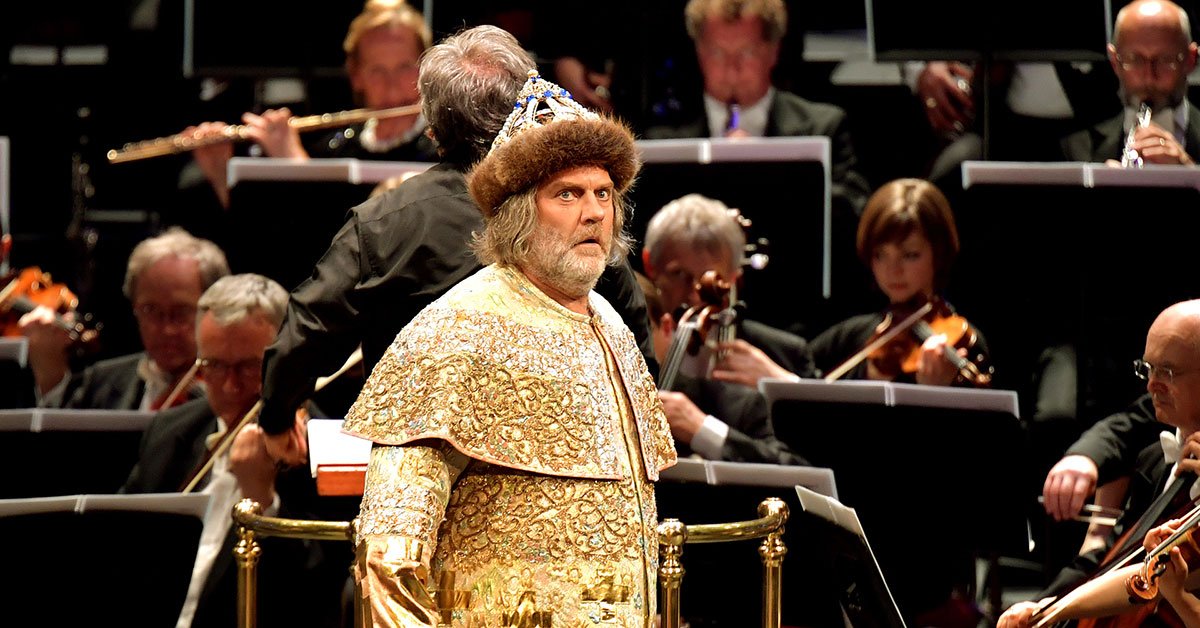
| Terfel as Tsar: Boris Godunov at the London Proms |
Showing posts with label Bryn Terfel. Show all posts
Showing posts with label Bryn Terfel. Show all posts
Monday, July 18, 2016
Madness in Great Ones: Bryn Terfel's Boris at the Proms


Sunday, October 26, 2014
Ich habe genug: Bach and Brahms with the BSO

Tuesday, May 1, 2012
Die Walküre: der Gottheit nichtigen Glanz
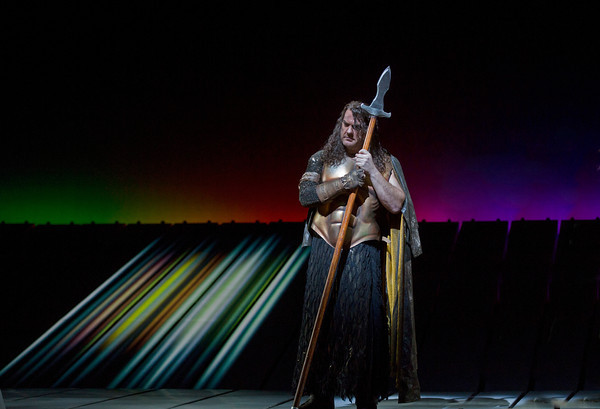
I am becoming a Walküre completist. With my mother, I attended Saturday's matinee at the Met, but will make this a brief report. Let me pass over the Lepage production in comparative silence (for once!) It is so very dull, so lacking in any apparent imagination except the visual. The only fresh insight it has inspired in me is: I really need to go to Germany. Saturday's orchestral performance seemed slightly cool, with a lyric melancholy that served the latter two acts better than the first. Coordination issues, however, were noticeably improved from the previous cycle's Walküre. Luisi and the orchestra were notably supportive of Frank van Aken, making his Met debut as Siegmund. I regret to note that the Machine's Walkürenritt configuration drew applause from the audience, but the Valkyries themselves contributed excellent work, with strong and exciting singing. (My mother opined moreover that Eve Gigliotti deserved awards for bravery, "getting back up on the horse" with a vengeance after the Machine bucked her in last year's run.)
Hans-Peter König made an impressively stentorian Hunding, coarsely possessive of Sieglinde, coarsely threatening towards Siegmund, and singing with diction that dripped with contempt. Stephanie Blythe was impressively rich-voiced as ever as Fricak; the constraints of staging her in her chariot are increasingly irksome to me. Eva-Maria Westbroek made a very touching Sieglinde. Her ardent singing was notable for beautiful tone and phrasing, especially in the first act. She sounded slightly fatigued by the end but still very expressive (I admit to tearing up at "O deckte mich Tod, dass ich's denke.") Frank Van Aken's Siegmund was indisputably valiant, and admirably engaged, but vocally underpowered. He has a bright voice which I might gladly hear in a smaller house, but here he sounded rough at the top of his range. Lack of rehearsal or nerves might account for his errors of omission and commission with the text; I found these distracting. Bryn Terfel's Wotan continues to be incredibly exciting. At Saturday's performance, his god was visibly and wildly despairing. Terfel did growl in places for effect, but sang expressively and responsively. His treatment of text--intellectually and emotionally nuanced--continues to delight me. ("Götternot!" gave me chills.) The Abschied was sung with beauty and power, and acted with profound tenderness and profound sorrow. Even as Brünnhilde begs for a softening of her sentence, Wotan reaches out as if to take her hand. Throughout the fraught dialog, Wotan himself seemed on the brink of weeping... and I sobbed. Katrina Dalayman gave a vocally solid performance as Brünnhilde, if not (to me) a terribly involving one. She sang the second act with accuracy, but without much ardor. Dalayman did bring warmth and sweetness of tone to the final scene. I was an emotional mess as the fire rose around Brünnhilde's cliff, which may be no bad way to leave a Walküre.
Curtain call photos:
Hans-Peter König made an impressively stentorian Hunding, coarsely possessive of Sieglinde, coarsely threatening towards Siegmund, and singing with diction that dripped with contempt. Stephanie Blythe was impressively rich-voiced as ever as Fricak; the constraints of staging her in her chariot are increasingly irksome to me. Eva-Maria Westbroek made a very touching Sieglinde. Her ardent singing was notable for beautiful tone and phrasing, especially in the first act. She sounded slightly fatigued by the end but still very expressive (I admit to tearing up at "O deckte mich Tod, dass ich's denke.") Frank Van Aken's Siegmund was indisputably valiant, and admirably engaged, but vocally underpowered. He has a bright voice which I might gladly hear in a smaller house, but here he sounded rough at the top of his range. Lack of rehearsal or nerves might account for his errors of omission and commission with the text; I found these distracting. Bryn Terfel's Wotan continues to be incredibly exciting. At Saturday's performance, his god was visibly and wildly despairing. Terfel did growl in places for effect, but sang expressively and responsively. His treatment of text--intellectually and emotionally nuanced--continues to delight me. ("Götternot!" gave me chills.) The Abschied was sung with beauty and power, and acted with profound tenderness and profound sorrow. Even as Brünnhilde begs for a softening of her sentence, Wotan reaches out as if to take her hand. Throughout the fraught dialog, Wotan himself seemed on the brink of weeping... and I sobbed. Katrina Dalayman gave a vocally solid performance as Brünnhilde, if not (to me) a terribly involving one. She sang the second act with accuracy, but without much ardor. Dalayman did bring warmth and sweetness of tone to the final scene. I was an emotional mess as the fire rose around Brünnhilde's cliff, which may be no bad way to leave a Walküre.
Curtain call photos:
Monday, April 23, 2012
Siegfried: Mut oder Übermut
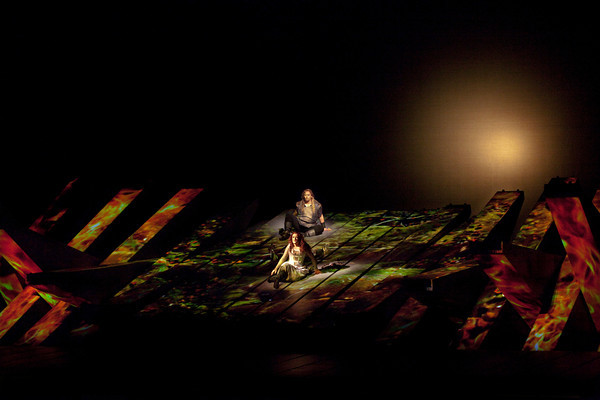 |
| Jay Hunter Morris, Deborah Voigt in Siegfried's final scene. Photo (c) Ken Howard/Metropolitan Opera |
With inexorable momentum, Wagner's Gesamtkunstwerk rolls on at the Met. Saturday's performance of Siegfried was remarkable for its emotional immediacy, a musically and dramatically exciting experience. I am still frustrated that Lepage's approach to the staging of the Ring is descriptive rather than analytical, but the performers did an admirable job. The humanizing approach to the Ring, while it may be the best approach to working with Lepage's sets, does not serve all the relationships of Siegfried equally well. The staging's implication that Mime is an unreliable narrator remains unexplored, but there was more detailed characterization of his relationship with Mime, which worked well. Siegfried's abuse of Mime is thus adolescent pique. The dwarf's interactions with the Wanderer further establish that Mime's disagreeability is personal, not part of a larger scheme of value; his refusal of Gastfreundlichkeit is shrugged at by the old man who dries his own boots at the fire. The orchestral performance was better-coordinated than at this cycle's Walküre; there were one or two moments where the brass sounded slightly unfocused, but matters were much improved. The horn and woodwind soloists distinguished themselves, and the forest murmurs were dreamily lovely. Whether it was the result of added experience or simply an example of a performance "clicking," I found myself more convinced and engaged by Fabio Luisi's Siegfried on this second hearing. Flexible dynamics and responsiveness to the singers made it a lively, but not a lightweight account. The orchestral playing in the final scene was so radiantly sensual as to border on the obscene; from my perspective, this counts as warm praise.
Monday, April 16, 2012
Die Walküre: Wunder und wilde Märe

Sunday, April 15, 2012
Rheingold: Vollendet das ewige Werk
Thursday, March 8, 2012
Va là, che sei il grand'uom: Don Giovanni
In the three times I've seen Michael Grandage's new Don Giovanni for the Met, I've progressed from disappointment, to frustration, to outright resentment of its lack of substance. (Is there a modified Kübler-Ross model for coping with bad opera productions?) Its visual clichés I find increasingly reminiscent of Phantom of the Opera: red velvet, ostentatious chandeliers, torch-bearing crowds with pitchforks, and, not least, theatrical blasts of flame. For the sake of Gerald Finley's Don, and Bryn Terfel's Leporello, however, I went. Both gave vivid vocal performances of great beauty... and both had, apparently, decided to fill the dramaturgical vacuum with bass-baritonal hijinks. They were supported by very fine singing from the rest of the cast. Andrew Davis' conducting was fleet and energized, but alert to the dark undercurrents in the music. The dramatic propulsion provided by the orchestra (which could also be slyly insinuating, when such was called for) was most welcome.
Monday, November 7, 2011
Udite, udite: Richard Tucker Foundation Gala
In his opening remarks on Sunday evening, Barry Tucker thanked the loyal audiences of the Richard Tucker Foundation Gala who made the concert a tradition. From the comparatively cheap seats, I enjoyed it for the first time, (upgrading from the Foundation's free citywide concerts.) The all-star lineup had undergone some serious shuffling in the weeks and even days preceding, but I had no reason to complain of the final results. Angela Meade was feted as the Tucker Award winner, and surrounded by colleagues of international stature (Opera Chic provides additional background.) The chosen selections relied more on star power than subtlety for their success, but the latter was not wholly lacking, and the former was often a delight. Members of the Metropolitan Opera orchestra provided sensitive support, playing with fine energy throughout under the leadership of Emmanuel Villaume. Their opening bacchanal from Samson et Dalilah was played with panache, employing sensual rubato in the woodwinds and embracing the clashing of brass and cymbal with gusto. After this orchestral prologue, the evening was turned over to the singers. The program seemed to be organized more around the singers' need for rest than around shared themes in the selections, with occasionally curious results. The overall quality, however, was high.
Friday, October 28, 2011
Ich lausch dem Gesang: Siegfried at the Met
 Despite some very fine singing, and some very fine orchestral playing, the Met's new Siegfried was less than fully satisfying. Robert Lepage promised hyperrealism, and this he delivered; the Machine has come into its own as a representational set. But that is all it is (and it nearly ground to a halt, with ominous clanking, between the second and third scenes of Act III; that Siegfried did not fear the fiery cliffs was indeed impressive.) The visual influence of Fritz Lang
 was apparent, and I was reminded of a cherished childhood possession, The Story of Siegfried
 . This is more than a failure to provide a clear and consistent interpretation; this is a problem. Siegfried is the only one clad completely in "medieval" costume; the rest are more directly inspired by the nineteenth century. I find it hard to believe that anyone charged with directing the Ring could be unaware of, or insensitive to, the problems in depicting Mime and Alberich in working-class clothes of the nineteenth-century, and then making them unrepentant and unsubtle schemers against our nature-child hero. Worse: Mime is made into a child-stealing hunchback. This allows Lepage to visually echo, in the dying Sieglinde's futile reach for her child, the dying Siegmund's reach for his wife. But: that is not how you deal with the question of whether or not Mime is an antisemitic caricature, Robert Lepage. [Update: Likely Impossibilities has a post about this.] After this, Brünnhilde as Pre-Raphaelite fantasy--Waterhouse would have been proud of that radiant, autumn-haired woman, shift-clad in a meadow--seemed positively innocuous. The few non-literal touches in the staging--Wotan causes the sun to turn blood-red in Act I, and unrolls the bark from around his staff in Act III--I found more confusing than illuminating.
Thursday, May 5, 2011
Bryn Terfel... Bad Boy?
It ain't necessarily so. Bryn Terfel is, however, an extraordinarily chameleon-like performer, whose unmistakable timbre is used on his latest CD to evoke a remarkably diverse cast of unsavory characters. I treated myself to Terfel's Bad Boys CD in the holiday mood inspired by the unexpected chance to hear his Scarpia last month; I've been enjoying it as much as I had hoped. What I had not expected was for listening to it to be a feel-good experience. It is impossible for me to hear Terfel's Dulcamara brazenly charming Donizetti's rustici without doing a little dance step around the apartment. "When the Night Wind Howls" from Ruddigore is simply a treat (and I think it would be even if I did not have a sentimental fondness for the piece, which I tried to make my father teach me by rote when I was about seven.) Even in the portentous finale of Don Giovanni--sung by Terfel, Terfel, and Terfel, with the help of good sound engineering and great voice characterization--Leporello draws a chuckle. In Terfel's hands, the Devil--whether from Gounod's Faust or Boito's Mefistofele--is a perfect charmer.
I don't mean to imply a lack of effective characterization in keeping the various villains distinct; in this I think Terfel succeeds remarkably well. Moreover, I was quite impressed, on the whole, with the organization of this musically eclectic album (for complete track listing go here.) A few of the arias do inevitably wrest one into the world of the opera and then drop one unceremoniously out again. "Tre sbirri, una carrozza, presto," purrs Terfel, and I'm in Sant'Andrea. Iago's credo is another such piece for me. I thought the tempo for "Ha! welch ein Augenblick!" fast--shouldn't Pizarro be luxuriating in sadistic pleasure?--but loved the smooth snarl Terfel brought to it. A special treat is Anne Sofie von Otter (no less!) as Mrs. Lovett in "Epiphany" from Sweeney Todd. I'm not really an enthusiast for Sweeney Todd (Really Shameful Confession?) but with their vivid and subtle and intensely human characterization, the scene comes across brilliantly. I'd say I'm getting as much enjoyment out of the CD as those involved in its creation did, but the competition looks stiff:
I don't mean to imply a lack of effective characterization in keeping the various villains distinct; in this I think Terfel succeeds remarkably well. Moreover, I was quite impressed, on the whole, with the organization of this musically eclectic album (for complete track listing go here.) A few of the arias do inevitably wrest one into the world of the opera and then drop one unceremoniously out again. "Tre sbirri, una carrozza, presto," purrs Terfel, and I'm in Sant'Andrea. Iago's credo is another such piece for me. I thought the tempo for "Ha! welch ein Augenblick!" fast--shouldn't Pizarro be luxuriating in sadistic pleasure?--but loved the smooth snarl Terfel brought to it. A special treat is Anne Sofie von Otter (no less!) as Mrs. Lovett in "Epiphany" from Sweeney Todd. I'm not really an enthusiast for Sweeney Todd (Really Shameful Confession?) but with their vivid and subtle and intensely human characterization, the scene comes across brilliantly. I'd say I'm getting as much enjoyment out of the CD as those involved in its creation did, but the competition looks stiff:
Tuesday, April 26, 2011
Die Walküre: Wes Herd dies auch sei
 |
| Final scene: Voigt, Terfel; (c) Ken Howard/Metropolitan Opera |
Sunday, April 17, 2011
Tosca è un buon falco!

Tuesday, September 28, 2010
Rheingold! Rheingold!
 |
| (c) Ken Howard/Metropolitan Opera |
Friday, July 16, 2010
Zur Kunst die Lieb'

The Proms performance of Meistersinger will be broadcast live on BBC Radio 3 this Saturday, at 4:00 London time which means 11:00 a.m. for me. It will then be available on demand for a week. (Full details here.) I'll be sorry to miss the Richard Jones production, but still, I will get to hear the avuncular Mr. Terfel sing, or channel, Hans Sachs.
Update: the debate about Wagner and anti-Semitism is apparently being formally (re-)taken up by historian and author Mark Berry (his really interesting music blog here; his impressive faculty page here; his book about politics and religion in the Ring here
 ) and critic Barry Emslie, author of the recent Richard Wagner and the Centrality of Love
 . Heavy but fascinating stuff; the discussion starts at The Wagner Journal online. Hans Sachs, who surely can be enjoyed with a clear conscience and cheerful mood (quoth she, not unaware of potential for being shown error of her ways), here:
Sunday, April 18, 2010
Ecco un artista!
 Photo credits to Cory Weaver and the Met via the New York Times; Opera Chic has ferreted out some others, including a great one of Terfel's Scarpia. Update: YouTube has been plundered for audio excerpts from the 24 April performance. Scroll down for links! Update II: the Met has posted pictures!
So. Tosca. While I've been trying to pull myself together, professional reviewers have made their contributions, which I don't want to simply rehash. And I've been soul-searching: what am I doing here? why am I commenting? Well, in this case especially, as a cathartic personal exercise; I remember this performance and my pulse quickens, my hands tremble. I try to start writing and end up huddled muttering "My God my God my God..." I need to try to explain that. I want to share my joy in what I experienced, knowing how I hang on the words of other opera-lovers as they describe this or that performance that held them spellbound. And even in this strange medium simultaneously obscure and public, I want to pay tribute to the artists who gave me this. I will take as encouragement the words of a nice older man named Bruce, who turned to me as we sat on a bench waiting to take our standing room places for last year's Siegfried: "And do you also know opera?" he asked. I stammered that I didn't think I could claim that, but that I certainly did love it--oh, I certainly did love it, and I was trying to learn. He patted me on the shoulder in avuncular fashion. "If you feel that way about it, young lady," he said, "you know it. Or you will." So, with no further authorization, Tosca.
Friday, April 16, 2010
Mia Tosca idolatrata
At the risk of losing all credibility by enthusing effusively for two successive operas, I have to say that Wednesday's "Tosca" was an extraordinary experience. I am firmly and passionately in the camp that argues for "Tosca" as intelligent, effective drama. There are so many moments in it which leave me in awe of Puccini--how did he know to do that?--and I am a happy believer in Tosca and Mario and Scarpia as complex, passionate people. So, my susceptibility (but also the choosiness that is based on love!) having been established, onwards.
To be honest, I can't quite say "ogni cosa in te mi piace" about the Met's current production, but let me try to follow the King's advice from Alice and begin at the beginning (and, when I come to the end, stop.) Luc Bondy's stark new production, and the Met audience's reaction to it, have both achieved notoriety by this point. But having seen it twice now (in standing room for the glamor--and, as it turns out, for the boos--of the season premiere) I think I can honestly say that... it's hit and miss. In Act I, the image of the Virgin at which Tosca prays is invisible to the audience. The space in which the action of Act I takes place is simply a stark, slightly untidy work space. Act II is... well, I still think it's ugly. Scarpia's walls are mustard-yellow and chocolate brown; he has aggressively magenta sofas, large maps on the walls, a writing desk (of course!) and a tiny table with one straight chair and one armchair for his "povera cena." And a throw rug which looks like something from IKEA gone wrong, which I was mercifully spared this time by standing in the orchestra instead of at the top. Act III is, again, stark, monumental. No angel, but a sheer staircase leading up to the battlements on the right, and a hatch in the center for the soldiers' entrances and exits. It's a comfortless, exposed place; the production as a whole does not seek to distract from the bleak realities of the plot. The approach is mostly naturalistic, with a few exceptions in lighting (stark spotlights on Angelotti's entrance, an ominous, hospital-bright glow from the off-stage room in Act II) and blocking (there's no plausible reason for Scarpia to enter the church and climb a staircase so that he overlooks the entire set... but it sure does make an entrance!) I think the first and third acts work well; I don't think a sensualist like Scarpia would have an ugly study! but there. More images from the whole thing here.
To be honest, I can't quite say "ogni cosa in te mi piace" about the Met's current production, but let me try to follow the King's advice from Alice and begin at the beginning (and, when I come to the end, stop.) Luc Bondy's stark new production, and the Met audience's reaction to it, have both achieved notoriety by this point. But having seen it twice now (in standing room for the glamor--and, as it turns out, for the boos--of the season premiere) I think I can honestly say that... it's hit and miss. In Act I, the image of the Virgin at which Tosca prays is invisible to the audience. The space in which the action of Act I takes place is simply a stark, slightly untidy work space. Act II is... well, I still think it's ugly. Scarpia's walls are mustard-yellow and chocolate brown; he has aggressively magenta sofas, large maps on the walls, a writing desk (of course!) and a tiny table with one straight chair and one armchair for his "povera cena." And a throw rug which looks like something from IKEA gone wrong, which I was mercifully spared this time by standing in the orchestra instead of at the top. Act III is, again, stark, monumental. No angel, but a sheer staircase leading up to the battlements on the right, and a hatch in the center for the soldiers' entrances and exits. It's a comfortless, exposed place; the production as a whole does not seek to distract from the bleak realities of the plot. The approach is mostly naturalistic, with a few exceptions in lighting (stark spotlights on Angelotti's entrance, an ominous, hospital-bright glow from the off-stage room in Act II) and blocking (there's no plausible reason for Scarpia to enter the church and climb a staircase so that he overlooks the entire set... but it sure does make an entrance!) I think the first and third acts work well; I don't think a sensualist like Scarpia would have an ugly study! but there. More images from the whole thing here.

Subscribe to:
Posts (Atom)
LinkWithin
