 |
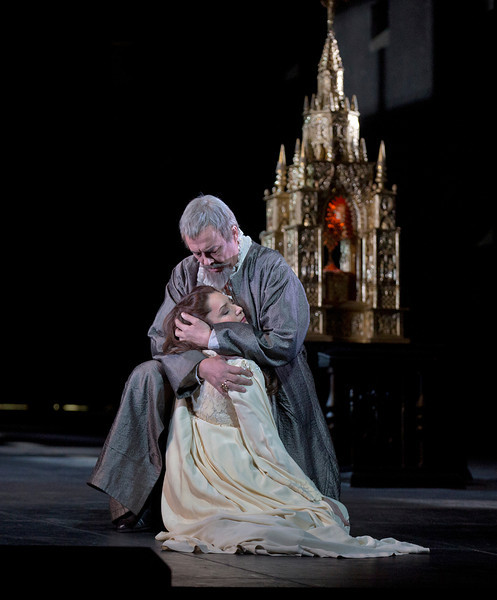
| Filippo (Furlanetto) mourns what might have been. Frittoli is Elisabetta. Photo (c) Met Opera |
Showing posts with label Ramon Vargas. Show all posts
Showing posts with label Ramon Vargas. Show all posts
Friday, March 8, 2013
Don Carlo: lo spirto che vacilla


Tuesday, August 14, 2012
Viva la liberta: Don Giovanni at the ROH
CATHERINE%20ASHMORE.jpg) |
| Keenlyside as Don Giovanni. Photo (c) Catherine Ashmore |
 for Covent Garden with some skepticism. For one thing, I wasn't sure how Zambello would handle a work of Don Giovanni's density. For another, I had trouble imagining Simon Keenlyside's assumption of the Don. Keenlyside is an accomplished and intelligent musician whom I've been moved by in a number of roles... as thoroughly nice, if not actually self-sacrificingly noble characters. My skepticism, however, proved unjustified. It takes a little time for Zambello's directorial perspective to become clear, but the story that she has Mozart's opera tell is an interesting one, with the three women as joint protagonists with the Don himself. (This works surprisingly well.) And Keenlyside, in addition to singing with elegance and gusto, created a thoroughly amoral Don: cunning and exuberant, and boundless in sensual appetites (until the curtain calls, when he gave his Leporello an impromptu bear hug and helped the frail Sir Charles Mackerras on a step created by the sets. Niceness will out!) That said: the production may judge Don Giovanni too charitably, and I may judge the production itself too charitably, having been recently bored and bored again by Michael Grandage's kitschy creation for the Met. These caveats in place, I must say that I thoroughly enjoyed it. More subtle visual cues could have helped put across more precise ideas, but the casting was very fine, Mackerras' conducting was a joy, and the singers were admirably committed to portrayals of their characters specific to Zambello's concept.
Saturday, October 15, 2011
Don Giovanni: Cogliere io vo’ il momento

Amid a plethora of painted shutters and dancing peasants, it was the Don himself who brought the color and life to Thursday's Don Giovanni at the Met. Michael Grandage's staging was Sevillian and serviceable. The lighting by Paule Constable reflected the progress of the unfolding day, and used chiaroscuro to suggestive effect, echoing the plot's preoccupation with identity mistaken and revealed. The casinetto is a richly appointed townhouse among the many which slid into different configurations as the action progressed. The opulent eighteenth-century costumes (Christopher Oram) made social distinctions clear. But, although the production was not entirely unreflective, I still found it somewhat unsatisfying. It was clear that Grandage was aware of the gender and class hierarchies shaping the plot, but his own ideas on these subjects weren't strongly developed in visual terms. Many episodes of the dramma giocoso were played--I thought--too close to comedy, but that may be largely a matter of taste. I found the hellfire of the finale grotesque rather than terrifying. Fine singing and exciting orchestral playing made for a dramatically engaging evening, but I wish the production had been helping more.
The Met orchestra and Fabio Luisi gave a vigorous account of the score which did not sacrifice detail to its generally fast tempi. From my vantage point, I couldn't see Maestro Luisi moving between podium and harpsichord, but transitions occurred seamlessly. The chaos of the party in the Act I finale was handled brilliantly. Delicacy in intimate or introspective sequences was savored, and the ominous chords of the Commendatore were delivered with bone-shaking relish. (To those around me who whispered during the overture: now you know the fate of malefactors; I hope you are suitably chastened. To those who were hastening down the aisles before the closing ensemble... be warned! Be warned!)
Wednesday, February 2, 2011
Boccanegra! Boccanegra!

Tuesday, March 23, 2010
Il re s'avanza
What do graduate students do with spring break? Why, take advantage of the quiet library during the day, and take advantage of its early closure to go see opera in the evening! There were three of us who planned ahead and bought tickets to make sure we didn't miss Verdi's Attila. As the Met tirelessly reminded us, this was to be an Event: the first time the opera was performed at the Met, Riccardo Muti's Met debut, etc. Being medievalists, we were especially excited at the prospect of tumultuous fifth-century history (plus myth, of course!) on the opera stage.
Subscribe to:
Posts (Atom)
LinkWithin
