|
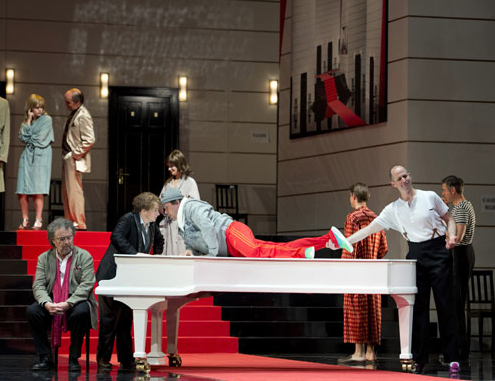
| Artistic philosophies go head to head. Photo (c) Oper Frankfurt/Monika Rittershaus |
Brigitte Fassbaender's new production of
Ariadne auf Naxos for Frankfurt's opera house has me falling in love with Strauss's opera all over again. It works on multiple narrative levels, as perhaps any production of
Ariadne must if it is to work at all. The hectic backstage activity of the prologue is organized around the poignantly relevant struggles of opera to function as
heilige Kunst when treated as commercial product (
musikalisches Handwerk, as the Haushofmeister dismissively puts it.) The production was musically sensitive and creative throughout, beginning during the overture with a dance only half seen. The curtain (black, bisected with a red line) was raised just enough to show us feet and calves, some instantly identifiable, some not, dancing waltzes and Charlestons in shifting pairings, at least one of which was of two women. When the curtain is fully raised on the house of the richest man in Vienna, we're in the improvised back stage area, with half a dozen dressing rooms opening off a central hall. There's a suggestion of surrealism provided by a painting on the wall (see above) and lines that draw the eye strongly. Thus, while there were often multiple vignettes occurring simultaneously, I never felt overwhelmed.
The mercurial musical moods of the prologue were handled deftly: the conversation (if it can be called that when people are talking past each other) between the Haushofmeister and the Musiklehrer was unusually moving, but there were also moments of sly humor. There is at least the possibility that while the Komponist muses on art after his altercation with the lackey, absolutely everyone else is having sex behind closed doors. Although there are moments of sympathy between the artistic factions, tempers are running high when the entrance of the guests forces the end of the prologue. When the curtain opens again on the opera, everything was just different enough that I asked myself whether it was a dream landscape; I don't think it was, necessarily, but it was reminiscent of one, perhaps by Hitchcock, where individuals are forced into unaccustomed relationships with their surroundings. Ariadne's thread, that symbol of navigating perils, has been broken in pieces, and the denizens of the island make to mend it. At the outset, the efforts of the
commedia troupe to insert themselves in the action are grotesquely miscalculated, but gradual adjustment takes place so that genuine interactions become the basis of a rapprochement. This may sound banal, but was sensitive and nuanced. The Komponist's vision, of course, is not fully realized; but working together, the artists--with the formerly opposed groups integrated--achieve something like transcendence.
 |
| Perfecting perspective: divinity of music. Photo (c) Oper Frankfurt/Monika Rittershaus |