Showing posts with label Robert Lepage. Show all posts

Wednesday, October 24, 2012

Something rich and strange: Adès' Tempest at the Met

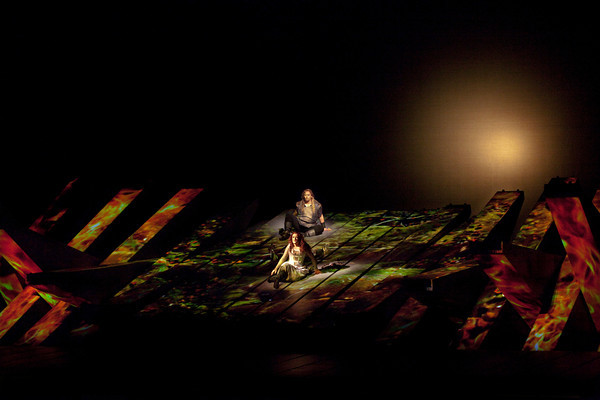
Opening of the Tempest  Photo (c) Met Opera/Ken Howard
In the mythical, mystical world of Thomas Adès' Tempest, there are rich aural experiences associated with the island and its denizens: wild storms and eerie calm; smooth, politic betrayal and innocence so profound as to be unwittingly cruel. Allusive orchestrations are given unexpected twists. In the overture--a tempest that drew on the storms of operatic history while possessing a distinctive texture--there were echoes of late romanticism in the brass, and perhaps inevitable reminiscences of the sea interludes from Peter Grimes. The orchestra is also used creatively to evoke different characters and their emotional states (sometimes in ways that seem at odds with the doggerel libretto.) Caliban, on the rare occasions when he isn't in coercive situations, has some of the most beautiful music in the opera. Ariel gets unearthly winds, Ferdinand and Miranda gracefully intertwining lines, the courtiers of Milan and Naples more formal exchanges structured around declamation. These rich dynamics (which cannot be easy to create with both precision and impulsive energy) were richly realized by the Met orchestra under the baton of the composer. Despite all this excitement, the dramatic pacing of the opera seemed uneven to me. After the stormy beginnings, the action seemed somewhat becalmed until the second act. My perception of this, however, may have been adversely affected by the production, which had Miranda and Prospero sitting alone on a slightly raked stage for most of Act I, where others came to join them. The prompter's box, of course, belongs to Prospero.

Robert Lepage's production (located often inside a model of La Scala as it was in the eighteenth century) was not infrequently thoughtful, but it was not coherently so. Many of its most interesting ideas appeared in the final tableau, where I saw for the first time serious engagement with the reasons for presenting the drama inside an opera house. The chorus exults in their pardon: do we go to the opera to get our sins forgiven? Do we need to go through the harrowing of hell to receive this absolution? Ferdinand and Miranda are radiant and radiantly illuminated on the stage. Is this what we want to be promised--the future of the young lovers--at any cost, and no matter how artificially engineered? Here (at last) it became fully apparent that Prospero's theater is a trap to him as well as to those he manipulates with and in it. For the most part, however, I couldn't see that Lepage was doing much beyond spatially confusing the narrative. If layering of narratives was going on, I couldn't make it out: however artificial the tableaux he stages, Prospero's dilemma, and his corrosive anger, are stunningly real. Some of the incoherencies must be attributed to the plot as well as the production. Why is the full court of Naples (and Milan) under sail? And why does Prospero drown them only to resuscitate them? The further question raised by Lepage's production--what does this say about the reanimation of the dead by theatrical art--was left hanging. Caliban also fared badly; the production clad and choreographed him as a simian savage, and the rest of the island inhabitants fared not much better. (I literally cringed during some of the dance sequences; postcolonialism takes harder work than casual appropriation of stereotypes.) The libretto, too, though significantly altered from the Shakespearean plot  (and replacing his verse with halting rhymes) has Caliban as lustful, treacherous, gullible, and prey to base desires. Those who denigrate him can of course be viewed as unreliable and manipulative narrators, but this doesn't fully solve the problem. The sea-change the drama undergoes at the hands of Adès and librettist Meredith Oakes creates scenarios rich and strange indeed.

Wednesday, April 25, 2012

Götterdämmerung: Fliegt heim, ihr Raben

It's all over. Although Lepage's production has been modified, I still feel that it lets the Ring down badly in its cataclysmic conclusion. The plaster statues of the gods now crumble into the Rhine instead of exploding above the hall of the Gibichungs, which I find dramatically and theatrically more felicitous. But while the music is driven on by the momentum of all that has gone before, the production drifts. The orchestral performance was remarkable. The sound could occasionally seem unfocused, but the Beloved Flatmate were almost directly over the pit in a Family Circle box, which may have affected my perception. The dense tapestry of leitmotivs was given vibrant color; the score's movement towards an inevitable conclusion was thrilling with tension at every turn. The close connection to the singers which has characterized the rest of the cycle under Luisi was still apparent, especially effective in evoking the clash between Siegfried and Hagen. The Trauermarsch was of a shattering intensity, silence and sound alike pushed to the limits of the bearable. The long threnody of the immolation was handled with emotional nuance, and the Erlösungsmotiv over the Rhine was radiant. If only the production had made a bolder claim about the whys of this music.

Monday, April 23, 2012

Siegfried: Mut oder Übermut

Jay Hunter Morris, Deborah Voigt in Siegfried's final scene. Photo (c) Ken Howard/Metropolitan Opera

With inexorable momentum, Wagner's Gesamtkunstwerk rolls on at the Met. Saturday's performance of Siegfried was remarkable for its emotional immediacy, a musically and dramatically exciting experience. I am still frustrated that Lepage's approach to the staging of the Ring is descriptive rather than analytical, but the performers did an admirable job. The humanizing approach to the Ring, while it may be the best approach to working with Lepage's sets, does not serve all the relationships of Siegfried equally well. The staging's implication that Mime is an unreliable narrator remains unexplored, but there was more detailed characterization of his relationship with Mime, which worked well. Siegfried's abuse of Mime is thus adolescent pique. The dwarf's interactions with the Wanderer further establish that Mime's disagreeability is personal, not part of a larger scheme of value; his refusal of Gastfreundlichkeit is shrugged at by the old man who dries his own boots at the fire. The orchestral performance was better-coordinated than at this cycle's Walküre; there were one or two moments where the brass sounded slightly unfocused, but matters were much improved. The horn and woodwind soloists distinguished themselves, and the forest murmurs were dreamily lovely. Whether it was the result of added experience or simply an example of a performance "clicking," I found myself more convinced and engaged by Fabio Luisi's Siegfried on this second hearing. Flexible dynamics and responsiveness to the singers made it a lively, but not a lightweight account. The orchestral playing in the final scene was so radiantly sensual as to border on the obscene; from my perspective, this counts as warm praise.

Monday, April 16, 2012

Die Walküre: Wunder und wilde Märe

I know it's irresponsible to play favorites with the Ring operas, and of course nearly impossible to really choose, but I love Die Walküre a lot. Wearing flat shoes and armed with chocolate, the Beloved Flatmate and I stood for Friday's performance at the Met. Very fine singing made it an emotionally intense experience. Robert Lepage's production contributes little except a dramatically useful forest for pursuer and pursued in the staged overture and second act. There was a malfunction with the projections in the final act which I mention only to say that although it shouldn't have happened, I didn't feel it was a disastrous distraction; I was prepared for Terfel and Voigt to carry the confrontation in front of a fence instead of an avalanche. More worrisome to me were the lapses in the Met orchestra's customary precision. One brass quaver may be regarded as a misfortune; two looks like carelessness. In Act I the orchestra seemed occasionally ahead of the singers, a problem which was swiftly rectified. Fabio Luisi is currently doing the work of several, and I'm not sure how much time there was for the orchestra to rehearse with him. Overall, however, it was a fine and sensitive performance. This was Wagner on a human scale, with the singers' emotions leading the expression of the orchestra throughout. The coming of spring was beautifully handled; the lovers' embrace was interrupted with a crash, but thereafter the textures of the orchestra were delicate as moonlight. Similar dynamic contrasts were used effectively in the confrontations of Act II. The overture seemed to be played from Siegmund's perspective, the fury of the storm and the threat of echoing horns taking second place to the rhythms of racing blood and hard-won breath. The orchestra found melancholy tenderness for the Wälsungs, an almost breezy tone for Brünnhilde's entrance, and gave a fiercely exuberant Ride. The Valkyries, in this most (in)famously excerpted moment, contributed exceptionally good work. This wild music was sung with beauty of tone, vivid characterization, and good handling of text, making the formal phrases sound like sisters' chatting.

Sunday, April 15, 2012

Rheingold: Vollendet das ewige Werk

Last Saturday evening saw the auspicious beginning of the Met's first complete Ring cycle in the Robert Lepage production. On every level (except that of the production) I was enormously impressed. Revisiting the production, I did feel that my initial Ring-optimism had not been entirely unwarranted: this Rheingold, complete with functional rainbow bridge, does contain some powerful theatrical images, and uses space in ways which can at least be overanalyzed as alluding to the complex and precarious networks of power within the work. But it remains, in the end, primarily a backdrop for the performers.

Monday, January 30, 2012

Götterdämmerung: So gut und schlimm es geh'

In a world where the gods don't matter, why should we care about their downfall? In the last installment of his Ring, Robert Lepage has banished the gods to plaster-of-Paris altars, which are exploded (almost comically, I regret to say) in the conflagration of the Gibichungs' hall. An exploration of how the (misplaced?) religious devotion of the mortals is used to justify their own decisions was, however, lacking as far as I could see. The Gibichungs' society, indeed, was surprisingly functional, as were the sibling relationships of Gunther, Hagen, and Gutrune. Theatrically, I felt that this was the best yet of the Lepage productions, but its apparent lack of conviction is a crippling defect. (For instance: the Norns' weaving creates a series of impressive images, but its unraveling is not attuned to the moment when the music registers the horror of "Es riss!") Without either an argument for wider significance to the events of Götterdämmerung, or an ironic commentary on the lack of such significance, the production is reduced to a series of tableaux, which no amount of grandeur can save from triviality.

The musical performances were of a high standard, and offered much to ponder, even if dramatically shackled by the vagueness of the production. Rather than a Götterdämmerung of grandeur, guts, and glory, Luisi gave a reading of the score which was transparently detailed, intimate, even introspective. I really appreciated this--the Rhine journey was at its most gorgeous--although it was perhaps not without its drawbacks. The timpani before Siegfried's death, dying into silence, could have been the last rattle of breath, the last flutter of a pulse; the crash of sound that initiates the Trauermarsch can hardly fail to stun, but I wanted it to overwhelm. The portrayals of the singers were also characterized by impressive emotional nuance, which Lepage must have taken care over (but this is Götterdämmerung, where it is never just about the individual.)

Friday, October 28, 2011

Ich lausch dem Gesang: Siegfried at the Met

Despite some very fine singing, and some very fine orchestral playing, the Met's new Siegfried was less than fully satisfying. Robert Lepage promised hyperrealism, and this he delivered; the Machine has come into its own as a representational set. But that is all it is (and it nearly ground to a halt, with ominous clanking, between the second and third scenes of Act III; that Siegfried did not fear the fiery cliffs was indeed impressive.) The visual influence of Fritz Lang was apparent, and I was reminded of a cherished childhood possession, The Story of Siegfried. This is more than a failure to provide a clear and consistent interpretation; this is a problem. Siegfried is the only one clad completely in "medieval" costume; the rest are more directly inspired by the nineteenth century. I find it hard to believe that anyone charged with directing the Ring could be unaware of, or insensitive to, the problems in depicting Mime and Alberich in working-class clothes of the nineteenth-century, and then making them unrepentant and unsubtle schemers against our nature-child hero. Worse: Mime is made into a child-stealing hunchback. This allows Lepage to visually echo, in the dying Sieglinde's futile reach for her child, the dying Siegmund's reach for his wife. But: that is not how you deal with the question of whether or not Mime is an antisemitic caricature, Robert Lepage. [Update: Likely Impossibilities has a post about this.] After this, Brünnhilde as Pre-Raphaelite fantasy--Waterhouse would have been proud of that radiant, autumn-haired woman, shift-clad in a meadow--seemed positively innocuous. The few non-literal touches in the staging--Wotan causes the sun to turn blood-red in Act I, and unrolls the bark from around his staff in Act III--I found more confusing than illuminating.

Tuesday, April 26, 2011

Die Walküre: Wes Herd dies auch sei

Final scene: Voigt, Terfel; (c) Ken Howard/Metropolitan Opera
In brief, I thought the best thing about the Met's Walküre was its phenomenal orchestra, and the worst its Picket Fence of Symbolism, as I am calling the set.  Update: the Met has posted pictures; tellingly, most of them focus on the singers. The singing was thoroughly committed, and held many pleasant surprises.  In the program was printed a "conversation with the director."  Lepage was asked how he planned to engage the new dimensions of Walküre, after Rheingold.  "Suddenly," said Lepage, "we deal with love and nature. Walküre is a piece where there are snowstorms, where there is lightning..." I had a sinking feeling. Lepage has often spoken of his fascination with the landscapes of Iceland, whence, of course, much of Wagner's source material hails.  And so we got a Walküre obsessed with landscapes, rather than ideas.  I grant, the forest for pursuer and pursued to weave through was effective, and yes, having the gods' conversations of Act II on top of a volcano can be an (unsubtle) metaphor for potentially explosive undercurrents.  But I was not seeing a Walküre with landscape-as-metaphor.  Lepage belabors the point of desired fidelity to the work. Failing to explore its layers and its ambiguities is, I would argue, a serious failing in this respect.

Tuesday, September 28, 2010

Rheingold! Rheingold!

(c) Ken Howard/Metropolitan Opera
Leuchtende Lust!  Robert Lepage's Rheingold design may not deserve to be labeled as an artistic triumph, but I do think it can be called a success.  It doesn't read against the libretto; the action is clear, and Lepage seems to be more interested in showing off Wagner's drama (and, sometimes, his own technical imagination in doing so) than imposing a heavy-handed interpretation on it.  This is not to say that it was devoid of ideas.  The use of space was creative, placing singers in arresting tableaux and dramatic interactions.  He wasn't afraid of the opera's moments of humor, but let them happen.  And we got a Riesenwurm with thrashing tail menacing Wotan from one side of the stage and fossil-like head, with malicious tongue and deadly jaws, entering from the other: es wand sich ringelnd!  There were moments where the interaction between realism and abstraction didn't sit perfectly easily, but overall it worked well.  There was, occasionally, an audible, unsettling creaking as the enormous mechanism shifted; I imagine, and hope, that something may be done to silence it.  Update: a Met gallery of production photos may be found here.

Saturday, July 31, 2010

Folge mir, Frau...

The Ring sets are here!  The New York Times has the story.  Frankly, reading about hydraulic machinery, steel girders, and a brand new room to house thirty-two (!) computers causes me a shiver of pragmatic worry about finances.  Zerbinetta over at Likely Impossibilities has voiced reasoned doubts about other aspects of the production as well.  But if this comes off... it would be so exciting.  My only exposure to Robert Lepage so far has been through his Damnation de Faust at the Met last autumn, which left me, on the whole, favorably impressed.  A fine instinct for theatrical spectacle and striking, stylized imagery will, of course, get one a great deal further with Berlioz' Faust than with the Ring.  Lepage himself has been quoted (repeatedly) in Met programs describing the Ring, enthusiastically, as containing its own universe.  One is tempted to snap back, "Of course it does, Mr. Lepage!  What are you going to do about it?"

Monday, May 3, 2010

À vos jeux, mes amis

Although Carmen is still under my skin, I had a pleasant musical interlude on Saturday: the graduate recital of one my oldest friends, no less! A soprano, she chose madness as the theme of her recital, and it was tremendous fun, as well as, for me, a surprising experience to sit and hear someone whom I know quite well open their mouth, strike an attitude, and create a vivid characterization through difficult repertoire. (I have talented friends... so thrilling!) A standout was, unsurprisingly, the mad scene of Ambroise Thomas' Ophelie; you can find Mady Mesplé singing it here.

This recital was also the occasion of a discovery for me: Richard Strauss' Ophelia-Lieder which (Really Shameful Confession) I did not know at all, despite my love for Strauss, Shakespeare, and Lieder. Shocking. Searching for them to hear again via YouTube, I found surprisingly little, but I did find a gripping rendition of all three ("Wie erkenn' ich mein Treulieb," "Guten Morgen, 's ist Sanktvalentinstag," "Sie trugen ihn auf der Bahre bloß") by Camilla Tilling. Which brought me to the question, who is Camilla Tilling? IMG Artists tells me that she is a Swedish soprano in a still young career, a "versatile concert artist and committed recitalist." Poaching on White Shirt territory, here she is in "Si io non moro a questi accenti" with Joyce DiDonato, and here she is singing "Saper vorreste," in what strikes me as a pleasingly stylized production by Gilbert Deflo for the Opera National de Paris:

I still remember listening to Ballo for the first time, absolutely cold, and thinking: Oscar, no, don't taunt him; you're going to die!!! I do believe that Ballo was the opera which started me on the path to Verdi-love, first through the recording above, and then through Callas, Di Stefano, and Bastianini live at La Scala. A few clicks of research reveal that this production only seems to be available on DVD under less-than-completely-official circumstances. It also appears to be on YouTube, having been broadcast on French television. All very mysterious.

Strauss discoveries and Verdi productions are all I have for now, except for a very warm welcome to readers who have found their way here from the Carmen review at Likely Impossibilities (recommended generally for a more musically savvy and hilariously irreverent take on all things operatic than my own.) I hope you stick around (and say hello, if you feel like it.) If you have found your way to this post while searching for reviews of Jonas Kaufmann's recent performances at the Met, here are my Tosca and Carmen reviews; Carmen now has audio, thanks to YouTube user Macbett0. Wenn deutsche Zusammenfassungen oder Übersetzungen von diesen (oder sogar anderen!) Rezensionen wunschenswert wären, bitte sagen Sie es in den "Comments"! A closing tidbit: at the reception on Saturday, I was asked by a friendly acquaintance (with whom I was animatedly discussing Jon Vickers), "Warum bist du keine Musikerin? Du strahlst ja!" Why am I not a musician, when opera (apparently) makes me glow? Well, the answer to that question is possibly that, when I was supposed to be practicing the piano, there was always a book I wanted to be reading. So I turned into an opera-going medievalist.

Update: just as I was going back from the world of opera news to the world of medieval monasticism, what should I find (via Intermezzo) but THIS:

...I'm still not sure whether I'm excited or afraid, but I think I'm excited. And I like the costumes.

Wednesday, April 21, 2010

Se non vi spiace, un poco di lezione

Gentle (and long-suffering) Readers, I am actually capable of writing a post that is not the length of a smallish novella. Herewith some operatic miscellany from the time I've spent in Tosca-recovery.

Firstly, I spent a thoroughly enjoyable and very instructive hour on Saturday afternoon sitting in on the voice lesson of a new acquaintance. When in the line for rush tickets for Traviata, I overheard the man two places behind me saying that he was going to be singing Florestan in the city next year... being the Fidelio fangirl I am, I of course ditched propriety and customary timidity in favor of breathless enthusiasm and the only slightly mendacious claim that I "couldn't help overhearing." This led into a three-hour conversation (ah, opera line bonding!) So, yesterday, I had a bit of an aural education as I sat and listened to him make a sound... and then his voice instructor would say "Yes, that is good; now do this," or "More air!" or "Drunken, drunken, he is drunken with love here!" and he would do it again, and I would think, aha! Fascinating.

Furthermore, I encountered Christof Loy via Joyce DiDonato's most recent blog entry, and felt not only illuminated about the behind-the-scenes mechanics of acting-in-opera (or lack thereof,) but inspired to research Mr. Loy, whose name I keep hearing without gaining more than a vague impression of "adventurous opera director?" I soon figured out that one of the reasons his name is so familiar is that he is the patron saint of the Handel-worshiping Purity McCall... and finding his website, I found out that he was responsible for "my" 2007 Simon Boccanegra in Frankfurt. Very exciting!!! This production had long been my token anecdote wielded in argument with opera-listeners whose sensibilities incline towards the exclusively literalistic in set design. The set furnishings for this, as I remember, consisted of an iron staircase and a velvet curtain (sometimes with view of the sea). Characters were dressed in black or white (with a red robe for the Doge.) And I thought this worked brilliantly for the convoluted plot, and I had an absolutely marvelous time. While some stills from Loy productions cause me confusion, a surprisingly exhaustive list of his opinions (convictions might be more apt) on drama and its staging, also on his website, I find quite stimulating.

LinkWithin

Related Posts Plugin for WordPress, Blogger...