Showing posts with label Tristan. Show all posts

Wednesday, June 10, 2015

Tristan und Isolde: an appreciation

Twitter informed me this morning that it was the 150th anniversary of Tristan und Isolde's postponed and scandalous premiere. I felt impelled to pour out some of my own feelings about Tristan (and collect some relevant resources on it) here. Even without a Twitter account, one can enjoy the videos, images, and anecdotes of #Tristan150Tristan has inspired me with stereotypically ecstatic fervor since I first encountered it. Almost a decade ago, it was my first live Wagner; seven years ago, it was the first opera I saw at the Met; and the brilliant performance I got to see last year in Frankfurt still resonates freshly. In between those landmarks in my own opera-going experience, I acquired several recordings and a libretto from secondhand shops, and, one memorable semester, was thoroughly distracted from a week of lecturing on the fourteenth century by those timeless chords of unappeased yearning echoing from a music history class down the hall. Since Tristan is an opera so resolutely profound, so rich in possible theatrical representations, herewith a few links. The entire Konwitschny production, with Waltraud Meier radiant at its heart, is available to view here. Definitely the Opera's thoughtful commentary on the Sellars/Viola production is here. A review of Chérau's 2007 production for La Scala--with the justified observation that "a perfect Tristan is probably beyond mere mortals"--is here.

Even in inevitably imperfect performances, it is inevitably haunting. I cherish the memory of having heard Christine Goerke sing the Liebestod in a school auditorium. I'm inclined to agree with Nietzsche's assessment: there is nothing else quite like it in its mysterious perfection. I will close, though, with a famous assessment by a very different author: Mark Twain. His biting wit is on full display in his account of Bayreuth's 1891 season, but the satirical mood of his assessments of Parsifal and Tannhäuser is not in evidence in his account of Tristan. And in his account of Met audiences, I recognize a kindred spirit. Also instantly recognizable is his testimony that a good Wagner performance can leave one "in no fit condition to do anything."

Tuesday, January 13, 2015

Nights at the Opera: 2014


However belatedly, I decided to round up a personal "best of" list for the last calendar year. It's always an enjoyable experience of revisiting... particularly poignant for me as I looked back on the last of my German opera-going (for now.) Due to my own relative restraint (not to say remissness) in attending, I've limited myself to a top three in my usual categories.

Standout performances:

Tanja Ariane Baumgartner. Selecting one of her performances was difficult, as she was one of the most reliably exciting singers in my Frankfurt season. But her Charlotte, in Werther, was not only richly sung, but intensely intelligent and intensely sensual; showing Charlotte as a lively, trammeled spirit, rather than a domestic saint, was much appreciated by me!

Anja Silja. She's still got it. She may have invented it. In Aribert Reimann's Gespenstersonate, she made parrot noises and commented on the human condition, and I was thrilled and terrified.

Saturday, May 3, 2014

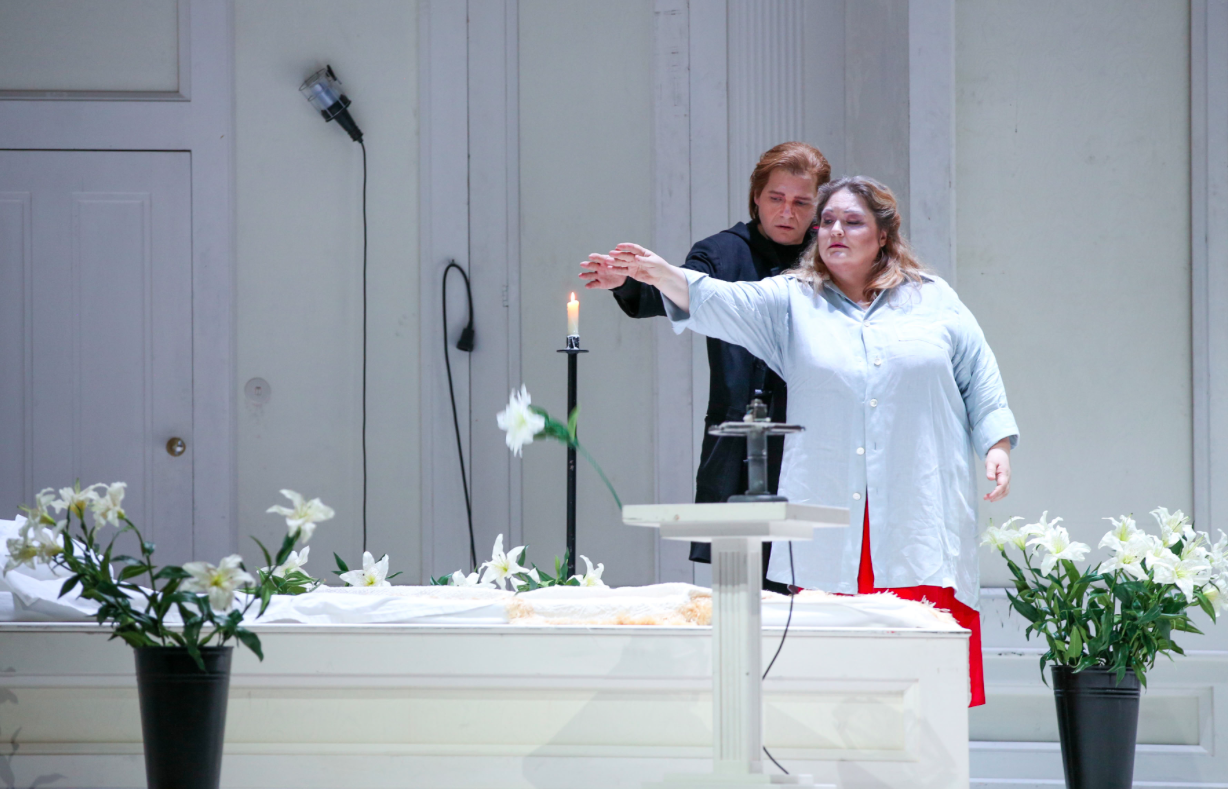
Trug des Herzens, Traum der Ahnung: Tristan und Isolde in Frankfurt

Liebesnacht: Ryan/Wilson in Act II
Photo © Oper Frankfurt/Wolfgang Runkel
It seemed appropriate to me to begin the month of May with Frankfurt's Tristan und Isolde, an opera I've loved since hearing it cold as my first live Wagner. Frankfurt's current run boasts not only an impressive pair of lovers in Lance Ryan and Jennifer Wilson, but strong performances in further roles, and a rich reading of the score from conductor Stefan Blunier. Christof Nel's atmospheric production is a darkly pessimistic one, suggesting that there can be no comfort this side of death, and even that is denied to Isolde. The man next to me dozed stertorously through much of the first act, and whispered more than once in the second two… but I was gripped and moved.

Monday, May 28, 2012

Reading List: The Metropolis Case

As promised by the title, Matthew Gallaway's novel is an elaborately allusive one, drawing on art and architecture, science and philosophy, politics and history, and most of all opera. This literary concoction is less a novel of ideas, however, than an exuberantly erudite adventure novel. There is also more than a whiff of magic realism about it, as the narrative incorporates the improbabilities of several opera plots, and even the glorious impossibilities that opera often seems to promise. Although the title refers to Janáček's Makropulos Case, it is Tristan which is most deeply woven through the narratives of the novel. The opera's history--and the dream of its potential to make and and alter history--shapes the lives of the novel's characters, and gradually brings their lives together.

Thursday, July 21, 2011

Treuloser Holder! Konwitschny's Tristan on DVD

I have not forgotten your collective request for opera DVD posts, Gentle Readers! Now, I do realize that reviews of recent DVD releases are more likely to be valuable than ones for those with a decade's figurative dust on them. But I found Peter Konwitschny's take on Götterdämmerung so impressive that I tracked down his Tristan. Then the unexpected affordability of summer festival events (hooray for student tickets) lured me away and has let this languish... but here it is! Enjoy, and if you've seen it, please do comment with your thoughts; my vague sense is that my positive response may be a minority one. It's a deceptively simple production, but don't let the streamlined visuals fool you, and don't let the hideous couch put you off. I thought this was brilliant, and I found it profoundly moving. I'm not sure how to judge a Tristan orchestra on a DVD; how am I supposed to tell what they're doing if I can't feel it through my bones? That said, I liked the warm sound of the Bayrisches Staatsorchester, which played sensitively and passionately for Zubin Mehta. If there's a choice between the drama and the philosophy of the piece, they emphasized the former.

The dramatic performances are all scrupulously detailed. Brangane and Kurwenal (Marjana Lipovšek and Bernd Weikl) are well-characterized and well sung. Kurt Moll is a Marke of immense dignity; his voice is too worn for pure beauty, but he uses it masterfully. The King in this production is a frail old man, but he loves Tristan and Isolde and they love him, and the fact that, nonetheless, tragedy divides and breaks them... yes, it's always tragic, but it was very humanly so, here. Jon Fredric West gave a conscientiously thought-out Tristan, but he never sounded fully comfortable to me; there was a tendency to come out of his vocal lines with a shout. I was dreading Act III, but the vocal issues bothered me there least. Waltraud Meier took my breath away. Repeatedly. The first time through the DVD, I wondered whether the production would work without an Isolde whose every thought you could see, and whose erotic energy was (for me, at least) a force of destabilizing intensity. The second time through, I became fairly certain that it would. Welcome to the Tristan where the realm of eternal night is staged. Oh, and there is no love potion. Frau Minne kenntest Du nicht? Nicht ihres Zaubers Macht?

Monday, January 18, 2010

Dich grüsste mein Herz mit heiligem Grau'n

If opera tends to be a love-it-or-hate-it art form, surely it has no more polarizing practitioner than that prickly, erratic, quite possibly insane man, Richard Wagner. A musical critic and priest once delivered a lecture series on Wagner tellingly subtitled "The Terrible Man and his Truthful Art." (Available for purchase here.) The man himself was famously inspired by Nietzsche, and the movements of anarchism and nihilism. In turn, Wagner's music inspired Ludwig II of Bavaria to build what is arguably Europe's most recognizable castle (complete with Wagnerian murals and an awesome grotto). It inspired George Eliot, and Marcel Proust, not to mention countless writers of movie and TV music. And yes, it also was embraced by the man whom the inimitable Charlie Chaplin is spoofing here, accompanied by the Lohengrin overture.

LinkWithin

Related Posts Plugin for WordPress, Blogger...