 |
| Placido Domingo & John Denver, ca. 1980 |
Showing posts with label Plácido Domingo. Show all posts
Showing posts with label Plácido Domingo. Show all posts
Friday, July 26, 2013
Great Voices Sing John Denver


Saturday, March 3, 2012
Ogni farfalla da uno spillo è trafitta

Sunday, January 1, 2012
The Enchanted Island: Insubstantial Pageant
 To their credit, the creators of The Enchanted Island (in contrast to publicity materials) do not pretend that it is a baroque pastiche. The work would be better described as a new opera using old music. I'm afraid that a parable about wine and wineskins springs to mind. For despite the excellent music and fine singing, the evening as a whole was something of a disappointment. The opera is not without charm; but all the charm is on the surface. "We like to wrestle with destiny," proclaims David Daniels' Prospero at the conclusion of Act I, as he muses on his lot and that of humanity. For Prospero, and for the production, the vital differences between magic and interference were perilously blurred. I can't explain why the lovers from A Midsummer Night's Dream ended up on Prospero's isle; I'm far from sure there was a reason. Although the profound power of forgiveness was invoked throughout and celebrated at the conclusion, I didn't see that the characters or their society were transformed by it. Giving you a synopsis and an itemized list of the music may be all I can do for you, Gentle Readers. (And how I wish I could, instead, give you a meditation on what the work was about.)
Phelim McDermott's production created a phantasmagorical utopia. The sets, by Julian Crouch, were influenced by eighteenth-century stage scenery, Maurice Sendak illustrations, and steampunk. The overall effect was as magically immersive as a children's book. McDermott himself described his desired effect as being that of a child's dream of opera; William Christie likened it, aptly, to Disney's Fantasia. As you may have guessed, Gentle Readers, there is a "but" of explosive force upon my lips (Phantom Tollbooth reference intentional.) I saw little meaningful or coherent development of character or plot. I anticipate your incredulous responses: yes, both Shakespeare and Handel, upon whose work the evening was substantially based, were masters of psychological insight. The Enchanted Island was not. Jeremy Sams' libretto had moments of subtlety and insight which left me waiting--eagerly and in vain--to see them developed. It was very clever, but sometimes too clever by half. The possibilities of exploring questions of gender, power, and colonization were acknowledged and passed over, in favor, it seemed, of a quartet of lovers, a series of spells, and a dizzying succession of arias. The contrivances whirled by at a pace requiring music originally intended for emotional exploration to serve the needs of exposition. The fine cast gave committed performances, but I wish they had had a better vehicle.
Tuesday, March 8, 2011
Roméo et Juliette: L'heure s'envole


Sunday, February 13, 2011
Iphigénie en Tauride: partage mon bonheur
 |
| Christoph Willibald von Gluck, c. 1775 |
Thursday, January 20, 2011
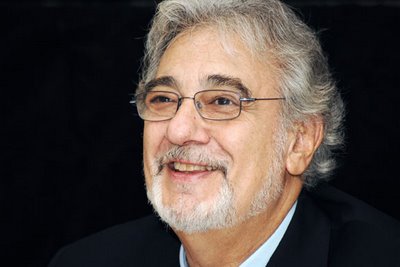
Plácido Domingo: ad multos annos
Friday, March 12, 2010
Egli muore! o, ciel, ei muore!
Last Sunday, as posters around the city and banners on websites insistently reminded me, the Oscars were awarded. In theory (leaving aside the probably disheartening answer of how the system of nomination actually works) this celebrates Excellence in Film Generally. And I have a confession: besides Cinematography, the acting categories are usually the only ones--if any--that really arouse my partisanship. (Related confession: I don't see many films, because if I have a choice between spending $12 on a film and $20 on an opera...!) And all this is leading up to something: what about acting in opera?
Friday, March 5, 2010
Fach Schmach
The title of this post is intended to be read in German, as a confession of shame [Schmach] rather than a dismissive splutter of indifference. Yes, among the Really Shameful Confessions which seem to be piling up is that the concept and limits of fach have been a source of confusion to me. Of course, I've done enough opera listening to understand that a tenore di grazia and a Heldentenor are on opposite ends of a spectrum where lirico and spinto come somewhere in between. But what about a lirico spinto? What about singers who transition into (predominantly) one type of repertoire from another? What about Placido Domingo? When more experienced devotees (usually in the line for Rush Tickets at the Met) started talking about a singer's fach, I remained shyly silent, trying to understand what was going on and what the disagreements were about.
Like the protagonist of Daddy-Long-Legs , however, I usually cope with not understanding things by quietly going and reading up on them. The faithful branch libraries of the NYPL provided me with Fred Plotkin's Opera 101
 (clearly mendacious subtitle: "a complete guide to learning and loving opera.") I found it less patronizing than I had feared (hooray), frequently entertaining, and on pages 125-43 (sneakily viewable through Amazon), informative about fach. What about Placido Domingo? may be a question for the ages, but I feel better informed now. Whew!
Like the protagonist of Daddy-Long-Legs
, however, I usually cope with not understanding things by quietly going and reading up on them. The faithful branch libraries of the NYPL provided me with Fred Plotkin's Opera 101 (clearly mendacious subtitle: "a complete guide to learning and loving opera.") I found it less patronizing than I had feared (hooray), frequently entertaining, and on pages 125-43 (sneakily viewable through Amazon), informative about fach. What about Placido Domingo? may be a question for the ages, but I feel better informed now. Whew!
Saturday, February 6, 2010
Viva Simon, del popolo l'eletto!!!
All three of those exclamation points, I would have you know, are in the libretto of Verdi's Simon Boccanegra. I have just finished listening to this opera, which I love, on the Met broadcast (sadly too busy to make it downtown) and am still a little choked up. I made the acquaintance of Boccanegra by seeing it absolutely cold in Frankfurt in 2007, in a strikingly successful minimalist production, with Zeljko Lucic unforgettable in the title role. While preparing oneself for a performance with some combination of score, libretto, recordings, and history may be the nobler path, I had a fantastic evening entirely caught up in the Hitchcockian suspense of Verdi's drama. This time, more prepared but scarcely less on the edge of my seat, I was treated to Placido Domingo as the Doge, the great James Morris as Fiesco, Adrianne Pieczonka as Amelia and Marcello Giordani as Gabriele Adorno. (Stephen Gaertner was Paolo; perhaps my greatest tribute to his performance is that I originally left him out of my list because of being angry at him. Who could hate Simon Boccanegra? Only evil, sneaky conspirators! Edit: Gentle Reader Bearitone has corrected my original listing of Nicola Alaimo in the role.)
Subscribe to:
Posts (Atom)
LinkWithin
