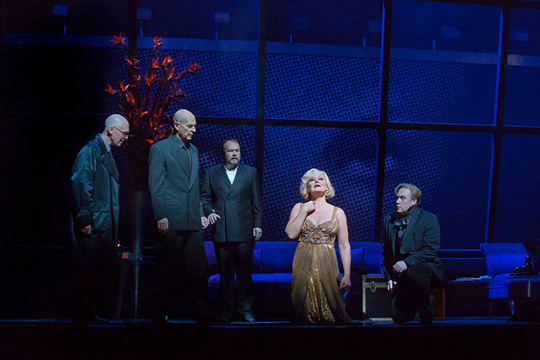
I went to Tuesday's performance of
Lucia di Lammermoor for the sake of the singing, but the quality of the performances from the four principals surpassed my expectations. Even in a production which didn't give them much help, I thought they also each managed to give a striking dramatic portrayal as well. Despite some inconsistent conducting and the tragic absence of a glass harmonica (beautifully played flute solo, but I want my eerie esoteric instrument, please!) Donizetti's
bel canto masterpiece shone. As far as Mary Zimmerman's production goes, I think a stylized visual vocabulary based on the tropes of Gothic literature is actually a neat idea for
Lucia, and the mixture of exaggerating certain elements (see the moon, above) with naturalism didn't strike me as too jarring (
pictures here.) However, and this is a not inconsiderable criticism, I didn't feel the production gave much support to the dramatic arc of the plot or the inner life of the characters; the stand-and-sing syndrome had a tendency to manifest itself. The production did leave space for the characters to have inner life, and the two final scenes were, I thought, superior to the rest of the production in this respect, with Edgardo's death scene visually echoing Lucia's madness very movingly.