Showing posts with label German consonants. Show all posts

Sunday, April 30, 2017

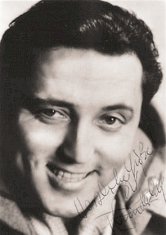
Fritz Wunderlich sings Schlager

The new two-disc collection of Fritz Wunderlich's popular output from the 1950s and '60s is an impressive achievement on several levels. Put out by Naxos in collaboration with Südwest Rundfunk, it's a testimonial to skilled archival work -- in Mainz, Stuttgart, and Freiburg -- and skilled technological remastering. The sound quality is excellent, and it's nice to have a record of several Unterhaltungsorchester. It is also, of course, a testimony to Wunderlich's versatility as an artist. In two ways, this collection is a document of what might have been. According to his daughter, quoted in the CD booklet, Wunderlich seriously considered embarking on a career as a popular singer; only a favorable audition outcome at a propitious moment secured him for the opera world. As this collection testifies, Wunderlich continued to record popular ballads with enthusiasm and skill. In its two hours -- and more! -- of high-quality recording, it is thus also a valuable document of a voice too little heard on the opera stage before Wunderlich's untimely death. 

I might characterize the songs as belonging to three categories: sentimental love songs, sentimental regional odes, and sentimental Mediterranean exoticism. They're pleasant to a fault. Both in the repertoire and in my reception of it, there are similarities to Jonas Kaufmann's recent excursion into Italian ballads. What Kaufmann sings as "Parlami d'amore, Mariù," Wunderlich sings as "Sprich zu mir von Liebe, Mariù," but in both cases, I was left wishing to hear the tenor in rarities of the Italian repertoire. Wunderlich's musicianship is never less than polished and generous. More than once, I was left whimpering with the desire to hear his Lohengrin. But the collection is worth listening to in its own right.

Friday, September 25, 2015

Liedsommer in autumn: Michaela Schuster's Morgen!

Michaela Schuster, photographed by Nikola Stege
I could just tell you that this CD is endorsed by Brigitte Fassbaender and have done, Gentle Readers. But I can't pass up an excuse to enthuse about lieder, and I also wholeheartedly recommend Michaela Schuster's creative, intimate, and sensual recital disc, Morgen! The ambitious selection of lieder--generous samplings of Brahms, R. Schumann, Reger, and Strauss--along with Schuster's reputation as a Wagnerian, led me to expect sweeping magnificence. What Schuster presents, partnered by Markus Schlemmer on the piano, is something much more intimate, and invariably interesting. The disc was recorded during the Eppaner Liedsommer of 2012, and the production process does not appear to have been aggressively interventionist. (Either coughing has been edited out, or the audience was silent with a quasi-miraculous silence.) Voice and piano are sweetly resonant, with spontaneity in interpretation taking precedence over polish. I wish I knew enough about the technology of recording to explain this better; I only know that suddenly hearing Brahms as though performed in a living room was so unexpectedly soothing that I practically melted into the sofa.

Friday, August 7, 2015

Proms Postcard: a belated Beethoven blog post

 My summer, as you may have suspected, Gentle Readers, was mostly spent in libraries, pursuing the Ph.D. which seems to take up more time the further it progresses. But! under the good influence of Zerbinetta (recently reporting on Bregenz, for those indulging in vicarious opera-travel or planning their own) I was pulled away from my desk and up to London for a gorgeous Sunday afternoon. My experience of the famous queue was enjoyable and fairly low-key. Arriving in mid-afternoon, we took our seats on the stairs, were eventually given numbered slips marking our appointed place, and were instructed not to be absent for more than half an hour at a time. As at the Met, and perhaps as in any opera queue (cf. Benzecry's anthropological study) official staff were joined, and sometimes challenged, by line regulars in the enforcing of good order. But it was all very pleasant, and rather less hectic than I'd expected. (Picnicking highly recommended.) Later in the afternoon, the queue became longer and more anxious, but everyone seemed to get in. Once packed in the arena, it became somewhat difficult to struggle out in the interval, as those standing sat down... but despite suffering from mild claustrophobia, I was never uncomfortable. And the concert itself? With Andris Nelsons leading the magnificent CBSO in the music of my beloved Beethoven, it was a treat indeed.
Sunday, October 26, 2014

Ich habe genug: Bach and Brahms with the BSO

This past weekend took me to Boston; having learned that Bryn Terfel and Rosemary Joshua would be performing in Brahms’ Requiem with the Boston Symphony Orchestra, it was to the first of their concerts I repaired on Thursday night. A poignant “Ich habe genug” was paired with Brahms’ sweeping choral masterpiece, and it was interesting to compare the emotional complexities and musical modes of expression in the two pieces, with their different relationships to the tradition of German sacred music. Another unexpected revelation was the performance of the Tanglewood Festival Chorus, who offered a compelling and nuanced exploration of Brahms’ vast harmonic and emotional landscapes.

Saturday, May 3, 2014

Trug des Herzens, Traum der Ahnung: Tristan und Isolde in Frankfurt

Liebesnacht: Ryan/Wilson in Act II
Photo © Oper Frankfurt/Wolfgang Runkel
It seemed appropriate to me to begin the month of May with Frankfurt's Tristan und Isolde, an opera I've loved since hearing it cold as my first live Wagner. Frankfurt's current run boasts not only an impressive pair of lovers in Lance Ryan and Jennifer Wilson, but strong performances in further roles, and a rich reading of the score from conductor Stefan Blunier. Christof Nel's atmospheric production is a darkly pessimistic one, suggesting that there can be no comfort this side of death, and even that is denied to Isolde. The man next to me dozed stertorously through much of the first act, and whispered more than once in the second two… but I was gripped and moved.

Friday, October 25, 2013

Tannhäuser: dem unsren sei dein Lied nicht fern

Desire and the dangers of female archetypes: Tannhäuser Act III. Photo (c) Oper Frankfurt


I only made it into Thursday's performance of Tannhäuser by the skin of my teeth, nabbing the last rush ticket about four minutes before curtain. Frankfurt's house was packed, eager, and informed, respectfully silent during the performance, and busily chatting about this and other Tannhäusers during the intervals. The adrenaline rush of ticket-getting may have contributed to my sensitivity, but I found the treatment of the score by the orchestra under Constantin Trinks never less than exciting and compelling. Although I did not find all aspects of Vera Nemirova’s production equally convincing, it was both intellectually sophisticated and viscerally moving. Its greatest achievement was in handling Wagner’s presentation of dichotomous feminine ideals, exposing the perniciousness and inevitable violence of such attitudes. This was achieved by teasing out many of the other ideas in the score (Dresden version) and libretto. I appreciated that religious faith was not treated as intrinsically foolish or deluded, as I appreciated Nemirova’s refusal to treat the sentimental piety of the text as though it were both profound and axiomatic. Instead of a fictionalized thirteenth century, Nemirova creates a fictionalized 1960s for the drama of desire, conviction, and community. 

Monday, January 30, 2012

Götterdämmerung: So gut und schlimm es geh'

In a world where the gods don't matter, why should we care about their downfall? In the last installment of his Ring, Robert Lepage has banished the gods to plaster-of-Paris altars, which are exploded (almost comically, I regret to say) in the conflagration of the Gibichungs' hall. An exploration of how the (misplaced?) religious devotion of the mortals is used to justify their own decisions was, however, lacking as far as I could see. The Gibichungs' society, indeed, was surprisingly functional, as were the sibling relationships of Gunther, Hagen, and Gutrune. Theatrically, I felt that this was the best yet of the Lepage productions, but its apparent lack of conviction is a crippling defect. (For instance: the Norns' weaving creates a series of impressive images, but its unraveling is not attuned to the moment when the music registers the horror of "Es riss!") Without either an argument for wider significance to the events of Götterdämmerung, or an ironic commentary on the lack of such significance, the production is reduced to a series of tableaux, which no amount of grandeur can save from triviality.

The musical performances were of a high standard, and offered much to ponder, even if dramatically shackled by the vagueness of the production. Rather than a Götterdämmerung of grandeur, guts, and glory, Luisi gave a reading of the score which was transparently detailed, intimate, even introspective. I really appreciated this--the Rhine journey was at its most gorgeous--although it was perhaps not without its drawbacks. The timpani before Siegfried's death, dying into silence, could have been the last rattle of breath, the last flutter of a pulse; the crash of sound that initiates the Trauermarsch can hardly fail to stun, but I wanted it to overwhelm. The portrayals of the singers were also characterized by impressive emotional nuance, which Lepage must have taken care over (but this is Götterdämmerung, where it is never just about the individual.)

Friday, October 28, 2011

Ich lausch dem Gesang: Siegfried at the Met

Despite some very fine singing, and some very fine orchestral playing, the Met's new Siegfried was less than fully satisfying. Robert Lepage promised hyperrealism, and this he delivered; the Machine has come into its own as a representational set. But that is all it is (and it nearly ground to a halt, with ominous clanking, between the second and third scenes of Act III; that Siegfried did not fear the fiery cliffs was indeed impressive.) The visual influence of Fritz Lang was apparent, and I was reminded of a cherished childhood possession, The Story of Siegfried. This is more than a failure to provide a clear and consistent interpretation; this is a problem. Siegfried is the only one clad completely in "medieval" costume; the rest are more directly inspired by the nineteenth century. I find it hard to believe that anyone charged with directing the Ring could be unaware of, or insensitive to, the problems in depicting Mime and Alberich in working-class clothes of the nineteenth-century, and then making them unrepentant and unsubtle schemers against our nature-child hero. Worse: Mime is made into a child-stealing hunchback. This allows Lepage to visually echo, in the dying Sieglinde's futile reach for her child, the dying Siegmund's reach for his wife. But: that is not how you deal with the question of whether or not Mime is an antisemitic caricature, Robert Lepage. [Update: Likely Impossibilities has a post about this.] After this, Brünnhilde as Pre-Raphaelite fantasy--Waterhouse would have been proud of that radiant, autumn-haired woman, shift-clad in a meadow--seemed positively innocuous. The few non-literal touches in the staging--Wotan causes the sun to turn blood-red in Act I, and unrolls the bark from around his staff in Act III--I found more confusing than illuminating.

Sunday, June 12, 2011

Modernism, Morbidity, and Eroticism with the NYPhil and Deborah Voigt

Arnold Böcklin, Der Toteninsel (New York version, 1880)
The musicians of the NYPhil are back in town and, under the baton of David Robertson, were in excellent form on Friday night, giving an intriguing program of Shostakovich, Rachmaninov, and Schoenberg.  And before I give my impressions of the proceedings, I would like to step onto a metaphorical soapbox for a moment and deplore the fact that the hall was far from full. Advance student tickets were available; there was a week-of special price offer for all e-mail list subscribers for any seat in the house. This is the NYPhil, people! You know, one of these world-class institutions this city does so much boasting about. I sat in the orchestra, with a fifteen-dollar ticket that I knew I'd only have to buy fifteen minutes before the bell. You're neglecting your arts organizations and depriving me of my traditional student-hardship narratives! And more importantly, you're missing out!  On Friday, we got three pieces from the tumultuous early years of the twentieth century, passionate considerations of nothing less than matters of life and death. Oh, and sex. That too.

Tuesday, March 29, 2011

Höheres gilt es als Zeitvertreib

Kaiser and Fleming; (c) Ken Howard/Metropolitan Opera
Wort oder Ton? Ton und Wort... The Met's elegant Capriccio helped me understand better how Richard Strauss' last opera could be both a concatenation of playful jokes about the operatic genre, with heavy helpings of Straussian irony, and a thoughtful exploration of some of the unresolved (unresolvable?) questions of how opera--and all art--moves us, and why.  In the hands of an accomplished cast, the conversation in this conversation piece seemed both witty and genuinely-felt, rather than merely self-absorbed (this was a problem I had while merely reading the libretto and listening to recordings, I admit. And yes, I realize how funny it is that that should be the case with this particular opera.)  I may never become a devotee of Renee Fleming, but I think she's at her best in Strauss, and her diva-charisma was of not insignificant importance to creating a credible Madeleine.  Those in the countess's orbit ranged from creditable to excitingly good, so I had a lovely night, though I never experienced the quasi-mystical emotional release Madeleine extols.

Tuesday, September 28, 2010

Rheingold! Rheingold!

(c) Ken Howard/Metropolitan Opera
Leuchtende Lust!  Robert Lepage's Rheingold design may not deserve to be labeled as an artistic triumph, but I do think it can be called a success.  It doesn't read against the libretto; the action is clear, and Lepage seems to be more interested in showing off Wagner's drama (and, sometimes, his own technical imagination in doing so) than imposing a heavy-handed interpretation on it.  This is not to say that it was devoid of ideas.  The use of space was creative, placing singers in arresting tableaux and dramatic interactions.  He wasn't afraid of the opera's moments of humor, but let them happen.  And we got a Riesenwurm with thrashing tail menacing Wotan from one side of the stage and fossil-like head, with malicious tongue and deadly jaws, entering from the other: es wand sich ringelnd!  There were moments where the interaction between realism and abstraction didn't sit perfectly easily, but overall it worked well.  There was, occasionally, an audible, unsettling creaking as the enormous mechanism shifted; I imagine, and hope, that something may be done to silence it.  Update: a Met gallery of production photos may be found here.

LinkWithin

Related Posts Plugin for WordPress, Blogger...