 |
La Gazza Ladra and the theater of justice
Photo © Oper Frankfurt/ Wolfgang Runkel |
I confess that, in trying to summarize the plot of
La Gazza Ladra (
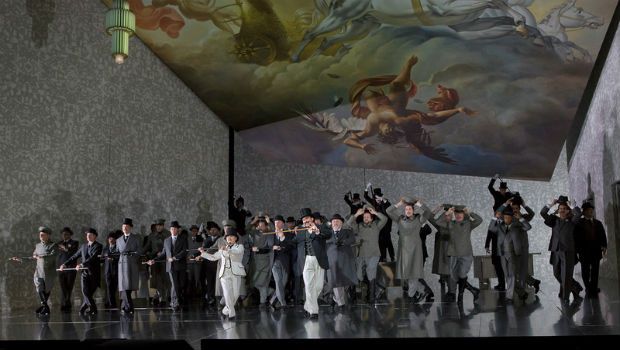
Die Diebische Elster on Frankfurt's posters,) I've often fallen back on over-simplications: "A bird steals silverware; confusion ensues; star-crossed lovers live happily ever after, eventually." But although this is not inaccurate, it is misleading. The late-nineteenth-century assessment of Rossini as a composer of cheerful, even superficial music, has clung stubbornly to this rarely-performed work, the overture to which has been used as musical shorthand for sinister insouciance. The new production by David Alden, which I saw on Saturday, is designed to strip all that away, following instead a darker vision, realized well by singers and orchestra. Rossini created a happy ending for the opera, but petty and systematic tyrannies, offhand and official acts of oppression, characterize its unfolding. The composer used a ripped-from-the-headlines plot; the unjustly accused maidservant in the original episode was, in fact, executed. Rossini wrote at a time when much of Italy was under occupation, which would have influenced how the sinister brutality (and absurdity) of officialdom in the opera was perceived.
 |
Pippo and the Magpie
© Oper Frankfurt/Wolfgang Runkel |
Alden sets his production approximately a century after the opera's 1817 premiere, using a predominantly black-to-white palette (significantly, mostly in shades of gray) and doing much with individual characterizations, as well as clever use of stagecraft. Everyone here is in danger of being crushed: the bourgeois couple, where the woman presides over her realm in brittle denial of the fact that her power is not absolute, and the man uses his wealth as a means to escape, wearing the clothes of a young and forward-thinking man, and drinking like a man with no future. There is Pippo, whose often inexplicable conduct is here motivated by the traumas he has suffered wandering a war-torn landscape, the magpie his only companion. The podestà is more acutely aware than anyone of how easily his iron rule could be toppled, how necessary his theater of power is. Then there are our young lovers, miraculous optimists: Ninetta who believes in the power of honesty to save her, who views the return of her lover and her father with nothing but joy; and Giannetto, who is as fearless in fighting for domestic justice as he is reputed to have been on the battlefield. The performance was notably well sung. This and the thoughtful, nuanced, and darkly humorous engagement with the opera's
libretto, combined with--in close collaboration with--a biting, energetic reading of the score under the leadership of
Henrik Nánási, helped me hear Rossini's music in new ways.

 ) should show the Met audience that spectacle doesn't have to come coated in glitter or burdened by brocade.

