Showing posts with label Eve Queler. Show all posts

Tuesday, April 9, 2013

I Lombardi alla prima crociata: o nuovo incanto

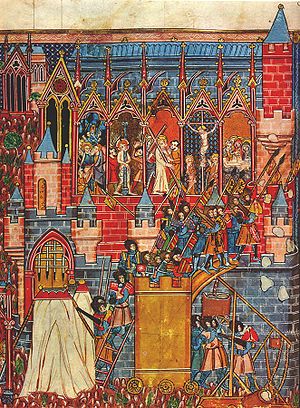
The Siege of Jerusalem, 1099
(from a 12th-century chronicle)
Verdi's fourth opera, written when he was 29 years old, was penned at a time when Meyerbeer's grand operas were beginning to dominate the opera stage, and when resistance to foreign occupation was beginning to dominate Italy's political stage. Both influences are apparent in I Lombardi alla prima crociata, which the composer makes far more interesting and nuanced than Temistocle Solera's libretto, based on an epic poem (!), gives it any right to be. The most striking anachronism of Verdi's opera is its most conspicuous: there was no single word for crusade at the time of the first or indeed the second strange, sweeping, composite movements which would become known by that name (and under that name famously condemned by Steven Runciman as "one long act of intolerance in the name of God, which is the sin against the Holy Ghost.") The libretto for I Lombardi acknowledges the spirit of pilgrimage and the mixed gender of the European hosts; it also, however, claims a mercenary motive which recent historians have noted was implausible in view of the extreme expense and danger involved. Mortgages and wasting fevers were well-known hazards to the Lombard and Frankish hosts, and yet they journeyed to what they called "Christ's land," determined to possess and administer it as faithful vassals of the Lord of Lords. Verdi's music is alert both to the poignancy of pilgrim aspiration, and to the deep tragedy of the perversion of that aspiration into bloodthirstiness. The lovers Oronte and Giselda, often in text he gave them himself, are aware of the contradictions in so-called holy violence: Oronte is convinced of the truth of Giselda's faith because of her own patience and generosity of spirit. In the tremendous finale of the second act, Giselda inverts the cry of the crusaders in screaming against her father's bloodshed: "God does not will this." Michael Fabiano and Angela Meade gave impressive performances in these crucial roles, at the heart of a gratifyingly tight performance from the Opera Orchestra of New York under their respected director Eve Queler.

Tuesday, January 31, 2012

Rienzi: Sage an, hast deine Sendung du vollbracht?

Opera Orchestra of New York: Chauvet, Matos, Storey (c) AP Photo
Wagner's 1842 opera Rienzi is a heady cocktail of medieval history and political idealism, shaken together in grand operatic fashion (libretto here.) Hardly a curiosity from a noted composer's juvenilia, Rienzi was among Wagner's most popular operas during his own lifetime. Music historian Carl Wilhelm Bauck, writing in the 1860s, characterized Rienzi as possessing "an unusual power, a living spirit, [and] a design of massive, even at times imposing dimensions, and that this all springs from an imagination that surrounds all that enters its purview with burning colors." Another early review praised its "energy of feeling and warmth of imagination." That it is rarely performed, and still more rarely staged, may be partly due to the demands of this form: elaborate processions--and a cast of dimensions to make Cecil B. DeMille proud--do not come cheap. There is also the question of how to piece the opera together; the original manuscript has been "lost, presumed destroyed" since the Second World War, so some cuts are inevitable and, given its massive length (over 8000 bars) further editing is a commonplace. The three-hour version given by the Opera Orchestra of New York (slightly shorter than the EMI recording) was missing some ambassadors and a ballet, but the former are easily omitted from the elaborate plot, and the latter perhaps a prudent excision from this concert performance. (I didn't notice specifics of other cuts; Zerbinetta's report on Likely Impossibilities will almost certainly have a more detailed and thoughtful consideration of these issues.) What of the work itself? Like the early critics cited above, I was drawn in by its musical and dramatic vividness. Many of Wagner's characteristically rich harmonies are present, as are his concerns with the individual's relationship to social institutions. But all of this inhabits, in structural and stylistic terms, the world of grand opera--most decidedly, the world of Meyerbeer--rather than the late nineteenth-century orchestral landscape which Wagner himself did so much to create.

Thursday, March 3, 2011

L'Africaine: A Love Triangle and a Poisonous Tree

Principals of L'Africaine 1865 premiere in costume
L'Africaine is Meyerbeer's final opera, polished and premiered posthumously.  In my quest to read up on it, I found a site for the Meyerbeer Fan Club which shows its age, but contains discographies and links to scholarly articles, not to be despised.  There's a synopsis here.  It would seem not unstageable in the twenty-first century--see this detailed review of a 2004 production by the Opera du Rhin--despite the drama deriving from encounters between Europeans and an extravagantly exotic Other.  The identity of this Other is somewhat flexible; the libretto--by none other than  Eugène Scribe--started out with the action in Africa and Spain, but later revisions placed the story in Portugal and India.  No civilization has a monopoly on stock villains in the opera, as there is both a character who invokes Indian gods against sailors, and an Inquisitor; in fact, the dagger-wielding, pagan-gods-invoking Nelusko is a fairly complex character.  The only libretto I could find was an English translation of the hilariously ornate variety.  (Also impressively ornate are the headdresses worn by Selikas of the past.)  As far as I could judge from the text, there are both subtleties and ambivalences in how the characters are presented.  These uncertainties and inconsistencies, I would argue, make this fantasy narrative about Vasco de Gama, his ambitions, and the two women who think he's just the dishiest thing, more stageable rather than less.  My cursory investigation seems to reveal a dizzying lack of consensus among scholars as to the actual natures and motivations of the characters.  Naturally this entails a certain amount of disagreement as to the Point Of The Opera as well.  The Opera Orchestra of New York skipped past the historical-philosophical debates in the tagline: Torn Between Two Lovers--How Will It End? 

My impressions are of course hampered by the fact that this was my first hearing of the music, but I was favorably impressed, if not transported.  Eve Queler was--understandably and, I think, commendably--applauded with a fervor that acknowledged her role as the OONY founder.  However, while the orchestra gained in energy over the course of the evening, I suspected that the music could have been given more variation in dynamics and tempi to communicate the emotional drama of the score.  Maybe I'm looking for something that's not there, but the orchestration, the vocal characterization, and the libretto all seemed to suggest the possibility for more intensity than I experienced.  Still, the music was interesting and evocative.  Piccolos, soft cymbals, and a triangle may seem like a musical cliché in the introduction of the Exotic Other, but if everyone else was copying Meyerbeer, one can't blame him (except for Orientalism.)  The scene where de Gama's plans are debated in council was dramatically great--factions of a male chorus shouting at each other over an orchestra, with more important characters voicing their own motivations as well!--and the music of the mysterious island was lushly sensual.  I'm not familiar enough with the score to say whether or not there were cuts; the music and drama developed smoothly, though.

LinkWithin

Related Posts Plugin for WordPress, Blogger...