Showing posts with label Mariinsky. Show all posts

Tuesday, October 11, 2011

Russian Romanticism at Carnegie Hall: Gergiev and the Mariinsky do Tchaikovsky

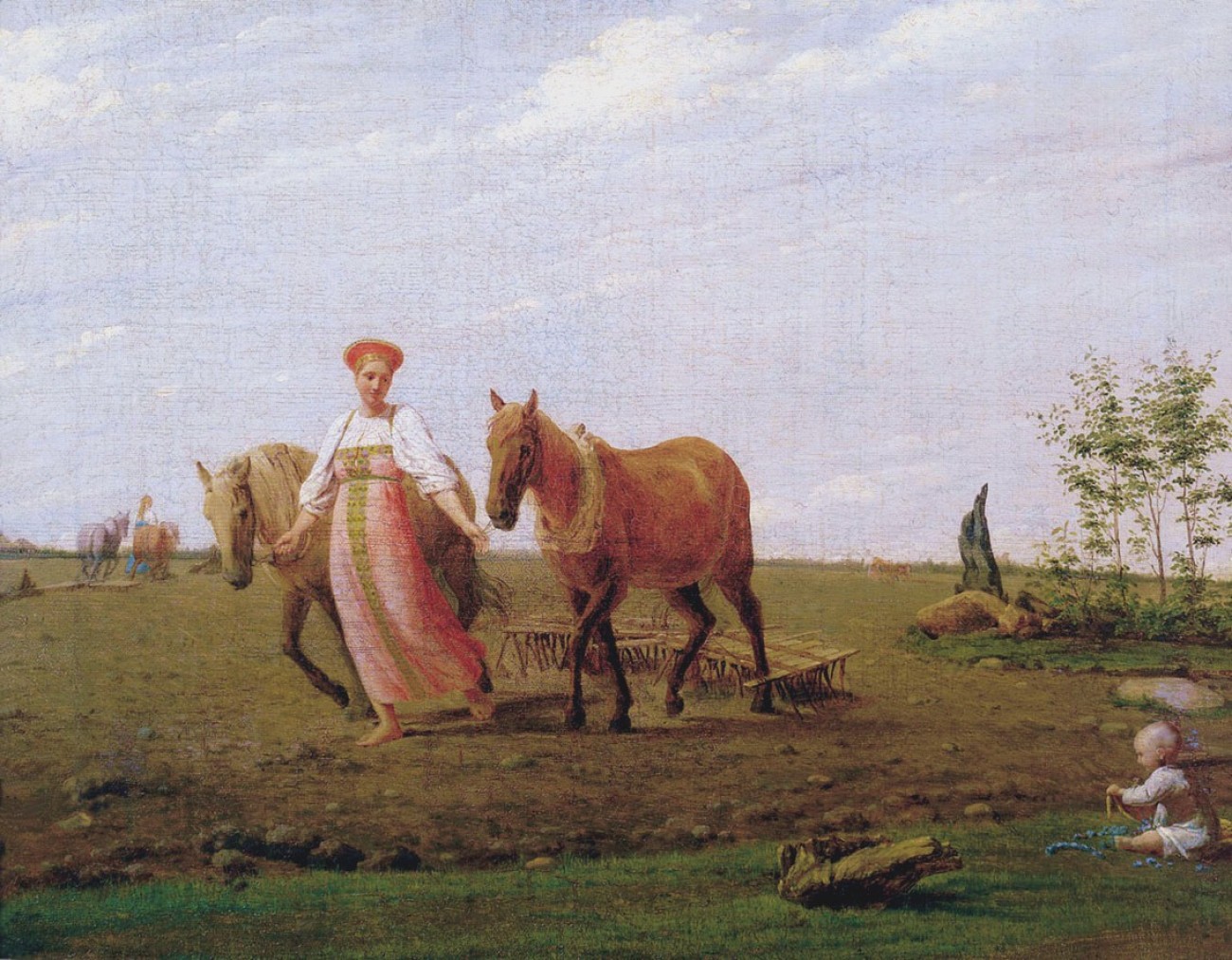
Spring Plowing: Alexsey Venetsianov, 1820s
Pyotr Ilyich Tchaikovsky, despite or because of the widespread popularity of much of his music, has often been regarded as a composer of more passion than profundity. I confess that I've even wondered from time to time whether my own regard for him wasn't at least partly the result of really, really good emotional manipulation via the seductions of Swan Lake etc. The Mariinsky Orchestra is currently performing a series of concerts at Carnegie Hall, bringing a powerful reminder of Tchaikovsky's skill and creativity with the symphonic form. In Monday night's concert, the pairing of the third and fourth symphonies provided a fascinating journey through the many moods of Romanticism.
"I am now composing a new symphony, but am taking it steadily, not spending all my time on it, and taking long walks." --Tchaikovsky in a letter to friends, summer of 1875 
In the first half of the concert, the third symphony charmed with a robust, Romantic pastoralism. Although the symphony is sometimes known as the "Polish," the adopted dance forms of its five movements evoked a robust rusticity which (however artificially constructed) did not have the specific national connotations which that title suggests (see this article by R.S. Edgecombe for more context on the use of dance forms such as the waltz in the Romantic symphony.) Thanks to the musicians of the Mariinksy, this seemed full-blooded rather than merely quaint. The dark-hued strings evoked fields ripe for the harvest, and the well-handled woodwind solos the dancing with which the harvest was celebrated. The romanticism I always associate with Tchaikovsky was indeed present, but in the exuberant celebration of nature and those who lived close to it, worlds away from Sturm und Drang. The tempest was to come.

Friday, October 22, 2010

True Symphony: Gergiev leads Mariinsky in Mahler's 8th

Fluchtdrang war sie, daß er es sich eingestand, diese Sehnsucht ins Ferne und Neue, diese Begierde nach Befreiung, Entbürdung und Vergessen,--der Drang hinweg vom Werke.  --Thomas Mann, Der Tod in Venedig

It is simplicity itself, the true symphony, in which the most beautiful instrument of all [the human voice] is led to its calling. --Mahler, correspondence on the Eighth Symphony.

Tome on marriage litigation stuffed into my purse, guilty knowledge about the hours of the open library I was missing stuffed to the back of my mind, I sped downtown last night for the only concert in this week of Mahler at Carnegie Hall that I could possibly make.  Valery Gergiev led what I think can safely be called his orchestra, that of the Mariinsky, with soloists from the same theater and Orfeón Pamplonés, the Choral Arts Society of Washington, and the Brooklyn Youth Chorus Academy.  I was told at the box office that, by request of Maestro Gergiev, holders of the ten-dollar student tickets would be seated in the first rows, rather than in the back of the balcony.  I was thrilled.  I love being able to sit in Carnegie at all for that money, but actually walking into the beautiful gold hall, rather than climbing up the back stairs and trying not to bump my head on the ceiling and sitting with my knees jammed against the row in front of me, was a real treat.  It did affect the balance of how I heard the music (the choirs probably rode over the orchestra more for anyone who wasn't sitting practically underneath the first violinist) but such issues were counterbalanced for me by getting to watch the conductor and the musicians... and feeling the music of the climax vibrating through my bones.

Thursday, March 11, 2010

Nuits d'ivresse

Grand-operatic sensibilities turned loose on a masterwork of world literature, containing the ruin and founding of civilizations... I knew I wasn't going to see a fully-staged production of Berlioz' Les Troyens for some time. I also know that travel to St. Petersburg is not in my near future (more's the pity.) So this week's Carnegie Hall concerts with Valery Gergiev and the orchestra, chorus, and soloists of the Mariinsky were welcomed with jubilation. (The split--Acts I and II on Tuesday, III-V on Wednesday--was irksome, but I noticed a considerably fuller house for the second half, and there were mid-concert departures both nights, so I may be in an unwearied-by-Berlioz minority.)

I can't imagine what Maestro Gergiev would do on a podium; here he stood in the midst of his orchestra (in a space curved forward like a proscenium in reverse) behind a music stand. And "stood" is a misleading verb. On the second night, his movements were usually limited to an encouraging sashay to one side or the other, or a few steps back to give scope to his cues for the chorus. In directing the frenetic fall of Troy, however, he fairly danced, darting and swooping with the movements of the music itself. There were moments when, directing the chorus, he actually left the ground with both feet. Nor did this come across as histrionic distraction; the orchestra and the chorus reflected his energy.
LinkWithin

Related Posts Plugin for WordPress, Blogger...