 |
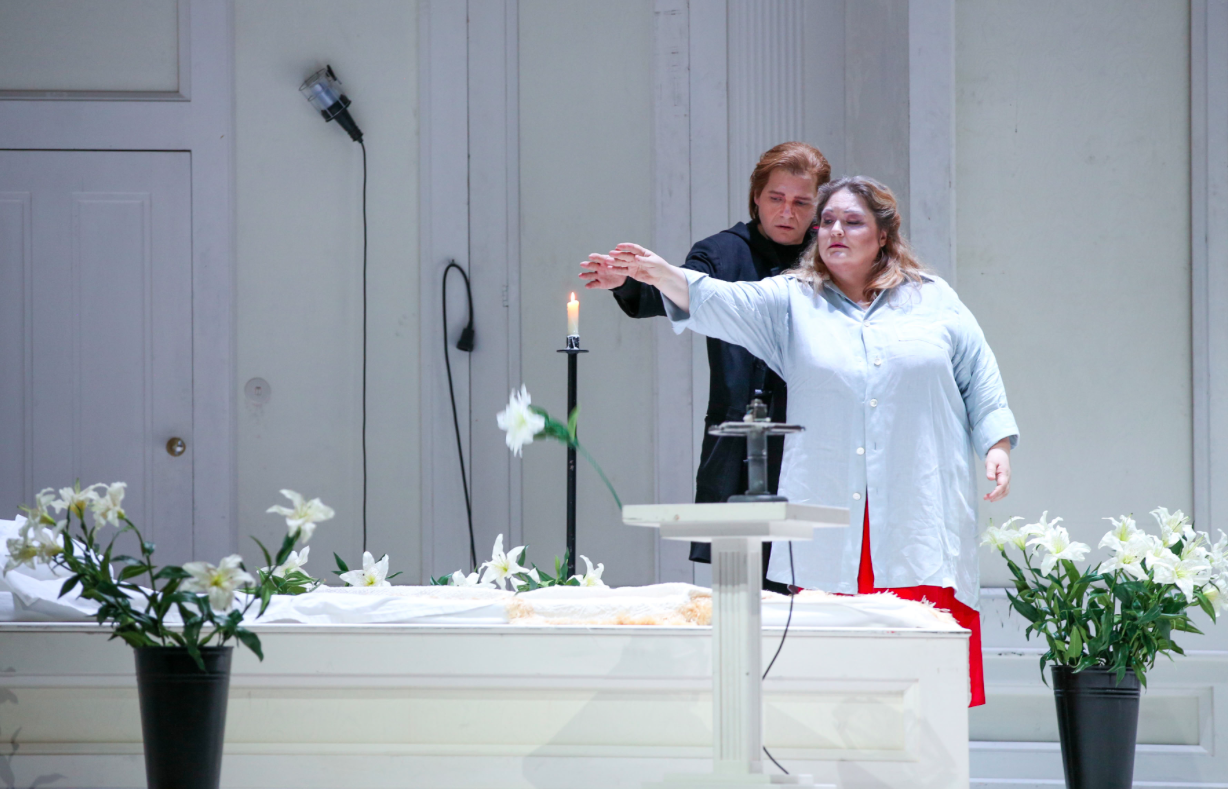
| Liebesnacht: Ryan/Wilson in Act II Photo © Oper Frankfurt/Wolfgang Runkel |
Showing posts with label Christof Nel. Show all posts
Showing posts with label Christof Nel. Show all posts
Saturday, May 3, 2014
Trug des Herzens, Traum der Ahnung: Tristan und Isolde in Frankfurt


Sunday, February 23, 2014
Reading List: Warum Oper?
The last few weeks of my reading-on-public-transit time have been spent with "Warum Oper?" (Why Opera?) a collection of interviews with opera directors which was published in 2005. Barbara Beyer, herself an opera director, leads 14 conversations circling around this question. "Why opera?" quickly splits into "Why do you dedicate yourself to engaging with opera?" or "Why does (or should) society engage with opera?" The answers provided by those interviewed are remarkable for being both rigorously thought out and intensely personal. Working one's way through these conversations provides insights and opinions from a "who's who" of directors working primarily in German-speaking Europe: Calixto Bieito, Claus Guth, Peter Konwitschny, and Martin Kusej among them. Somewhat to my surprise, Karoline Gruber was the only woman whom Beyer interviewed. I loved reading the book, but its virtues make it difficult to summarize. Rather than working through a set list of questions, the conversations as reproduced here seem to flow from topic to topic, responding to issues raised, sometimes structured to provide contrast with (or responses to) other interviews in the book. As someone not very familiar with the history of movements and key figures in 20th-century opera direction, I enjoyed the background provided on previous generations of directors, and was surprised by the diversity of approaches and philosophies represented by those interviewed. I was also impressed by what all the directors (with the possible exception of Sebastian Baumgartner) shared: a deep passion for and trust in opera scores, and tireless willingness to challenge themselves.
Wednesday, June 1, 2011
Stuttgart Ring: Die Walküre
After watching Christof Nel's version of Walküre, I have concluded that I am musically spoiled by the Met. I even had a moment of weakness in which I wondered whether being faintly bored by a production was better than being deeply frustrated by one. This was a Walküre which lost mythic romance without substituting gritty bite. The program notes inform me that the director saw his role as that of a psychoanalyst, who wanted to reveal the internal conflicts and ambivalences of the characters, using "today's materials." I'm sorry, but putting Sieglinde in a print dress rather than a medieval kirtle does not automatically make her plight more moving. Brace yourselves, Gentle Readers; I'm going to rant! Act I of the staging specializes in emphasizing the obvious. In introducing gestures mimicking those of lust into Siegmund and Sieglinde's first exchange, I would accuse it of reducing the profound to the profane. Awkwardly stylized movements sat oddly with a set and properties which are insistently mundane. Robert Gambill's voice is leaner than what I usually expect from a Siegmund, but he had some beautiful phrasing, and I liked his tone. I found him sympathetic, as well, though it would be hard not to feel sorry for a man wearing a Lycra tank top, knit shorts, and an iridescent blue windbreaker. He also contributed moving moments in Act II, though he seemed a shade underpowered (the Stuttgart audience loved him, so maybe he was fine in-house.) Angela Denoke was, similarly, a slightly small-voiced Sieglinde, and I thought she had some intonation problems, but I'm not sure whether that might be the fault of the recording. The sword bore an unfortunate resemblance to a butter knife, but what the staging did with it was rather interesting: first visible as a sword of light on Sieglinde's body, the weapon itself is revealed when the walls open out during "Du bist der Lenz."
Subscribe to:
Posts (Atom)
LinkWithin
