Showing posts with label New York Philharmonic. Show all posts

Monday, June 10, 2013

Vieni fuori: Dallapiccola's Prigioniero with the NYPhil

I went to Saturday's concert with the New York Philharmonic for the sake of Luigi Dallapiccola's rarely performed Il Prigioniero, but ended up being entranced by the Prokoviev violin concerto which preceded it, as well.  Alan Gilbert and his orchestra were on very fine form. The degree of subtlety which they achieved in the concerto, and the sheer variety of orchestral textures in the opera, both were very impressive. I thought the latter might have used a little more dynamic restraint, but I don't know the score, and the overwhelming quality of the fortissimi may have been just what was called for.

Prokoviev's first violin concerto is singularly lovely; in this performance, it also registered as uneasy and elegiac. Its unusual form and unusual melodic patterns seemed to be gesturing towards an inarticulable truth. Lisa Batiashvili played with clarity and, in the first and third movements, with a haunting, remote melancholy of tone. Within the melancholy of the first movement she found extraordinary nuance, using the melodic progressions to move from near-anger to reflection sensual and sad as a rainy day, expressing questions of hope and fear. The strings supporting her were soft and smooth, the winds skillful and sympathetic in their echoing of the solo line. Gilbert emphasized the aggressive plurality of conflicting orchestral voices in the scherzo, with malicious pizzicato strings, wild winds, and dangerous brass. Batiashvili too embraced the unsettling mischief of the movement, varying her bowing technique, sometimes sweeping or bouncing against the strings, sometimes playing with almost delirious fluidity. Against the driven rhythms of the strings, the anxious questioning of the woodwinds, the plunging brass in the third movement, the dreamy romanticism of the solo violin wins an improbable victory. The intensity of the opera, in the second half, was of a different nature.

Sunday, April 28, 2013

And the dark became desire: Renée Fleming and the NYPhil at Carnegie Hall

The centerpiece of Friday evening's Carnegie Hall concert was unquestionably Anders Hillborg's The Strand Settings, a song cycle commissioned by the New York Philharmonic for Renée Fleming, and receiving its world premiere. Just as unquestionably, the occasion was an event: the buzz of audience chatter proclaimed eager anticipation in several languages. The performance, in its energy and subtlety, gratified this anticipation not only in the haunting, lapidary lieder, but in surprisingly nuanced and insightful accounts of two repertory staples. The programming of Respighi's Fountains of Rome and the Mussorgsky/Ravel Pictures at an Exhibition alongside Hillborg's work helped me hear each of the familiar works differently.

Friday, March 15, 2013

Bach's Mass in B Minor with the NYPhil

I have to accept the way [Bach] believed. His music never stops praying.... I do not believe in the Gospels in a literal fashion, but a Bach fugue has the Crucifixion in it—as the nails are being driven in.  --György Kurtág

This week, the New York Philharmonic's ongoing Bach Variations festival brings a deeply impressive slate of soloists to join the orchestra and the New York Choral Artists as Alan Gilbert leads his first performances of the B Minor Mass; I attended the first of these on Wednesday. For me, this was the first live performance of a piece I've listened to countless time since it taught me, when I was seven, that grown-ups could cry, and it's music I love deeply. It's music that's prayed with me and that has prayed for me when I could not. Under Gilbert's baton, the order and beauty of the baroque were celebrated in all their magnificence. Collectively and severally, the members of the orchestra delivered passionate and polished performances. And the evening led me to ponder: when it comes to Bach--especially when it comes to this Bach--can one achieve excellence without confronting eternity?

Wednesday, July 11, 2012

Tchaikovsky, Trpčeski, and the NYPhil

Had it not been for the prospect of hearing Simon Trpčeski play Tchaikovsky's second piano concerto, I might have given the Philharmonic's last "summertime classics" concert a miss. As it was, I went, marveled at Trpčeski's performance, and enjoyed the noisy pleasures of the Festival Coronation March and the 1812 Overture. And the selections from Swan Lake turned out not to be the clichéd ones I was half-fearing, but a substantial excerpt selected by conductor Bramwell Tovey. On the whole, a quite successful evening.

The Festival Coronation March, occasional music for that grandest of occasions, the 1853 coronation of Czar Alexander III, is solemn and jubilant by turns, and unmistakably celebrating its own importance as well as that of the occasion. "Look!" say the brass, "are we not splendid?" "Just think of it," urge the strings: "is this not grand?" The New York Philharmonic--almost incongruously, it seemed to me--played it with an air of resolute conviction belonging to that time of sweeping skirts and vast empires. The second piano concerto made a welcome change to the abstract and virtuosic, and was given with no less gusto. (I sometimes forget Tchaikovsky's enthusiasm for noise.) After some opening remarks by Tovey on the piece's structure, they were launched and away, and it seemed that Trpčeski scarcely paused for breath during the first movement. After about five minutes, I found myself quite literally open-mouthed. Trpčeski's facility was astonishing; he not only dispatched credulity-defying runs, but created interesting variations in tone and dynamics while doing so. (At one point, with his hands positioned close together, his left seemed almost perpendicular to the Steinway's keys. Another point of interest to me was that Trpčeski often played from the first knuckle. Extraordinary.) The slow movement offered a welcome opportunity to savor more leisurely--and exquisitely beautiful--phrasing. Hearing how the orchestra and soloist brought together the themes of the concerto in the final movement was to me viscerally exciting.

Friday, June 22, 2012

Season's end: Mozartean joie de vivre with the NYPhil

The New York Philharmonic seems to have taken as a truth universally acknowledged that you really can't top Mozart, and their season finale concerts are devoted entirely to that composer, pairing the 22nd piano concerto with the Great Mass in C minor. The Beloved Flatmate and I treated ourselves to a summer evening at the symphony. If short on sublimity, it was a thoroughly enjoyable night out. I confess to thinking the orchestra a trifle unfocused at first, but this was soon overcome, and each of the movements of the piano was gracefully shaped, and given with verve.  The joyous, light, elegant playing of Emanuel Ax was undeniably excellent, virtuosic without being jarringly showy. ("Without interpretation" was the last thing it was; this description in Mr. Gilbert's program note was meant as a compliment, but jarred. "If 'as if without interpretation' is the ideal," observed the Beloved Flatmate, "what's the point of live performance?" Exactly.) That Ax was so visibly delighted by the music was a delight in itself.

Thursday, May 31, 2012

Totus ardeo: De Falla and Orff with the NYPhil

Atlantis, as pictured by Athanasius Kircher in "Mundi Subterranei," 1669
This evening marks the first in a series of three performances of an imaginative and exciting program by the New York Philharmonic, under the leadership of Rafael Frühbeck de Burgos. Carl Orff's Carmina Burana is paired with selections from Manuel de Falla's final (unfinished) work, Atlantida, a "scenic cantata" combining poetic laments for the fall of Atlantis with visions of Columbus' transatlantic voyage on behalf of the Spanish empire. Under the baton of Frühbeck de Burgos, both works were brought to vibrant life by the Philharmonic, in sensual, powerful performances. As I attended the general rehearsal, the following cannot be a review, but I did want to put down some notes on what was a very impressive musical experience. Getting to see the orchestra--and the very fine forces of Orfeón Pamplonés--at work was a treat. 

Wednesday, February 29, 2012

Nuits d'été and other voyages: Joyce DiDonato/NYPhil

The promise of Joyce DiDonato's "Nuits d'été" drew me to the last in this series of concerts by the New York Philharmonic; I was pleasingly surprised by the vitality of the program as a whole. The sensuality and exuberance of Berlioz and Mussorgsky were preceded by a contemporary divertissement. Steven Stucky's "Son et Lumière" was aptly described by the composer's note in the program as an entertainment. Its textures, defined by glimmering strings and playful percussion, underwent whimsical metamorphoses. On this first listen, I noticed no apparent direction or climax to the piece, which was somewhat disorienting, but it was still enjoyable.

Gautier
After latecomers were admitted came my main event: Berlioz' gorgeous cycle "Les Nuits d'été," six songs set to texts by Théophile Gautier, and tinged with just enough irony to save the lush romanticism from feeling overindulgent. The orchestra, I felt, could have explored more of the subtleties of the piece, but they did create a beautiful tapestry of sound. DiDonato, to my delight, was alert to both the work's intensity of emotion and the shifts--and layers--of its moods. In addition to radiance of tone and liquid phrasing, DiDonato brought to the songs a sensitive restraint which made the rich orchestration and extravagant language seem only the most suitable ways of communicating intimacy. "Villanelle" unfolded from flirtation to ecstasy; "Le spectre d'une rose" had its sensuous syllables sensually caressed. The dreamy waltz rhythms of the remembered ball were nicely handled by the orchestra, as well. The dark gravi of "Sur les lagunes" were delivered with unexpected authority. DiDonato made this a (self-)hypnotic narrative of obsessive grief, carried on the dark currents of the orchestra. Brighter color returned to the voice for a poignant "Reviens, reviens..." but by the third repetition of this plea in "Absence," its hope was acknowledged as delusory (and I got teary.) By "Au cimetière," of course, the beloved is only a tremulous ghost, a presence less real than the white dove, the yew tree, and the marble tomb. This haunted mood was shaken off utterly for "L'île inconnue"; DiDonato's body language became freer, and the joyously uninhibited fantasies of fresh love were celebrated in her flirtatiously showy description of a boat freighted with citrus, piloted by angels. The orchestra evokes memories of old loves; but the breeze is rising and new voyages await.

Thursday, June 23, 2011

An Adventurous Vixen at the NYPhil

"My music remains young through contact with the eternally young rhythm of nature." --Janáček
To be honest, I found the scope and hyperbole of the NYPhil's advertising campaign for their latest collaborative event with Giants are Small rather irritating, but it seems to have paid off: last night, Avery Fisher Hall was very close to full with a healthy mixture of symphony stalwarts, twenty- and thirty-somethings, and European tourists. (Parenthetically, I didn't see many children in the audience. I did read articles about how Vixen is Not For Children Because It Has Sex And Death In It. But I read the Brothers Grimm when a child myself, and so was unimpressed by this argument.) As Andrew Porter once observed, avoiding "a Disneyish cuteness in the staging" can be difficult. I thought last night's effort succeeded reasonably well. Having the orchestra on stage behind the woodland glen (in the field of sunflowers) helped in this regard, as did the choreography of animal/human interactions. The costumes, too, balanced evocation of the animal and human, never to better effect than for the hens' print-dress plumage. Clifton Taylor's lighting design effected seamless transitions, transforming a sandy bank into a bridge, or the vixen's den into the table of the village inn. There was fine singing--some of it excellent--and the orchestra luxuriated in Janáček's musical landscapes. Lushness was emphasized over detail, I thought (though I should note that I'm not very familiar with the score) but the strings were on their best form, and both atmosphere and characterization were handled well.

Sunday, June 12, 2011

Modernism, Morbidity, and Eroticism with the NYPhil and Deborah Voigt

Arnold Böcklin, Der Toteninsel (New York version, 1880)
The musicians of the NYPhil are back in town and, under the baton of David Robertson, were in excellent form on Friday night, giving an intriguing program of Shostakovich, Rachmaninov, and Schoenberg.  And before I give my impressions of the proceedings, I would like to step onto a metaphorical soapbox for a moment and deplore the fact that the hall was far from full. Advance student tickets were available; there was a week-of special price offer for all e-mail list subscribers for any seat in the house. This is the NYPhil, people! You know, one of these world-class institutions this city does so much boasting about. I sat in the orchestra, with a fifteen-dollar ticket that I knew I'd only have to buy fifteen minutes before the bell. You're neglecting your arts organizations and depriving me of my traditional student-hardship narratives! And more importantly, you're missing out!  On Friday, we got three pieces from the tumultuous early years of the twentieth century, passionate considerations of nothing less than matters of life and death. Oh, and sex. That too.

Wednesday, March 23, 2011

Opening Doors: Esa-Pekka Salonen and the NYPhil

On Tuesday night, Esa-Pekka Salonen drew from the New York Philharmonic an exceptionally fine performance, where passion and energy overflowed, but not at the expense of nuance in dynamics, tempi, and of course, in drama!  The opening piece, György Ligeti's "Concert Românesc" was overflowing with passion.  I was unfamiliar with the piece, but I'd love to hear more of it; the program note informed me of Ligeti's interest in folk music, and echoes of dancing tunes (and Alphorns!) were clearly audible.  Deliciously surprising things happened to the form, there was off-stage brass, great, vigorous playing from the entire orchestra, and delightful violin work--given the Gypsy influence, I'm tempted to say fiddling!--by Glenn Dicterow in the finale, which made me want to get up and dance.   I assumed Haydn's 7th symphony had been selected because its common title, "Le Midi," giving it a thematic link to the Bartók.  The program note was helpful here, too; apparently the symphony was composed shortly after Haydn entered the employ of the Esterházy family, explaining how he made it into a series called "Hungarian Echoes."  Salonen and the orchestra also made a good case for its inclusion as a work that, like the other two on the program, pushed the boundaries of expected form and had a lot of fun doing it.  The music was rendered with a passion, precision, and panache that Haydn certainly deserves but too seldom, I think, gets.

Sunday, January 30, 2011

Northernness: Karita Mattila and the NYPhil with Beethoven, Sibelius, and Nielsen

Karita Mattila with Sibelius art songs and a Beethoven concert aria, plus Ludwig's Eighth and a twentieth-century Scandinavian symphony sounded pretty irresistible to me.  So I was surprised (though certainly grateful) to find the NY Phil flogging student rush tickets for the event on its website.  It was as I was shuffling my way across the slick surface of Lincoln Plaza, my hood up to protect from falling flakes, that I realized the probable reason why: there are mountains of snow everywhere.  For those who braved the weather, Mattila gave an incandescent performance.  I was less thrilled with the symphonic offerings, but they may have suffered by contrast. [Update: the concert will be available for listening on the NYPhil website from Feb. 11-25.]

Friday, December 10, 2010

Sir Colin Davis and Nikolaj Znaider with the NYPhil: Mozart and Elgar

Thanks to a friend's invitation, I threw caution and editing to the winds and spent Thursday night with the New York Philharmonic.  It was an evening of excellent performances: I confess to being intellectually and emotionally tired by the conclusion, as well as exalted.  I'm not sure that makes sense in print; the best way I can find to explain it is that the commitment of the artists created a need for listening which was committed not only to receiving but to reaching out, to conscientiously gathering in every last detail that I could possibly soak up, while feeling that a great deal was flowing past before I could quite understand what made it extraordinary.  This was enriching, and rewarding... and tiring! (I feel that I should also offer thanks to Mark Berry, who writes erudite and entertaining prose over at Boulezian, and whose encouragement gave an extra spur to the decision that in the grand scheme of things, an extra evening away from books and laptop could and should be spared.)

Friday, December 3, 2010

Lob des hohen Verstandes: Sir Colin Davis leads the NYPhil in Beethoven and Mahler

Yesterday I went to hear the first of three concerts in which Sir Colin Davis leads the New York Philharmonic in my beloved Beethoven's rarely performed second symphony, and Des Knaben Wunderhorn with soloists Ian Bostridge and Dorothea Röschmann.  I had heard neither piece live before.  Feeling more than usually incompetent, faced with an attempt to describe a symphonic performance (hence the self-deprecation in the title,) I'll keep this brief and hopefully coherent.  Under Davis (surprisingly spry in appearance!) the NYPhil sounded warm and played with vivacious responsiveness.  The Beethoven flowed like a conversation, individual parts clear and crisp, forming an elegant whole where the anticipated resolutions always held something unexpectedly complex.  I'm anything but a connoisseur, but I enjoyed the performance thoroughly.

This was not only my first live Wunderhorn, but also my first time hearing Bostridge and Röschmann in person (so many firsts in one evening!)  They had good chemistry together and both seemed to feel a strong connection to the music.  There was superb work from Davis and the orchestra here, too.  Unfortunately, Ian Bostridge will have to be marked alongside Alice Coote as an artist I'm glad to have heard, but must still look forward to hearing in peak form.  I had some trouble hearing him at the lower end of his range, especially at the outset, and was surprised and dismayed.  He seemed to be fighting a cough, though, and was forced to the discreet use of a handkerchief towards the end of the set.  (It is "cold season" in New York: the audience filled the hall with such a symphony of coughing and hacking as I hope never to hear again, by no means limited to the breaks between movements or songs.)  Still, Bostridge produced some beautiful tones and haunting phrases, often with an unexpected, incisive emotional twist.  More power to him, and good health.  Röschmann was a treat.  Her voice was radiant and rich, and filled with emotion, and her treatment of the language delighted my German Language Nerd soul.  Her characterization of the mother and child in "Das irdische Leben" was a standout in a riveting performance.  For more of Sir Colin with the NYPhil, lucky New York area folks can see not only this concert on two more dates, but also, on the 9th-11th, a program including Mozart's 36th symphony and Nikolaj Znaider with Elgar's violin concerto which, according to Jessica Duchen, is an experience not to be missed.

Friday, November 12, 2010

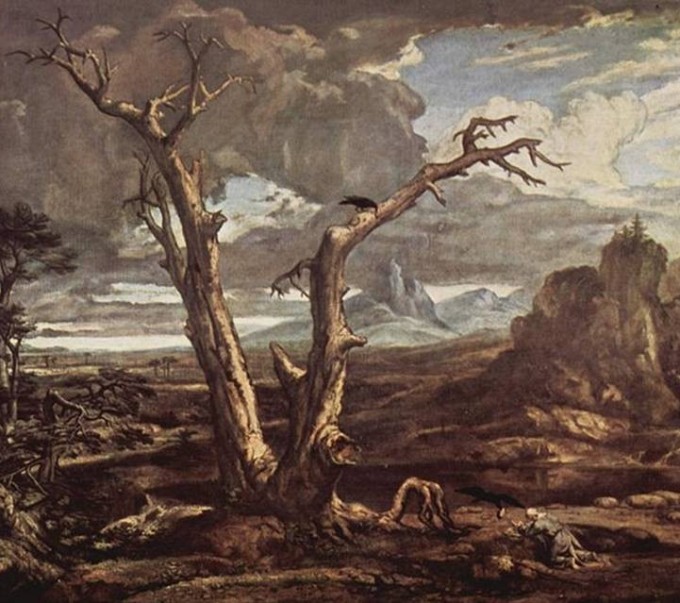
Then did Elijah the prophet break forth: Mendelssohn at the NYPhil

I was invited to hear Gerald Finley with the New York Phil under Alan Gilbert perform Mendelssohn's Elijah on Wednesday, and enjoyed a very fine performance from orchestra seating (a treat!)  The oratorio is a favorite piece of my Respected Father's, but it had been ages since I'd heard it.  Encountering it on Wednesday, I was intrigued by Mendelssohn's weaving of texts to create a powerful narrative of an individual's struggle for his faith (both on behalf of it publicly, and internally with doubt and even anger.) The English texts, excerpted from Job, the Psalms, and prophetic literature of the Old Testament, as well as the stories of Elijah, may be found here.  Many of the episodes in the oratorio are inherently--even sensationally--dramatic, with music for tempests, fire from heaven, and a miraculous raising of the dead, but Gilbert and the orchestra maintained a sense of tautness and drama through subtler passages as well.

Friday, October 8, 2010

The shape of sound: Debussy, Sibelius, and Lindberg at the NYPhil

Last night, I went to hear a much-advertised program comprising Debussy's Prélude à l’après-midi d'un faune, Sibelius' Violin Concerto in D minor, op. 47, and Magnus Lindberg's orchestral work Kraft.  (I then resisted the temptation to title this "A faun, a fantasy, and a Finn.")  Admittedly, none of this is opera, but it was exciting, so I thought I would share, with the caveat that I am, if anything, less qualified (because a less habitual listener) to review orchestral works than opera.  Still... it was a very interesting night out.  (An unfortunate drawback to the listening experience was that I was seated next to two snorers and behind a row of talkers; there was applause after the first movement of the Sibelius, and defections began approximately halfway through the Lindberg, growing gradually less surreptitious and more numerous up until a scant few minutes before the piece's conclusion.)

Saturday, July 10, 2010

La Dolce Vita

I'm supposed to be spending these languorous summer days planning lectures, and I am, mostly.  But New York, eternal temptress, lured me out this past week to the Philharmonic's "Summertime Classics" series.  As a side note, I was surprised both by the series' aggressively "accessible" marketing campaign, and by its apparent success: the average audience age seemed to have dropped by several decades from my usual NYPhil experiences, and also seemed more diverse in almost every conceivable way.  Apparently, the series is the brainchild of some NYPhil higher-ups and the conductor who presided over all the events, Bramwell Tovey.  I was wary of the label "conductor/host," but Tovey turned out to be not only a spirited conductor, but also overflowing with erudition which he seemed eager to share in a non-patronizing way.  The catalyst for the series?  Tovey's conducting of Webern's Symphony, Op. 21, back in 2001, which he decided to introduce with historical context and catchy anecdotes to intrigue and pacify the audience.  I fear this may be a Terrible Indictment of New York audiences... but I didn't find the format offensive, and if this does work as a successful gambit, I'd love to feel less alone in the under-50 crowd on those (admittedly somewhat rare) occasions when the symphony does steal an evening of my free time away from the Met.

Meandering aside: Tuesday evening's concert was entitled, inexplicably, "La Dolce Vita," and offered, in addition to the contributions of the evening's promoted diva, Nicole Cabell, the overture to La Cenerentola, Manon Lescaut's Intermezzo, and ballet music from Gounod's Faust and Massenet's Le Cid.  Well, seeing that line-up in the "special ticket offer" e-mail, I couldn't stay away!  The Massenet was a new discovery for me, and a pleasant one: so ostentatiously Spanish-flavored as to seem almost whimsical at times, but certainly seductive (a 2002 performance with the Berliner Philharmoniker under Mariss Jansons may be found here.)  The Gounod I found lulling as always; I was too conscious of the context of Puccini's passion not to be depressed by it.  Still, Maestro Tovey won my sympathy by his enthusiastic effusion about the dramatic punch packed by orchestral interludes in opera.  And there was Rossini, and I claim that not smiling irrepressibly in response to La Cenerentola must be a sign of some deep malaise. (Here is a recent version from the Met, with the bonus of an introduction by Thomas Hampson.)

LinkWithin

Related Posts Plugin for WordPress, Blogger...