Wednesday, March 2, 2016

Brief Notes on Beethoven in Boston

While recently attending a conference, I took time off to attend a very alliterative concert. Harry Christophers helmed the Handel and Haydn Society in a concert devoted to Beethoven at Boston's Symphony Hall. It was satisfying and stimulating to listen to, as well as to name. My brain being reduced by the weekend's academic labors to something like mush, my notes will be brief. I'm making them anyway because Friday night's concert offered me the exhilarating experience of hearing a beloved composer in new ways.

The evening opened with a nod to Handel, with a crisp rendition of the "How Excellent Thy Name" chorus from Saul. The forces of the Collaborative Youth Concerts were impressively professional in manner and expressive in diction. I'm sure there's been scholarly ink spilled on the political and social significance of Old Testament oratorios, and the orchestra's vibrant performance had me wondering where I could find it.

Tuesday, February 23, 2016

The Met in 2016-17: Tristan and Beyond

I know, the announcement's old news by now. But because I have many and complicated feelings about the opera house I've so long called home, I'm writing about it anyway. The Met's much-deplored habit of relying on blockbuster singers at the expense of interesting programming or productions still dominates, I think. There are some honorable exceptions in next season's lineup, though. I'd be much more excited about these if the Met didn't congratulate itself for them so vociferously. Still, I am cautiously allowing myself to be heartened about the fact that the publicity for the season and for individual productions is at least giving more time to the directors. Also, there are some exceptions to the "more is never enough" aesthetic in the promotional materials, notably in Willy Decker's sleek Traviata. The chances of my returning to NYC for the upcoming season are, alas, slim, so here's an annotated list of the things I'm most likely to make pilgrimages for. Feel free to tell me what else you think I should see, and who else you think I should hear, in the comments.

Friday, February 5, 2016

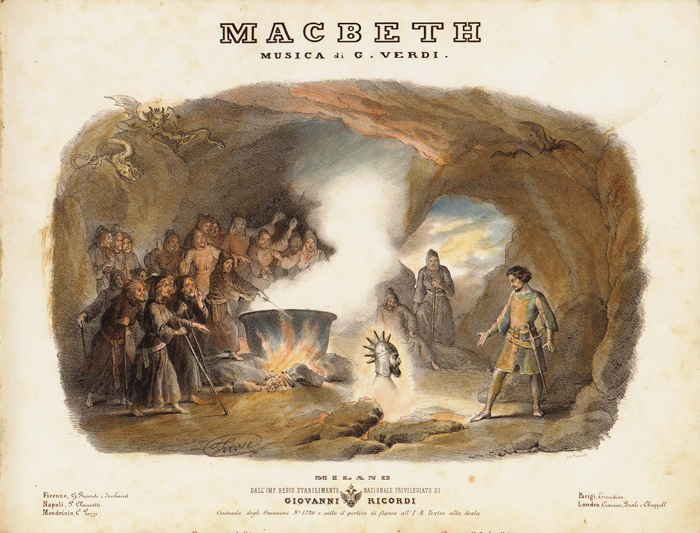
Semi-Scholarly Summary: Verdi's Macbeth

As an itinerant scholar, I've recently written a small piece about Verdi's Macbeth. The commissioning body doesn't know what it's unleashed. Among other things, it gave me the idea of starting a series of semi-scholarly summaries here, featuring historical background, colorful anecdotes, and a highly subjective selection of recommended reading and listening. As has been intermittently obvious on this blog, going to the research library as preparation for attending an opera performance is my idea of a good time. It would seem that I have a kindred spirit in Verdi himself; he paid a great deal of attention to the historical setting of Shakespeare's Macbeth, writing to his publisher and set-designer about political details of eleventh-century England and Scotland.

Macbeth was Verdi's own favorite opera at the time of writing. In 1864, however, when undertaking substantial revisions, he wrote of parts of it as "weak, or even worse, lacking in character." The mid-twentieth century saw a brief revival of the 1847 version, and in recent years, both versions have found place on the operatic stage. The work's very unconventionalities - to judge by essays and interviews - helped it to a mini-boom in the early years of the twenty-first century. (I've written about performances I've seen at the Met here and here.) Macbeth was Verdi's first foray into adapting Shakespeare, and he was unsurprisingly perfectionistic in working with Piave on the libretto, intent on having language echo feeling and fit with musical form.

Friday, January 15, 2016

Far More Than Mediocre: Salieri's Les Danaides

Look at that cover design!
In some corner of my mind, Salieri will always be F. Murray Abraham. I can't help it. To be honest, this was one of the reasons that I jumped at the chance to review a gorgeously-produced recording of his sweeping 1784 opera, Les Danaïdes. Another reason was that it was simply and irresistibly beautiful (see left.) It has the kind of apparatus I can't resist, with critical essays in French and English, lucidly written and in a nice typeface. (I do realize that I'm revealing novel facets and depths of my nerdery, here...) With Les Talens Lyriques led by Christophe Rousset, the musical quality promised to be similarly luxurious, and I was not disappointed. There is an energy and brio to the entire performance that is irresistible. There's also orchestral creativity and moral nuance that I found fascinating. I'm not alone in this. Berlioz, seeing a performance in the 1820s, enthused about the éclat of the drama, the harmonic cooperation of chorus and orchestra, and the talent of the singers. Even without the benefit of dramatic tableaux, it's easy to echo his praise.


Wednesday, December 9, 2015

Seasonal Special: Advent

Once again I find myself in the sweet spot of a target audience, this time as choral music aficionado and Liturgy Nerd.  The commercial season of Christmas has been going on long enough to bring a Scrooge-like gleam to the eye. In liturgical terms, however, we're still in the midst of Advent: a season, ideally, of quiet anticipation. It's one of my favorite times of the liturgical year, so it was with great delight that I discovered a new CD dedicated to music written for it. The Junger Kammerchor Rhein-Neckar, under the direction of Mathias Rickert, has recorded a really rich album, featuring not only music from such luminaries as Byrd, Victoria, and Pärt, but also many creative arrangements and original pieces by contemporary composers. Predictably, I love it.

Tuesday, December 1, 2015

Late Romanticism in Lieder: Mahler Contemporaries

Recording venue: St. Jacob the Greater, Jihlava
A disc entitled Mahler Contemporaries is as a siren call to me. I am always fascinated by music that doesn't fit easily into categories of the romantic or the modern, experimenting and exploring possibilities. I wondered, I confess, how a CD devoted to such music would acquire its coherence. Mahler Contemporaries, recorded live at a Mahler festival in 2014, doesn't impose much external structure on its offerings, instead allowing the wide range of musical styles to speak for themselves. I found the resulting listening experience stimulating and enjoyable, although I would have appreciated  more thorough liner notes, which were limited to potted biographies of the composers. I also suspect that the recording technology may have flattened the acoustics of the church where the works were performed. Including Strauss and Schoenberg, and ranging far beyond them, the disc offers rarities that should be welcomed by all those who (like me) are always complaining that there isn't enough weird central European romanticism being programmed by the concert and recital venues of the world.

Sunday, November 22, 2015

Medieval/modern Sunday special: Responsio

The Coronation of the Virgin, Rheims Cathedral
As a medievalist and liturgy nerd with an active interest in new music, I feel that I am standing somewhere quite near the metaphorical bullseye of the target audience for a contemporary Mass setting inspired by Guillaume de Machaut's Messe de Notre Dame. Canadian composer Peter-Anthony Togni's Responsio embroiders upon, responds to, and joyfully interacts with Machaut's hauntingly lovely setting. The resulting music is sometimes meditative, sometimes exuberant, and always interesting.

LinkWithin

Related Posts Plugin for WordPress, Blogger...