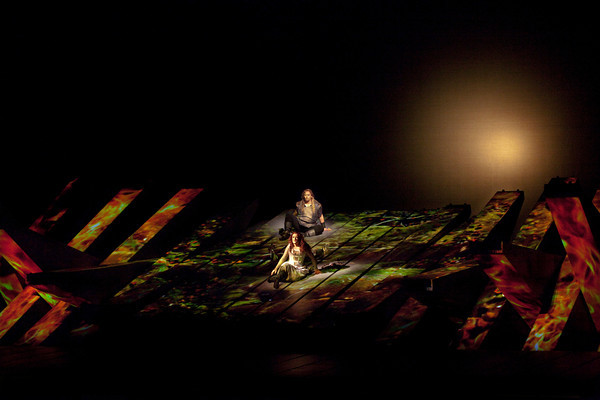
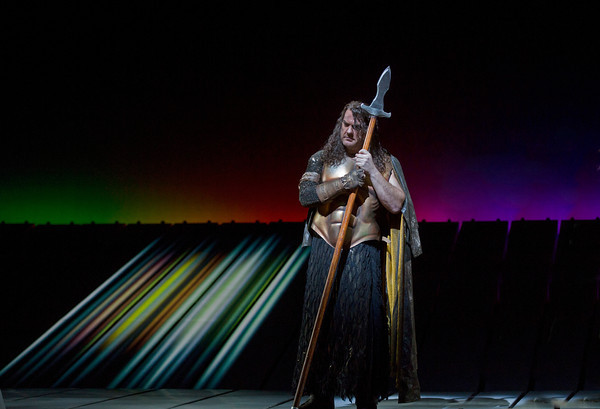
It's all over. Although Lepage's production has been modified, I still feel that it lets the Ring down badly in its cataclysmic conclusion. The plaster statues of the gods now crumble into the Rhine instead of exploding above the hall of the Gibichungs, which I find dramatically and theatrically more felicitous. But while the music is driven on by the momentum of all that has gone before, the production drifts. The orchestral performance was remarkable. The sound could occasionally seem unfocused, but the Beloved Flatmate were almost directly over the pit in a Family Circle box, which may have affected my perception. The dense tapestry of leitmotivs was given vibrant color; the score's movement towards an inevitable conclusion was thrilling with tension at every turn. The close connection to the singers which has characterized the rest of the cycle under Luisi was still apparent, especially effective in evoking the clash between Siegfried and Hagen. The Trauermarsch was of a shattering intensity, silence and sound alike pushed to the limits of the bearable. The long threnody of the immolation was handled with emotional nuance, and the Erlösungsmotiv over the Rhine was radiant. If only the production had made a bolder claim about the whys of this music.
Showing posts with label Ring 2012. Show all posts
Wednesday, April 25, 2012
Monday, April 23, 2012
Siegfried: Mut oder Übermut
![]() |
| Jay Hunter Morris, Deborah Voigt in Siegfried's final scene. Photo (c) Ken Howard/Metropolitan Opera |
With inexorable momentum, Wagner's Gesamtkunstwerk rolls on at the Met. Saturday's performance of Siegfried was remarkable for its emotional immediacy, a musically and dramatically exciting experience. I am still frustrated that Lepage's approach to the staging of the Ring is descriptive rather than analytical, but the performers did an admirable job. The humanizing approach to the Ring, while it may be the best approach to working with Lepage's sets, does not serve all the relationships of Siegfried equally well. The staging's implication that Mime is an unreliable narrator remains unexplored, but there was more detailed characterization of his relationship with Mime, which worked well. Siegfried's abuse of Mime is thus adolescent pique. The dwarf's interactions with the Wanderer further establish that Mime's disagreeability is personal, not part of a larger scheme of value; his refusal of Gastfreundlichkeit is shrugged at by the old man who dries his own boots at the fire. The orchestral performance was better-coordinated than at this cycle's Walküre; there were one or two moments where the brass sounded slightly unfocused, but matters were much improved. The horn and woodwind soloists distinguished themselves, and the forest murmurs were dreamily lovely. Whether it was the result of added experience or simply an example of a performance "clicking," I found myself more convinced and engaged by Fabio Luisi's Siegfried on this second hearing. Flexible dynamics and responsiveness to the singers made it a lively, but not a lightweight account. The orchestral playing in the final scene was so radiantly sensual as to border on the obscene; from my perspective, this counts as warm praise.
Labels:
Bryn Terfel,
Deborah Voigt,
Eric Owens,
Erin Morley,
Fabio Luisi,
Gerhard Siegel,
Hans-Peter Koenig,
Jay Hunter Morris,
Metropolitan Opera,
Patricia Bardon,
Ring 2012,
Ring des Nibelungen,
Robert Lepage,
Wagner
Monday, April 16, 2012
Die Walküre: Wunder und wilde Märe
I know it's irresponsible to play favorites with the Ring operas, and of course nearly impossible to really choose, but I love Die Walküre a lot. Wearing flat shoes and armed with chocolate, the Beloved Flatmate and I stood for Friday's performance at the Met. Very fine singing made it an emotionally intense experience. Robert Lepage's production contributes little except a dramatically useful forest for pursuer and pursued in the staged overture and second act. There was a malfunction with the projections in the final act which I mention only to say that although it shouldn't have happened, I didn't feel it was a disastrous distraction; I was prepared for Terfel and Voigt to carry the confrontation in front of a fence instead of an avalanche. More worrisome to me were the lapses in the Met orchestra's customary precision. One brass quaver may be regarded as a misfortune; two looks like carelessness. In Act I the orchestra seemed occasionally ahead of the singers, a problem which was swiftly rectified. Fabio Luisi is currently doing the work of several, and I'm not sure how much time there was for the orchestra to rehearse with him. Overall, however, it was a fine and sensitive performance. This was Wagner on a human scale, with the singers' emotions leading the expression of the orchestra throughout. The coming of spring was beautifully handled; the lovers' embrace was interrupted with a crash, but thereafter the textures of the orchestra were delicate as moonlight. Similar dynamic contrasts were used effectively in the confrontations of Act II. The overture seemed to be played from Siegmund's perspective, the fury of the storm and the threat of echoing horns taking second place to the rhythms of racing blood and hard-won breath. The orchestra found melancholy tenderness for the Wälsungs, an almost breezy tone for Brünnhilde's entrance, and gave a fiercely exuberant Ride. The Valkyries, in this most (in)famously excerpted moment, contributed exceptionally good work. This wild music was sung with beauty of tone, vivid characterization, and good handling of text, making the formal phrases sound like sisters' chatting.
Sunday, April 15, 2012
Rheingold: Vollendet das ewige Werk
Last Saturday evening saw the auspicious beginning of the Met's first complete Ring cycle in the Robert Lepage production. On every level (except that of the production) I was enormously impressed. Revisiting the production, I did feel that my initial Ring-optimism had not been entirely unwarranted: this Rheingold, complete with functional rainbow bridge, does contain some powerful theatrical images, and uses space in ways which can at least be overanalyzed as alluding to the complex and precarious networks of power within the work. But it remains, in the end, primarily a backdrop for the performers.
Subscribe to:
Posts (Atom)