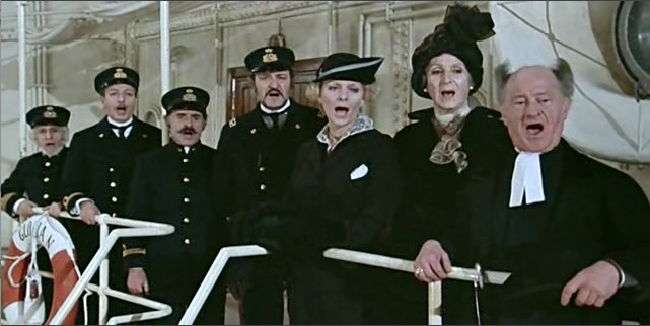
Let joy be un-confined! Let there be dancing in the streets, drinking in the saloons, and necking in the parlor! I decided it was high time I saw the Marx Brothers' "A Night at the Opera." I have to say I prefer Chaplin's comedy to that of the famous trio, but I tried to give it an open-minded go. There is of course the
famous stateroom scene, but more interesting is to me is
this one, where impossible capers of all kinds are introduced into a performance of "Trovatore," unsettling the well-heeled audience and the musicians alike. I must confess, though, that I never really settled into enjoying this example of the genre of slapstick comedy/MGM musical. Probably this says more about me than the film; I was unable to switch off whatever trained listening had me reacting to the introduction of operatic fragments as though they were supposed to illustrate the plot. No: a fragment of "Vesti la giubba" is sung in high spirits (!) and the "Miserere" from
Trovatore, after apparently concluding the opera (!) was encored as a triumphant love duet at the end.
That was painful. Also, important and persistent questions--the nature of 'high' and 'low' culture/art, the relation of profit to the creation of opera, reputation to talent in the forging of careers--kept being introduced into the plot and then just left there to be dealt with by means of, well, slapstick comedy.
The second installment in my exploration of "opera in film" was much more successful: Fellini's "
E la nave va.
" Now, this, I loved! Not only does it include musical extracts in an illustrative way, it sometimes gives them alternate texts (unfortunately for my inadequate Italian, they weren't subtitled, but I still found it fascinating.) The "normal" proceedings of the film often erupt into choruses at significant moments. And not only opera, but dreamy piano pieces, lively folk music, and even
complex water-glass playing (!) contribute to the aural landscape of the film. Extravagant and enigmatic characters inhabit the artificial, luxurious, threatened environment of a cruise ship, bound in 1914 to scatter the ashes of a diva off a Greek island. Moral and immoral decisions are made. Love blossoms and love is betrayed. And it's all gorgeous, and a great deal of fun, as well as poignant.