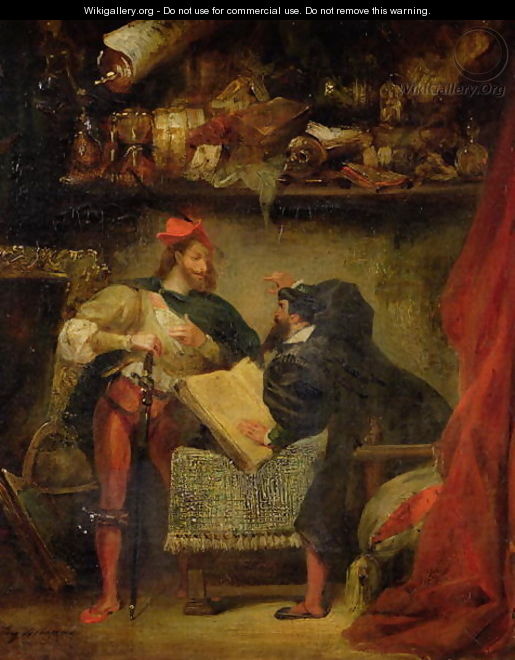
On Saturday, I headed downtown for the penultimate performance of Gounod's Faust, which filled Amore Opera's spring repertory staple slot this year. A fine orchestral performance, and impressively cohesive work from the chorus, supported a strong cast: a very creditable all-around effort. Director Nathan Hull used Amore's limited stable of sets intelligently, creating a staging that juxtaposed Gounod's era and the way that era imagined the opera's ostensible setting. Sixteenth-century urban spaces (looking strangely normal to anyone who's seen F.W. Murnau's amazing film of the story) surrounded townsfolk in mid-nineteenth-century garb, or approximations thereof. This is a strategy that has enjoyed a recent vogue in larger houses, and for Faust, I think it works: the passage of time is, obviously, Faust's main personal worry. In Goethe (cf. this post,) mutability on a larger scale is also a pressing, even torturing preoccupation for many: what good are new forms of knowledge if they don't alleviate human suffering? How do we explain--and counteract--evil if, in a rapidly secularizing society, we can no longer attribute it to diabolic agency? In Hull's production, Marguerite, like Faust, is fascinated by new knowledge and new ways of acquiring knowledge. She occupies her hours of petit bourgeois leisure with a stereoscope, approximating Faust's research and Valentin's travel in the only way allowed to her. Both this and the choreography suggested that the philosopher and the siblings are all the victims of Mephistopheles: a Mephistopheles who is part Caligari
 , part Dracula, and completely depraved. (As his power grows, his makeup becomes increasingly diabolical; there are visual echoes of Conrad Veidt's deformed hero in The Man Who Laughs
 . Mephistopheles' costumes and spotlights may be the kind of thing Bernard Shaw famously complained of, but as Goethe's devil remarks, turning Satan into a pantomime terror doesn't rid the world of evil's threat. Often, all Mephistopheles has to do is lurk in the background; the opera's human beings don't need much help damaging each other.
of the story) surrounded townsfolk in mid-nineteenth-century garb, or approximations thereof. This is a strategy that has enjoyed a recent vogue in larger houses, and for Faust, I think it works: the passage of time is, obviously, Faust's main personal worry. In Goethe (cf. this post,) mutability on a larger scale is also a pressing, even torturing preoccupation for many: what good are new forms of knowledge if they don't alleviate human suffering? How do we explain--and counteract--evil if, in a rapidly secularizing society, we can no longer attribute it to diabolic agency? In Hull's production, Marguerite, like Faust, is fascinated by new knowledge and new ways of acquiring knowledge. She occupies her hours of petit bourgeois leisure with a stereoscope, approximating Faust's research and Valentin's travel in the only way allowed to her. Both this and the choreography suggested that the philosopher and the siblings are all the victims of Mephistopheles: a Mephistopheles who is part Caligari, part Dracula, and completely depraved. (As his power grows, his makeup becomes increasingly diabolical; there are visual echoes of Conrad Veidt's deformed hero in The Man Who Laughs. Mephistopheles' costumes and spotlights may be the kind of thing Bernard Shaw famously complained of, but as Goethe's devil remarks, turning Satan into a pantomime terror doesn't rid the world of evil's threat. Often, all Mephistopheles has to do is lurk in the background; the opera's human beings don't need much help damaging each other.


 .) In Gaston Leroux' Phantom of the Opera, Faust is the opera chosen to represent both vocal virtuosity and dangerous sensuality (a connection emphasized in
