Showing posts with label Elijah Moshinsky. Show all posts
Showing posts with label Elijah Moshinsky. Show all posts
Wednesday, May 9, 2012
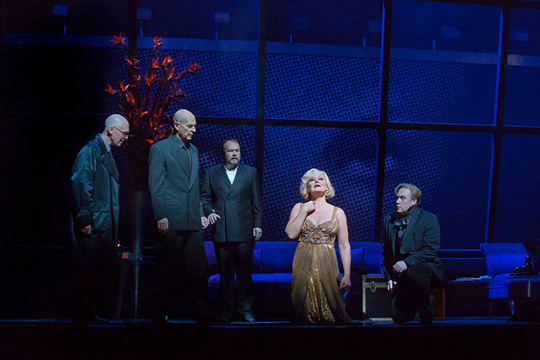
Věc Makropulos


Friday, November 18, 2011
Nabucco: non implora che la vita del suo cor

The singers, to their credit, managed to transcend this awkwardness to a significant degree. Elizabeth Bishop, as Fenena, warmed up to display a pleasingly rich, dark-hued soprano, and her expressive singing helped make Fenena credible as a soprano with a backbone. Carlos Colombara sounded a bit dry at the top of his range, but he had excellent gravitas and admirable vocal agility as Zaccaria. This was my first time hearing Yonghoon Lee in a full role, and I was impressed from his first notes onward by his sweet, bright-toned tenor. More variation in coloring might have helped give the role dramatic depth, but he was a pleasure to hear. Elisabete Matos, as Abigaille, had the unenviable task of taking on one of those roles to which the adjective most frequently applied is "impossible." Having heard a hum of excited anticipation, I was somewhat disappointed, but I don't have comparative evidence. I thought her pitch could turn erratic and her sound rough at the top of her range, but she had thrilling chest tones, and really impressive agility on the passages of runs required. Also, Matos used her voice adventurously, diving across octaves with reckless commitment. As a coherent dramatic portrayal, I felt the Nabucco of Željko Lučić came together better. He sang solidly throughout his range, authoritative and compelling in the first half, and with touching lyricism in the scenes where the deposed emperor battles for his sanity. The production limited the dramatic vocabulary of the role sadly, but I was still impressed.
The non-eponymous central character of Nabucco, though, may be the chorus. Of course, there is "Va, pensiero," and it was introspective and impassioned and lovely, but there is also a lot more. As Israelites and Babylonians, the chorus comments, exclaims, supports, rebels, and judges throughout. And the forces of the Met did so very well, with incisive, expressive singing, perhaps most strikingly in the final chorus to Jehovah, sung without the orchestra. It was a treat to hear the excellent Met chorus, for once, in a starring role.
Curtain call photos:
Saturday, May 7, 2011
Ariadne auf Naxos: Töne, töne, süße Stimme
 |
| (c) Cory Weaver/Metropolitan Opera |
Saturday, March 12, 2011
Queen of Spades: Three, Seven, ACE
I have a new object of hero-worship and his name is Andris Nelsons. I spent much of Friday night on the edge of my seat (which, unbelievably, was in the orchestra section and obtained at student price 15 minutes before curtain.) The Met's Queen of Spades, in a suitably moody production, romantic and stark by turns, and always stylish, is cast this season without a weak link; each of the principals brought impressive vocal artistry and theatrical intensity to their respective roles. Pictures from previous runs of Elijah Moshinsky's 1995 production may be found here and here; update: pictures from this run here. I feel I'd be better able to evaluate it if I were more familiar with the score, or other productions, but it served well to highlight the contrasts between the "normal" world of St. Petersburg and the fateful trajectory of the obsessed Hermann. I'm not quite sure I understood the device of the picture frame, although it did serve as a dramatic demarcation between Hermann and society in the scene at the ball and elsewhere. The restricted color scheme also helped keep even the grandest scenes from the merely spectacular (a scenery-applauder was shushed, and my soul rejoiced, but unfortunately they found strength in numbers on two occasions. Premature applauders were also shushed, twice! Overheard conversations confirmed the impression that although there were empty seats, those who were there were enthusiasts.) For a quick synopsis of the opera go here.
Subscribe to:
Posts (Atom)
LinkWithin
