 |
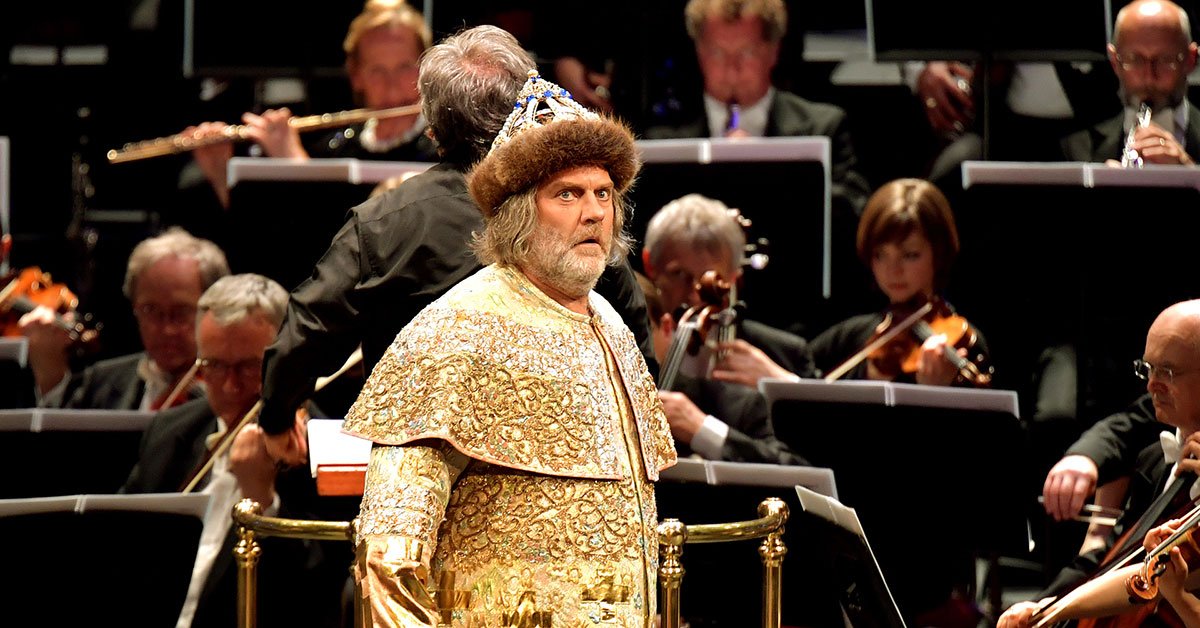
| Terfel as Tsar: Boris Godunov at the London Proms |
Showing posts with label Mussorgsky. Show all posts
Showing posts with label Mussorgsky. Show all posts
Monday, July 18, 2016
Madness in Great Ones: Bryn Terfel's Boris at the Proms


Sunday, April 28, 2013
And the dark became desire: Renée Fleming and the NYPhil at Carnegie Hall
The centerpiece of Friday evening's Carnegie Hall concert was unquestionably Anders Hillborg's The Strand Settings, a song cycle commissioned by the New York Philharmonic for Renée Fleming, and receiving its world premiere. Just as unquestionably, the occasion was an event: the buzz of audience chatter proclaimed eager anticipation in several languages. The performance, in its energy and subtlety, gratified this anticipation not only in the haunting, lapidary lieder, but in surprisingly nuanced and insightful accounts of two repertory staples. The programming of Respighi's Fountains of Rome and the Mussorgsky/Ravel Pictures at an Exhibition alongside Hillborg's work helped me hear each of the familiar works differently.
Wednesday, February 29, 2012
Nuits d'été and other voyages: Joyce DiDonato/NYPhil
The promise of Joyce DiDonato's "Nuits d'été" drew me to the last in this series of concerts by the New York Philharmonic; I was pleasingly surprised by the vitality of the program as a whole. The sensuality and exuberance of Berlioz and Mussorgsky were preceded by a contemporary divertissement. Steven Stucky's "Son et Lumière" was aptly described by the composer's note in the program as an entertainment. Its textures, defined by glimmering strings and playful percussion, underwent whimsical metamorphoses. On this first listen, I noticed no apparent direction or climax to the piece, which was somewhat disorienting, but it was still enjoyable.
After latecomers were admitted came my main event: Berlioz' gorgeous cycle "Les Nuits d'été," six songs set to texts by Théophile Gautier, and tinged with just enough irony to save the lush romanticism from feeling overindulgent. The orchestra, I felt, could have explored more of the subtleties of the piece, but they did create a beautiful tapestry of sound. DiDonato, to my delight, was alert to both the work's intensity of emotion and the shifts--and layers--of its moods. In addition to radiance of tone and liquid phrasing, DiDonato brought to the songs a sensitive restraint which made the rich orchestration and extravagant language seem only the most suitable ways of communicating intimacy. "Villanelle" unfolded from flirtation to ecstasy; "Le spectre d'une rose" had its sensuous syllables sensually caressed. The dreamy waltz rhythms of the remembered ball were nicely handled by the orchestra, as well. The dark gravi of "Sur les lagunes" were delivered with unexpected authority. DiDonato made this a (self-)hypnotic narrative of obsessive grief, carried on the dark currents of the orchestra. Brighter color returned to the voice for a poignant "Reviens, reviens..." but by the third repetition of this plea in "Absence," its hope was acknowledged as delusory (and I got teary.) By "Au cimetière," of course, the beloved is only a tremulous ghost, a presence less real than the white dove, the yew tree, and the marble tomb. This haunted mood was shaken off utterly for "L'île inconnue"; DiDonato's body language became freer, and the joyously uninhibited fantasies of fresh love were celebrated in her flirtatiously showy description of a boat freighted with citrus, piloted by angels. The orchestra evokes memories of old loves; but the breeze is rising and new voyages await.
 |
| Gautier |
Tuesday, October 26, 2010
Slava!

On Saturday, I finally made it to Mussorgsky's Boris Godunov at the Met, with original orchestration and the restoration of some censored scenes, in Stephen Wadsworth's production. The libretto (in Russian) may be found here; images from the current production here. Shameful Confessions up front: I am not familiar with this opera at all. I frantically skimmed some background reading
 and gave the Karajan/Ghiaurov recording
 a listen-through, and that was it, not counting a childhood encounter with the clock scene on LP thanks to my Respected Father's ideas on High Culture (it is still as viscerally terrifying as it was then.) So I arrived ill-equipped, but eager. Unfamiliar as I am with the score, I can only say that under Valery Gergiev's direction, it seemed fluid, evocative, and nuanced. Pacing and balance were problem-free as far as I noticed, and the music came across as emotionally powerful: tense, humorous, mysterious, and achingly empathetic by turns.
reading and gave the Karajan/Ghiaurov recording a listen-through, and that was it, not counting a childhood encounter with the clock scene on LP thanks to my Respected Father's ideas on High Culture (it is still as viscerally terrifying as it was then.) So I arrived ill-equipped, but eager. Unfamiliar as I am with the score, I can only say that under Valery Gergiev's direction, it seemed fluid, evocative, and nuanced. Pacing and balance were problem-free as far as I noticed, and the music came across as emotionally powerful: tense, humorous, mysterious, and achingly empathetic by turns.
Subscribe to:
Posts (Atom)
LinkWithin
