 |
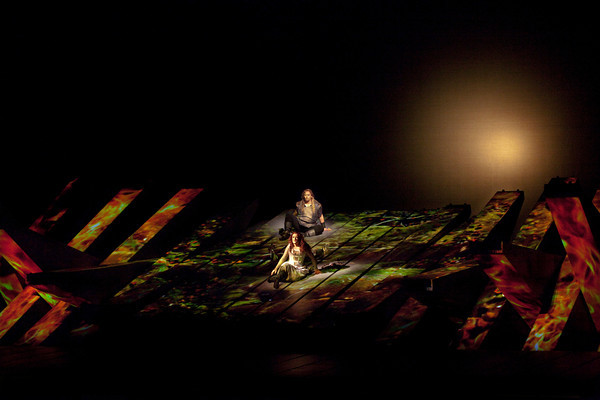
| Hoffmann (Grigolo), struggling with writing and the human condition. Photo (c) Met Opera |
Showing posts with label Erin Morley. Show all posts
Showing posts with label Erin Morley. Show all posts
Thursday, March 5, 2015
Blogging Backlog: Les Contes d'Hoffmann


Saturday, August 30, 2014
Richard Tucker Day: A reverential mission and a free concert

Thursday, May 23, 2013
Dialogues des Carmelites: il ne reste que l'Agneau de Dieu
I went to the last performance (of only three!) of the run of Poulenc's Dialogues des Carmelites which closed out the Met's season. The production and orchestra were solid, but it was the vocal performances that gave the evening its intellectual and emotional intensity. John Dexter's classic production is strong and stark, though it's hard for me to put myself in the place of audiences who saw it as revolutionary. Before the opening bars of the score are heard, we see the nuns all prostrate in the cruciform position. The grille, the rood screen, the prison bars all descend, making effective minimalist surroundings for naturalistic presentation. I quite liked the airy form of the grille, the incorporation of the cross into its pattern, emphasizing the voluntary rather than the absolute nature of the nuns' enclosure. The stage is marked--defined--by an ever-present cross. Its shape is obscured only at a handful of moments: it is in shadow while Blanche is in her father's house, cut off by the library with its Fragonard-like painting. Again it is partially hidden during the prioress' death scene, though she is in its light. During the martyrdom, the crowds mill in the transept, blind to it. I really liked this use of space suggesting the form of grace, the force of it even (especially?) in the mundane.
Thursday, May 31, 2012
Totus ardeo: De Falla and Orff with the NYPhil
 |
| Atlantis, as pictured by Athanasius Kircher in "Mundi Subterranei," 1669 |
Wednesday, April 25, 2012
Götterdämmerung: Fliegt heim, ihr Raben

It's all over. Although Lepage's production has been modified, I still feel that it lets the Ring down badly in its cataclysmic conclusion. The plaster statues of the gods now crumble into the Rhine instead of exploding above the hall of the Gibichungs, which I find dramatically and theatrically more felicitous. But while the music is driven on by the momentum of all that has gone before, the production drifts. The orchestral performance was remarkable. The sound could occasionally seem unfocused, but the Beloved Flatmate were almost directly over the pit in a Family Circle box, which may have affected my perception. The dense tapestry of leitmotivs was given vibrant color; the score's movement towards an inevitable conclusion was thrilling with tension at every turn. The close connection to the singers which has characterized the rest of the cycle under Luisi was still apparent, especially effective in evoking the clash between Siegfried and Hagen. The Trauermarsch was of a shattering intensity, silence and sound alike pushed to the limits of the bearable. The long threnody of the immolation was handled with emotional nuance, and the Erlösungsmotiv over the Rhine was radiant. If only the production had made a bolder claim about the whys of this music.
Monday, April 23, 2012
Siegfried: Mut oder Übermut
 |
| Jay Hunter Morris, Deborah Voigt in Siegfried's final scene. Photo (c) Ken Howard/Metropolitan Opera |
With inexorable momentum, Wagner's Gesamtkunstwerk rolls on at the Met. Saturday's performance of Siegfried was remarkable for its emotional immediacy, a musically and dramatically exciting experience. I am still frustrated that Lepage's approach to the staging of the Ring is descriptive rather than analytical, but the performers did an admirable job. The humanizing approach to the Ring, while it may be the best approach to working with Lepage's sets, does not serve all the relationships of Siegfried equally well. The staging's implication that Mime is an unreliable narrator remains unexplored, but there was more detailed characterization of his relationship with Mime, which worked well. Siegfried's abuse of Mime is thus adolescent pique. The dwarf's interactions with the Wanderer further establish that Mime's disagreeability is personal, not part of a larger scheme of value; his refusal of Gastfreundlichkeit is shrugged at by the old man who dries his own boots at the fire. The orchestral performance was better-coordinated than at this cycle's Walküre; there were one or two moments where the brass sounded slightly unfocused, but matters were much improved. The horn and woodwind soloists distinguished themselves, and the forest murmurs were dreamily lovely. Whether it was the result of added experience or simply an example of a performance "clicking," I found myself more convinced and engaged by Fabio Luisi's Siegfried on this second hearing. Flexible dynamics and responsiveness to the singers made it a lively, but not a lightweight account. The orchestral playing in the final scene was so radiantly sensual as to border on the obscene; from my perspective, this counts as warm praise.
Thursday, March 10, 2011
Il dolce suono mi colpì

Thursday, October 14, 2010
Ihr habt nun Traurigkeit

 will be my next stop. Update: see the comments section for a fascinating (and conveniently accessible) reference provided by Zerbinetta. The evocative text was excerpted from Harzreise im Winter. I do love Goethe, but I would never have guessed he could remind me so much of T.S. Eliot's Four Quartets. Maybe it was the setting. Stephanie Blythe is maintaining her perfect record of being fabulous when I've heard her. She here produced an almost chilly sound, without sacrificing fullness, remote, while still compassionate; the voice of a Miltonian angel, perhaps. The transition to a plea for divine mercy at the end seemed almost abrupt, given the bleakness of what had gone before, but she characterized it with equal conviction.
Subscribe to:
Posts (Atom)
LinkWithin
