I went to the last performance (of only three!) of the run of Poulenc's Dialogues des Carmelites which closed out the Met's season. The production and orchestra were solid, but it was the vocal performances that gave the evening its intellectual and emotional intensity. John Dexter's classic production is strong and stark, though it's hard for me to put myself in the place of audiences who saw it as revolutionary. Before the opening bars of the score are heard, we see the nuns all prostrate in the cruciform position. The grille, the rood screen, the prison bars all descend, making effective minimalist surroundings for naturalistic presentation. I quite liked the airy form of the grille, the incorporation of the cross into its pattern, emphasizing the voluntary rather than the absolute nature of the nuns' enclosure. The stage is marked--defined--by an ever-present cross. Its shape is obscured only at a handful of moments: it is in shadow while Blanche is in her father's house, cut off by the library with its Fragonard-like painting. Again it is partially hidden during the prioress' death scene, though she is in its light. During the martyrdom, the crowds mill in the transept, blind to it. I really liked this use of space suggesting the form of grace, the force of it even (especially?) in the mundane.
Showing posts with label Poulenc. Show all posts
Showing posts with label Poulenc. Show all posts
Thursday, May 23, 2013


Sunday, August 19, 2012
On ne meurt pas chacun pour soi: Dialogues des Carmelites
 |
| Ensemble, Act II. Photo (c) Dell'Arte Opera |
Francis Poulenc's Dialogues of the Carmelites is a work that I love: its structure is (to me) something of a marvel, its music is gorgeous and gripping, and its characterization, both through the music and the libretto, is brilliant. I was delighted, therefore, to hear it live for the first time, performed by the Dell'Arte Opera Ensemble. (Information on further performances is here, for all the rest of you complaining about the tragic brevity of the Met's run in spring.) With limited resources, they gave a performance notable for the commitment of its principals. Dell'Arte's orchestral forces were small, but sensitively led by Christopher Fecteau. The brass was afflicted with wobbles, but the ensemble as a whole did a fine job of sustaining dramatic momentum. Sets and costumes were minimal, but Victoria Crutchfield's direction was thoughtful, with the choreography of the nuns representing the tensions within their common life, as well as the affections and habits that bound them together.
Wednesday, June 27, 2012
L'heure exquise: French art song on CD
 |
| Mucha, "Music" |
The most recent album I found was Clair De Lune
 , Natalie Dessay's disc of Debussy songs. Dessay's intelligence and sensitivity are great assets to the interpretation of these vivid, romantic songs. The playing of Philippe Cassard made the piano part always wonderful, and sometimes breathtaking. I was not without reservations, though: the distinctive characteristics of each piece seemed a bit flattened by Dessay's approach. The longer selections on the disc shone: the "Chanson d'Ariel" and "La Demoiselle Elue" (the latter with Karine Deshayes) were highlights. Bonus points to those responsible for the cover design reminiscent of Alphonse Mucha's paintings.
Friday, May 18, 2012
Life, Death, and What Comes After at Opera Manhattan
 |
| Kala Maxym (c) Opera Manhattan |
 |
| Menotti (via G. Schirmer) |
Sunday, February 12, 2012
The undoing of women? Pasatieri and Poulenc at Opera Manhattan
The ambitious Opera Manhattan Repertory Theatre is filling this weekend with a triple bill of dramas for "women on the verge." The project pairs two shorter works of Thomas Pasatieri--his 2007 song cycle Lady Macbeth, and 1980 monodrama Before Breakfast--with Francis Poulenc's La Voix Humaine. As well as being seasonally appropriate (for those who are, like myself, heartily fed up with foil-wrapped chocolates and paper sentiments for February 14th) the program was musically rich, and emotionally devastating.
I am more familiar with the text of each of the works presented than with the musical settings created for them. The insinuating melodies of Lady Macbeth, sensual and almost jazzy, had me considering Shakespeare's well-known words from a new angle. Sofia Dimitrova created a portrayal of a woman trapped in an unbearable situation, for whom power is an aphrodisiac. Pasatieri subverts "Ye ministers of night, unsex me here" with unmistakably sexy music, which echoes throughout the remainder of the songs, even as Lady Macbeth descends into madness, fighting all the way. Dimitrova's plush, rounded soprano embraced the eroticism of Lady Macbeth's daring the powers of hell and earth to stop her, balanced between confidence and desperation. Even in fixation on her guilt ("All the perfumes of Arabia will not sweeten this little hand") it is far from certain that she is not, still, aroused by the promise of greater freedom implicit in the metallic, vital smell of blood.
 |
| Ellen Terry as Lady Macbeth |
Thursday, February 2, 2012
Tragic Women and Sexy Ladies: Susan Graham at Carnegie Hall

Monday, December 12, 2011
Harmonie du soir: Karita Mattila at Carnegie Hall
Karita Mattila's Saturday night recital offered an evocative selection of sensual art songs from the late nineteenth and early twentieth centuries (full listing here.) Partnered with Martin Katz, Mattila spun hypnotic melodies of fin-de-siècle seduction. I was bewildered, however, both by the number of empty seats and by the behavior of those who were there. In the first half of the program, applause from all levels came after each song, persistent, but sounding almost perfunctory. There was welcome silence during the Sallinen set, and then applause after two of five songs by Joseph Marx. I wanted to tell the applauders to take a glass of absinthe and relax, and let Mattila and Katz work their magic uninterrupted.
The first half of the recital was devoted to cycles by Poulenc and Debussy, both structured around the texts of a single poet to whose work the composer was specially drawn. Poulenc's Banalités, with texts by Apollinaire, comprised a series of vignettes united by wry wit rather than mood, from the lightly satirical "Chanson d'Orkenise," to the sensually languorous "Hôtel," through the poems to place that are "Fagnes de Wallonie" and "Voyage à Paris." The last song in Poulenc's cycle, "Sanglots," moves the furthest from realism, taking the listener through a series of romantically morbid images. The virtues of Katz' sensitive accompaniment were on full display here, as he let single notes and richly rolling chords convey equal intimacy of despair. Debussy's Cinq poèmes de Baudelaire, setting poems from Les Fleurs du Mal, continued our odyssey into impressionistic treatments of romantic love. Although Mattila's voice sounded somewhat exposed and fragile at the top, she sang with beautiful coloration of tone throughout, and admirable attention to text. (I was glad of having the texts open on my lap, for I didn't catch every syllable, but she treated the many examples of wordplay or extended metaphor with intelligence.) Here, too, Katz was her worthy partner in drawing out the expressive richness of Debussy's harmonies.
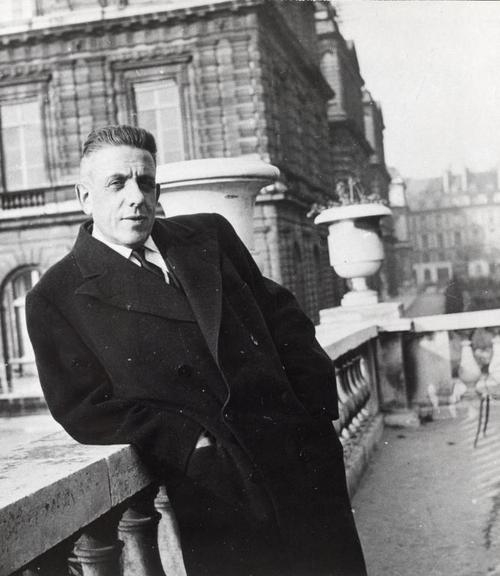 |
| Poulenc, date unknown |
Saturday, November 5, 2011
Se vuol ballare: operatic histories of the French Revolution
Verily, Gentle Readers, opera follows me around, even into the fastnesses of the library. I have been spending the past week immersed in the historiography of the French Revolution, and uncovering some intriguing aspects of opera history in the process. The eighteenth-century opera house was a theater of political representation and an arena for political debate; the disappearance of the ancien regime glories of Lully and Rameau were precipitated more by changes in public mood than changes in musical taste. The public debates over the style of Gluck vs. that of Piccini were as heated as more overtly political disputes (if not quite at the level of the mid-century querelle des bouffons.) The 1774 premiere of Iphigenie en Aulide caused furor not only because of its style, but also because of its subject matter. (Go here to hear Clytemnestre defy the authority of a king and father.) Piccini's rococo dramas were immensely popular. His Italian style, however, was decried by those who wanted natural simplicity and national character in their music. Here an excerpt from Piccini's 1760 work "La Cecchina, ossia la buona figliuola:"
As seen in the above clip, the opera flirts with social transgression despite the subtitle: La Cecchina, a sweet-tempered maidservant, is in love with a marquis. Shall their union be prevented by class boundaries? Fortunately not... as she turns out to be the daughter of a baron. Rousseau himself penned a musical drama entitled Le Devin du Village, extolling sentiment and simplicity. Gretry, meanwhile, was quoted with inflammatory effect at a military banquet, where an aria from Richard Coeur-de-Lion ("O Richard, o mon roi") was sung in commiseration with Louis XVI at "the universe being arrayed against him." And so, indeed, it might have seemed to be. The much-touted changes in mentality which facilitated the social revolutions of the end of the century find eloquent utterance in Mozart. After years of defying tyranny in opera seria, Mozart has Figaro kick over the cart, with a little help from Beaumarchais:
As seen in the above clip, the opera flirts with social transgression despite the subtitle: La Cecchina, a sweet-tempered maidservant, is in love with a marquis. Shall their union be prevented by class boundaries? Fortunately not... as she turns out to be the daughter of a baron. Rousseau himself penned a musical drama entitled Le Devin du Village, extolling sentiment and simplicity. Gretry, meanwhile, was quoted with inflammatory effect at a military banquet, where an aria from Richard Coeur-de-Lion ("O Richard, o mon roi") was sung in commiseration with Louis XVI at "the universe being arrayed against him." And so, indeed, it might have seemed to be. The much-touted changes in mentality which facilitated the social revolutions of the end of the century find eloquent utterance in Mozart. After years of defying tyranny in opera seria, Mozart has Figaro kick over the cart, with a little help from Beaumarchais:
Subscribe to:
Posts (Atom)
LinkWithin
