The opera season and the academic year are hurtling towards their respective conclusions, and so, although I got to see David McVicar's new production of the Cavalleria Rusticana/Pagliacci pairing on the 18th, it is not until now that I am organizing my ramblings. I'm glad to have seen the productions, welcoming the change from their rather dusty predecessors. Having read publicity advertising the fact that the two operas would be set in successive generations in similar southern Italian settings, I was expecting an exploration of destructive ideals of masculinity. But--despite this apparent gesture towards exploring commonalities and continuities--the productions were surprisingly different from each other in visual and dramatic style. Paradoxically, I found the bright, crowded, insistently specific Pagliacci much more effective in presenting the opera's underlying themes than the dark, curiously opaque stylization of Cavalleria Rusticana. The singing in both casts was fine, although Marcelo Alvarez, playing what must be two of the operatic canon's most unsavory tenor roles, was curiously lacking in brutality or charisma. For me, at least, it was Santuzza and Nedda--powerless in their yearning--who emerged most vividly in vocal and dramatic terms.
Showing posts with label Marcelo Alvarez. Show all posts
Showing posts with label Marcelo Alvarez. Show all posts
Monday, April 27, 2015


Sunday, November 25, 2012
Un Ballo in Maschera: Nell'ombre si matura
 |
| The recklessness of frivolity: David Alden's dark Ballo (Act I) |
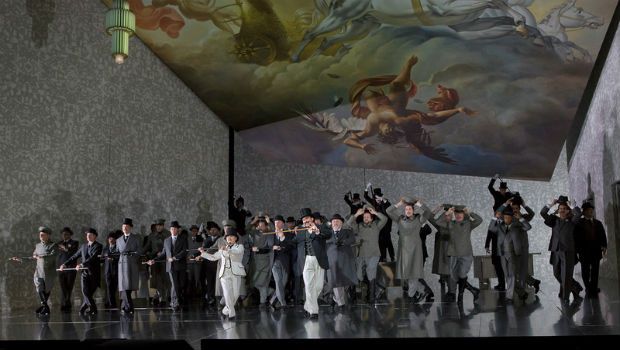
In Alden's production, it is the recklessness of Gustavo (his hamartia) which drives the action. The pleasure-loving and self-dramatizing monarch flirts with the contempt of the conspirators, openly mocks the insight and the power of Ulrica (clearly he's never read the classical dramatists), dismisses his friend's advice and undervalues his courage, and isn't even particularly interested in understanding Amelia. The frivolous page, Oscar, is established as a sort of alter ego to the king: he is an Icarus figure in the staged prelude and at the masked ball, expressing his monarch's emotional states throughout. Alden emphasizes Gustavo's flaws, but does not neglect his genuine generosity, which is praised by all in the denouement. The moods and morals of the evening having been expressed in shades of grey, I was surprised by the light-flooded triumphalism of the finale, but like many an old Hollywood ending, this one leaves the future uncertain. Incidentally, the sinister splendors of the final scene (think Litvak's Mayerling
 ) should show the Met audience that spectacle doesn't have to come coated in glitter or burdened by brocade.
Tuesday, January 18, 2011
Sta in voi salvarlo
Monday night was my third experience of Tosca in Luc Bondy's much-discussed production. It still strikes me as far from coherent, but last night it did offer some interesting ideas. These ideas didn't so much present a complete or compelling picture as float among costumes of 1800, film noir lighting, and Ikea furniture, but there they were. The lighting and staging both seemed even more Tosca-via-Raymond-Chandler than I remembered. An elderly gentleman sitting behind me, who had seen Tebaldi and Milanov, among others, in the role, plaintively remarked: "Well, it does focus one's attention on the singing, which I suppose is the point. But... I think a good production should say something." Well said, sir. One curious aspect was that all three of the principals seemed to have acquired something of Tosca's tendency for self-dramatization. Cavaradossi seemed the least aware of this, so maybe the overtly histrionic delivery was the fault of blocking. The theatrical Scarpia of Falk Struckmann, however, was deliciously, ironically self-aware; of this more later. My chief problem with the production remains that its visual and dramatic language is neither coherent, nor clearly propelled, as far as I can see, by ideas (other than general cynicism.) Hence the title of this post: what the production communicates is left largely up to the singers.
Subscribe to:
Posts (Atom)
LinkWithin
