Showing posts with label Michael Spyres. Show all posts

Thursday, February 2, 2017

Reading Round-Up: Beating the Winter Blues

Winter and my dissertation revisions both seem endless at the moment, so my first Reading Roundup focuses on sensual poetry, superb pianism, and sexy mezzo singing.

Definitely the Opera is always worth reading, and the latest piece there explores Lieder, language, and nineteenth-century musical interpretations of Sappho.

Because we all should think about Mitsuko Uchida more often, here's Boulezian's thoughtful review of her recent Mozart/Schumann concert.

Lastly, Marie-Nicole Lemieux illuminated the ever-enigmatic Carmen in Paris, and Operatraveller tells us about it. I was pleased to hear that Michael Spyres made a convincing Don José at her side, since I haven't heard much of him since reviewing his calling-card album, which I enjoyed.

Friday, December 28, 2012

Michael Spyres: A Fool for Love

The title of Michael Spyres' first recital album, A Fool for Love, demonstrates a pleasing degree of self-awareness about the fate and faiblesse of many (most?) romantic tenors in the operatic canon. Another album of tenor arias, you ask, Gentle Readers? Well, yes! This one offers an original narrative as its organizing principle, but what really sets it apart is the varied selection of arias and Spyres' thoughtful execution of them. If you want a track by track summary of the story as imagined, Gentle Readers, it's there, but you may enjoy the music as well without it. Spyres does a very fine job of inhabiting each character; in the end, I think, this works against following the journey of one, though the arc of the tracks still works well.

Thursday, December 6, 2012

Se amar non puo, rispettami: Beatrice di Tenda

Orombello e Beatrice, Pelagio Palagi, 1845/50
At Beatrice di Tenda's Venetian premiere in 1833, the audience was vociferous in expressing their resentment of what they perceived as a derivative piece, not worth their long wait for a new work by Bellini. Giuditta Pasta, the diva for whom--and at whose instigation--it was written, resorted to dramatically declaiming to the unruly carnival-goers the line intended for the tyrannical baritone: "If you cannot love me, respect me!" The audience was quieted, and the opera survived, although in relative obscurity. At Wednesday's Carnegie Hall performance, by the joint forces of the Collegiate Chorale and the American Symphony Orchestra, the audience was docile, and gave the diva of the evening, Angela Meade, the acclaim she richly deserved. I found it impossible, however, to accord the work itself more than a somewhat reserved respect. Bellini's gift for melody is on fine display, and there are some impressive musical moments, but the parts of the opera, at least on this showing, failed to cohere into a gripping whole, despite the contributions of an accomplished cast.

Wednesday, June 27, 2012

L'heure exquise: French art song on CD

Mucha, "Music"
After several days of cooler temperatures, New York City is poised to plunge back into baking, exultant heat. Much as I love the summertime, there seems to be, in the city, a disturbingly fine line between weather that is glorious and weather that has you sticking to things and wishing you weren't. To accompany hours of delicious languor, or to sweep through sticky afternoons like a cool breeze, my listening of choice this summer has been French art song. I'm not sure why, but it seems to fit. So here, without further ado, a brief commentary on a selection of discs old and new.

The most recent album I found was Clair De Lune, Natalie Dessay's disc of Debussy songs. Dessay's intelligence and sensitivity are great assets to the interpretation of these vivid, romantic songs. The playing of Philippe Cassard made the piano part always wonderful, and sometimes breathtaking. I was not without reservations, though: the distinctive characteristics of each piece seemed a bit flattened by Dessay's approach. The longer selections on the disc shone: the "Chanson d'Ariel" and "La Demoiselle Elue" (the latter with Karine Deshayes) were highlights. Bonus points to those responsible for the cover design reminiscent of Alphonse Mucha's paintings.

Monday, January 23, 2012

Not just Broadway's lullaby: Five Borough Songbook

The Five Boroughs Music Festival is an undertaking to which I'm admittedly partial. With (mostly) young artists, a wide-ranging repertoire, and lots of enthusiasm, their self-appointed mission is to bring creative classical programming to all of NYC. Loud cheers from this outer-borough blogger. Their latest project has been the commissioning of twenty songs, from twenty different composers, celebrating the city's architecture, history, and inhabitants... and even, wryly, its transit system. This has given rise not only to an acclaimed concert series, but also the festival's first recording.

I was a bit apprehensive about the coherence of such a deliberately kaleidoscopic project, but the aural odyssey through so many styles proves to be as oddly hypnotic as watching the pieces of colored glass fall into seemingly inexhaustible combinations. This approach to creating the songbook ensures discoveries for any listener, but also that these discoveries may be different for each. My own tastes inclined towards the rich texts of poets re-focused through their lean, contemporary settings (there is Whitman, of course, but also Auden and, to my delight, Julia Kasdorf for Yotam Haber's "On Leaving Brooklyn.") There are also, though, delights in Lisa Bielawa's "Breakfast in New York," which feels like a compressed song cycle, the setting of conversations overheard in the city's diners.

Thursday, May 5, 2011

Bryn Terfel... Bad Boy?

It ain't necessarily so.  Bryn Terfel is, however, an extraordinarily chameleon-like performer, whose unmistakable timbre is used on his latest CD to evoke a remarkably diverse cast of unsavory characters. I treated myself to Terfel's Bad Boys CD in the holiday mood inspired by the unexpected chance to hear his Scarpia last month; I've been enjoying it as much as I had hoped.  What I had not expected was for listening to it to be a feel-good experience.  It is impossible for me to hear Terfel's Dulcamara brazenly charming Donizetti's rustici without doing a little dance step around the apartment.  "When the Night Wind Howls" from Ruddigore is simply a treat (and I think it would be even if I did not have a sentimental fondness for the piece, which I tried to make my father teach me by rote when I was about seven.)  Even in the portentous finale of Don Giovanni--sung by Terfel, Terfel, and Terfel, with the help of good sound engineering and great voice characterization--Leporello draws a chuckle.  In Terfel's hands, the Devil--whether from Gounod's Faust or Boito's Mefistofele--is a perfect charmer.

I don't mean to imply a lack of effective characterization in keeping the various villains distinct; in this I think Terfel succeeds remarkably well.  Moreover, I was quite impressed, on the whole, with the organization of this musically eclectic album (for complete track listing go here.) A few of the arias do inevitably wrest one into the world of the opera and then drop one unceremoniously out again.  "Tre sbirri, una carrozza, presto," purrs Terfel, and I'm in Sant'Andrea.  Iago's credo is another such piece for me.  I thought the tempo for "Ha! welch ein Augenblick!" fast--shouldn't Pizarro be luxuriating in sadistic pleasure?--but loved the smooth snarl Terfel brought to it.  A special treat is Anne Sofie von Otter (no less!) as Mrs. Lovett in "Epiphany" from Sweeney Todd.  I'm not really an enthusiast for Sweeney Todd (Really Shameful Confession?) but with their vivid and subtle and intensely human characterization, the scene comes across brilliantly.  I'd say I'm getting as much enjoyment out of the CD as those involved in its creation did, but the competition looks stiff:

Saturday, November 27, 2010

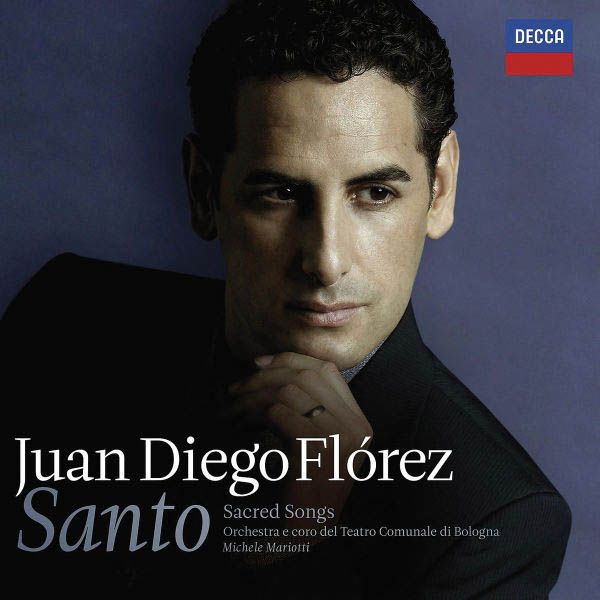
Juan Diego Flórez: Santo

Now that it's almost Advent, I can listen to Christmas music with a clear conscience.  And this year, I decided to start things off with something new: Juan Diego Florez' new album.  The commercial inevitability of "the Sacred Music Album" is something Florez jokes about in the liner notes; but he's succeeded brilliantly in putting together an interesting program.  Comparative rarities appear alongside familiar favorites, with an original composition thrown in: all of it beautiful music that plays to Florez' strengths.

LinkWithin

Related Posts Plugin for WordPress, Blogger...